
Teodoro eyes expanded visiting forces agreements to boost peacekeeping
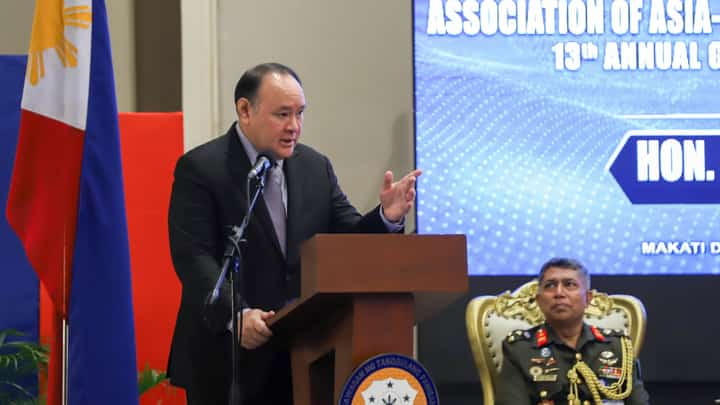
Philippines Defense Secretary Gilberto Teodoro Jr. explores expanding Status of Visiting Forces Agreements (SOVFAs) with like-minded nations to enhance peacekeeping, military interoperability, and collective security under UN initiatives.
Department of National Defense (DND) Secretary Gilberto Teodoro Jr. on Monday raised the possibility of expanding the Philippines’ Status of Visiting Forces Agreements (SOVFAs) with like-minded countries to strengthen international peacekeeping cooperation, enhance military interoperability and advance collective security efforts under the auspices of the United Nations (UN).
Speaking at the opening ceremony of the Association of Asia-Pacific Peace Operations Training Centers (AAPTC) 13th Annual General Meeting and Workshop 2026, Teodoro noted that the Philippines currently maintains SOVFAs with five member countries of the association: France, Canada, Australia, Japan and New Zealand.
He said these agreements are anchored on shared principles of international law, the United Nations Convention on the Law of the Sea (UNCLOS), interoperability, collective security and deterrence.
“It opens up my eyes, too, to the possibility of stronger relationships to include perhaps Status of Visiting Forces Agreements with countries where we do not have a misalignment of fundamental values,” Teodoro said.
He emphasized that such partnerships could facilitate more realistic joint training, strengthen force protection and improve the delivery of essential services to conflict-affected communities.
The defense chief also urged the Armed Forces of the Philippines (AFP) to actively cooperate with regional peacekeeping partners and explore opportunities to enhance defense cooperation, citing peacekeeping as a tool of military diplomacy that promotes knowledge-sharing, professional relationships and partnerships among participating countries.
He stressed the need for proper rules of engagement, effective command-and-control arrangements and adequate force protection measures to ensure peacekeepers can carry out their mandated tasks without being unnecessarily exposed to harm, while maintaining the credibility and effectiveness of UN peacekeeping operations.
Teodoro reiterated the Philippines’ commitment to UN peacekeeping and international law, highlighting the importance of stronger partnerships among participating countries to protect civilians, improve operational effectiveness and uphold international peace and security.
During the ceremony, Teodoro also led the formal turnover of the AAPTC chairmanship and flag from Bangladesh to the Philippines. Outgoing chairmanship representative Brigadier General Mohammad Hafiz Mahmud, deputy commandant of the Bangladesh Institute of Peace Support Operation Training (BIPSOT), and incoming chairperson Colonel Warlito A. Limet, commanding officer of the AFP Peacekeeping Operations Center (PKOC), led the turnover proceedings.
The event, themed “Technology, Information and Influence: Preparing Peacekeepers for Modern Conflict Zones in a Resource-Constrained Environment,” aims to enhance regional cooperation, promote knowledge exchange and identify new approaches to peace operations training. It also seeks to prepare peacekeepers for emerging security challenges, technological developments and resource limitations in conflict zones.
The opening ceremony also featured remarks from Captain James S. Ramon Jr., executive officer of the AFP PKOC, and Atul Khare, UN under-secretary-general for operational support.
Attendees included representatives of peace operations training centers from Asia-Pacific countries, military officers, peacekeeping practitioners and UN officials, including Harinder Sood, chief of the Integrated Training Service, and Herbert Loret, team leader of the UN Light Coordination Mechanism.