
Myanmar seismologist: Research saves lives
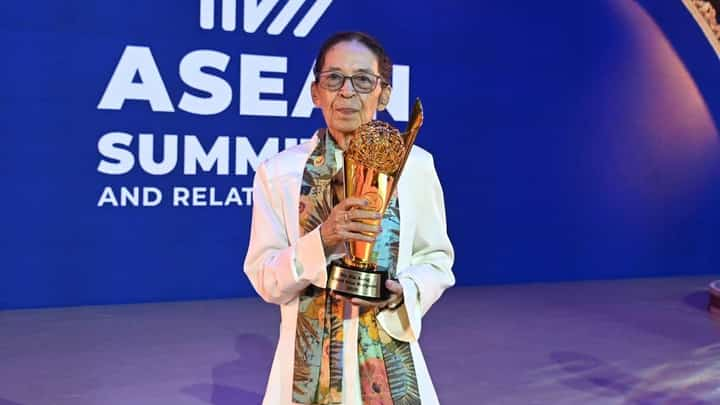
Research and information-sharing are essential to improving disaster preparedness in Southeast Asia, according to Myanmar seismologist Hla Hla Aung, who received the 2026 ASEAN Prize on Sunday.
The 79-year-old researcher, recognized for her work in earthquake studies and disaster risk reduction, urged ASEAN policymakers to invest in scientific research and make its findings accessible to communities.
Asked on the sidelines of the 49th ASEAN Summit what regional governments could do to improve disaster resilience, Aung answered, “Research.”
“I myself was writing articles. That’s why I’m a researcher. Because I want to share not my experience, but what I know about earthquakes. [I] have experience writing articles. Because earthquakes do not happen every day. [Y]ou have to read articles when someone is writing about this so you know what to do during an earthquake,” she told reporters at the Philippine International Convention Center.
Aung has spent decades studying earthquakes and raising public awareness, particularly in communities with limited access to scientific information and disaster preparedness resources.
Through her work with the Myanmar Earthquake Committee, she has contributed to research, public education, and coordination with disaster management authorities.
Her efforts have also reached schools and local communities, where she has helped promote earthquake safety and preparedness.
Beyond publishing research, Aung has worked to bring information directly to earthquake-affected communities while encouraging greater knowledge-sharing among countries.
“I have to write articles and print them and distribute them to places. Sometimes, we have an earthquake; we go to the places and distribute them,” she said.
Her work has extended beyond Myanmar through international conferences and collaboration with researchers from other ASEAN countries, focusing on the exchange of scientific findings and disaster preparedness practices.
President Ferdinand Marcos Jr. and ASEAN Secretary-General Kao Kim Hourn presented Aung with the ASEAN Prize during the summit’s opening ceremony.
The regional bloc recognized her contributions to earthquake research, disaster risk reduction, and efforts to turn scientific findings into practical preparedness measures.
Her work also highlights the importance of regional cooperation in addressing disasters that can affect communities across national borders.
“She has demonstrated how scientific knowledge, supported by regional collaboration, can translate into tangible and meaningful community initiatives that benefit the people of ASEAN,” Kao said.
The recognition comes as ASEAN expands to 11-member states following Timor-Leste’s admission, with disaster management remaining among the bloc’s areas of cooperation.
For Aung, the award also offered a chance to reflect on her decades-long career in geology, research and education.
“I am deeply honored and sincerely grateful to ASEAN for this recognition. Receiving the ASEAN Prize is a reminder that the true measure of our contributions lies not only in what we achieve, but in the difference we make to the community.
“At 79 years of age, I have come to appreciate that time is our most precious asset, and how we choose to use it defines our legacy,” she said.
“Throughout my journey as a geologist, researcher, educator, and above all, a mother, I have remained guided by the belief that knowledge must serve humanity,” Aung added.
Aung is the ninth recipient of the ASEAN Prize, which comes with a trophy and a $20,000 cash award.