
Review: ‘Filipiñana’ is all style, little feeling
Rafael Manuel’s Sundance- and Berlinale-screened experimental satire Filipiñana, this year’s Cinemalaya closing film, immediately brings to mind Ben Sharrock’s Limbo (2020).
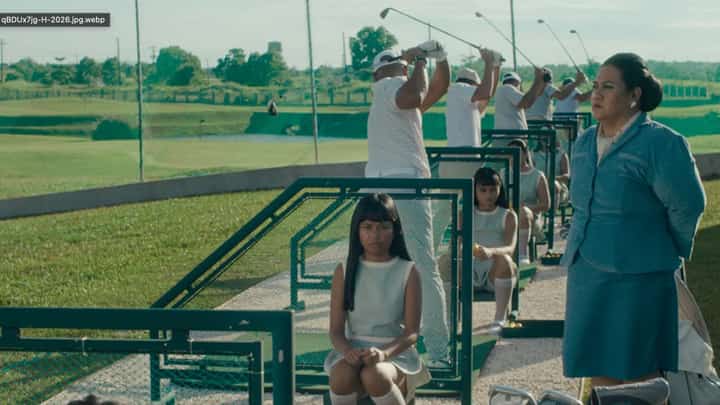
Not because Manuel copies Sharrock, but because both share a visual language: the boxed 4:3 frame and an almost completely static camera that works like a window. Rather than following characters, it lets them move through the frame and disappear, like figures in a painting.
The visual language is not new, but Manuel uses it with confidence. The compositions are striking, and the cinematography is easily the film’s biggest draw. The connection to Limbo goes beyond the frame: both films explore containment. Sharrock traps asylum seekers on a remote Scottish island, while Manuel encloses his characters within a Philippine country club, using the golf course as a microcosm of class inequality.
At the center are two parallel figures: Isabel (Jorrybell Agoto), an Ilokana newcomer working as a tee girl, and Clarita (Carmen Castellanos), a New Yorker and niece of an industrialist (Carlos Siguion-Reyna) associated with the club.
Both are outsiders observing this strange world from opposite directions. Isabel enters a world of privilege from Ilocos, while Clarita arrives from New York and enters an unfamiliar Philippine social environment. Through Clarita’s interactions with her caddy, Manuel also contrasts social practices in the Philippines and the United States, particularly the normalized servitude surrounding wealth.
Isabel becomes curious about the powerful Dr. Palanca (Teroy Guzman) after encountering him while returning a misplaced golf club. The film’s synopsis describes an infatuation with Palanca, but that attraction barely registers. What comes through is curiosity. Manuel directs Agoto with a deliberately dazed, almost stoned demeanor, making Isabel’s journey through the club feel glacial.
JORRYBELL Agoto as Isabel.
THE tee girls.
The pace may suit the experimental design, but it creates a problem. Conventional action is not the issue; experimental cinema can be slow without becoming emotionally inert. Filipiñana makes the class divide visible but rarely makes it felt.
The film is so preoccupied with looking beautiful that the cinematography overwhelms everything else. Its muted salmon, aqua, green, yellow and cream palette evokes a retro, sweltering summer inside an impossibly pristine country club. Some compositions recall Wes Anderson, though Manuel’s visual language is ultimately his own.
The club takes on an Alice in Wonderland quality as Isabel searches for Palanca. There are blind rondalla musicians led by Bullet Dumas, priests in red cassocks, Chinese visitors, elaborate buffets, a little girl in a red dress running like the White Rabbit, and recurring mangoes. A sequence plays like a musical, with workers moving in sync as they swing golf clubs, run, and dance. The choreography shows considerable visual control.
Yet Filipiñana often feels like a coffee-table photography book. One page presents Chinese visitors playing bingo, another shows tee girls posed like fashion models, and another offers a striking landscape. The costumes reinforce the artifice: tee girls wear aqua, while caddies wear pointed hats that evoke rural Filipino imagery and even suggest Vietnamese dress. The salmon uniforms are so pristine and newly stitched that they become distracting. Everything looks designed and arranged.
That control weakens the social critique. The divide between rich and poor is clear, but the film never makes the inequality feel urgent. Agoto’s slow, robotic, almost stoned delivery further distances the viewer, as do the similarly affected cadences of other characters, including the maid searching for the little girl.
The violence near the end also feels misplaced. Without revealing the eventual victim, the choice is puzzling because the victim is not even one of the poor workers the film has spent so much time portraying. If the tee girls and caddies represent a vulnerable and disposable class, the violence does little to reinforce that idea.
Before the closing credits, Manuel describes the film as something to be experienced like a song. A filmmaker’s explanation should not dictate interpretation. Filipiñana plays as a meticulously choreographed sequence of visual movements.
There is no denying Manuel’s artistic sensibility. The film is beautifully designed, precisely framed, and sometimes mesmerizing. But experimental cinema can still have power. Filipiñana has a powerful hold on the eyes but considerably less on the heart.
Its glacial pace will not necessarily trouble audiences accustomed to slow cinema. The more important question is what that slowness delivers. Here, the images are considerably more compelling than the story. Filipiñana offers plenty to look at but little to feel, ultimately resembling a beautifully composed photography book whose individual images are more affecting than the narrative connecting them.
2.5 out of 5 stars
Filipiñana opens exclusively at select SM Cinemas on 26 August 2026 for a limited theatrical run.