
Cinemalaya 22 proves urgent stories still matter
A stronger Cinemalaya finds urgency in Filipino realities and turns them into sharp, fully realized cinema


Cinemalaya 22’s biggest winner, Mag-iina, swept six Balanghai trophies, including Best Film, Best Director and Best Screenplay.
ALL PHOTOS BY ERICKSON DELA CRUZ
Cinemalaya 22 ended with a night of ties, surprises, and major wins at its August 17 awards ceremony at Shangri-La Plaza. Now that the winners have been announced and the usual lists have made the rounds, the more interesting question is what this year’s results say about Cinemalaya itself.
Cinemalaya 22 felt like a stronger edition than last year’s. Its most compelling films were closely attuned to the realities Filipinos are living through today, while finding distinctive cinematic ways to tell those stories. The competition felt topical and urgent without losing sight of what makes a film work as cinema.
When relevance meets craft
The films tackled bureaucracy, political corruption, family dysfunction, grief, loneliness, illness, desire, violence, and exclusion. But the strongest entries understood that having something important to say is only the beginning. The story still has to work as cinema—with writing, direction, performances, and technical elements that give its themes emotional and artistic weight.
Mag-iina is perhaps the clearest example. Its psychological-horror approach gives its story of three generations of women a distinctive language for exploring grief, madness, and family dysfunction. Its social and political concerns emerge through atmosphere, character, performance, and increasingly unsettling revelations.
That makes its Best Film victory especially satisfying. The film also took home awards for Best Director, Best Screenplay, Best Production Design, Best Musical Scoring, and Best Supporting Actor.
The jury cited Mag-iina for “pushing the boundaries of filmmaking,” praising its layered narrative, technical artistry, predominantly female cast, and fearless approach to filmmaking. It also recognized the film for using dark family secrets, grief, and matriarchal dynamics to expose broader truths about Philippine society and politics.
Its screenplay received similarly strong recognition. Guelan Varela Luarca was praised for a “masterfully written, fearlessly complex script,” with the jury highlighting its layered storytelling and ability to transform domestic grief and family dysfunction into a provocative reflection of darker realities in Philippine society.
The Filipino frustration in '2 Valid IDs'
Then there is 2 Valid IDs, whose Audience Choice win may be one of the festival’s most revealing results.
The film takes something painfully ordinary—the Filipino struggle with identification documents and bureaucratic requirements—and turns it into a deeply human ordeal.
Its Special Jury Prize citation praised the film for its socially vital storytelling, its portrayal of institutional absurdity, and its transformation of mundane bureaucratic red tape into a life-or-death struggle. It also highlighted the film’s portrayal of the quiet dignity of ordinary Filipinos navigating everyday survival.
The audience response feels particularly Filipino. There is a familiar indignation in watching someone struggle against a system that keeps asking for another document, another requirement, another proof of existence. The absurdity is funny—until it becomes infuriating because we know it.
That makes the Audience Choice award significant. Audiences recognized their own frustrations in a film that found both comedy and drama in one of the most persistent realities of Filipino life: the feeling that the system can make even the simplest things unnecessarily difficult.
Taken together, these films suggest that Cinemalaya 22 was less interested in offering easy answers than in reflecting the complicated ways Filipinos experience life today. The festival’s strongest films did not simply tell audiences what to think. They gave familiar frustrations, fears, and desires a cinematic language—and, in doing so, made them harder to ignore.
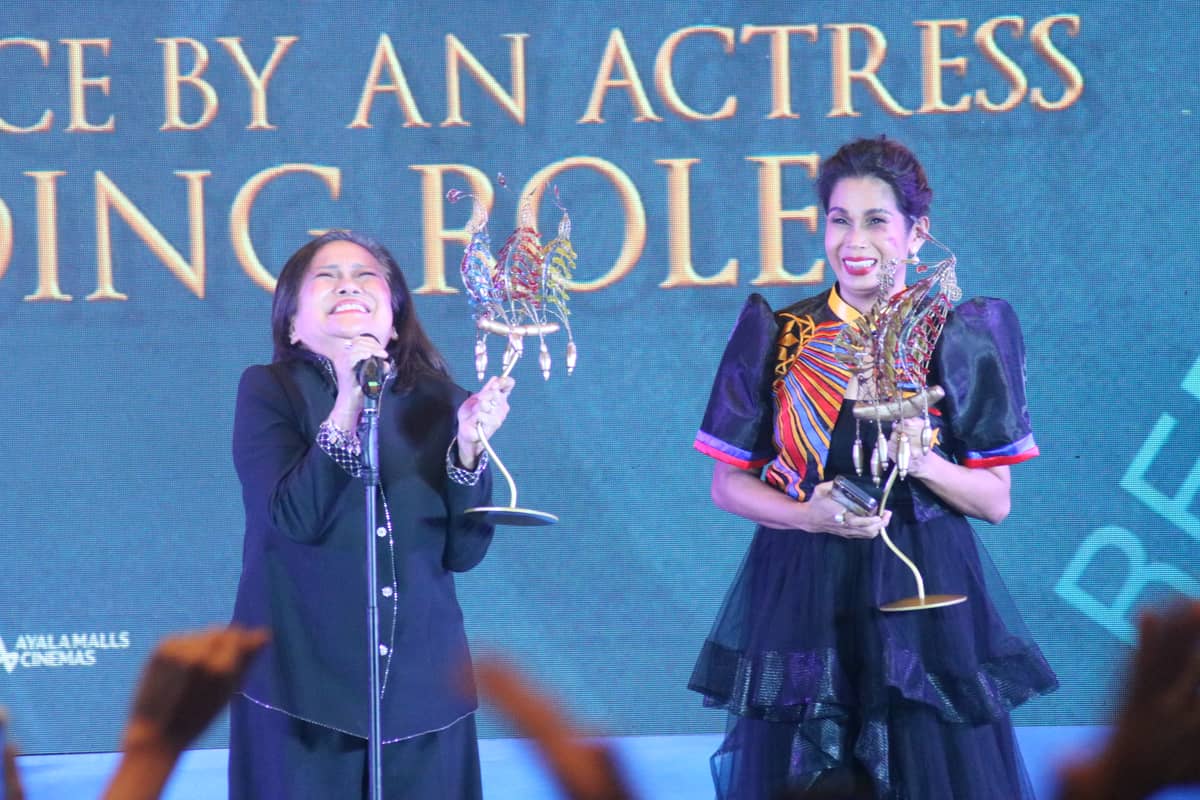
Ruby Ruiz and Marietta “Pokwang” Subong share the Best Actress Balanghai at Cinemalaya 22 for Status: Rejected and 2 Valid IDs, respectively.
Ruby Ruiz and Marietta “Pokwang” Subong shared the Best Actress award, with Ruiz recognized for Status: Rejected and Subong for 2 Valid IDs. Ruiz was cited by the jury for “an absolute masterclass in screen acting; for her pitch-perfect balance of mischievous spunk and delicate melancholy; for making herself a deeply human center of Pinay folly and absurdity; for making complex, heavy emotional scenes look entirely effortless; and for grounding a quirky online romance in the quiet, heartbreaking vulnerability of an aging woman yearning for love and companionship.”
Subong was cited for “a deeply transformative and devastating performance; for courageously shedding her comedic roots to deliver a riveting, grounded portrayal; and for her touching emotional control,” capturing “the raw frustration, quiet dignity” of her character.
The awards therefore point to something larger than a list of winners. They suggest a Cinemalaya that valued films capable of making urgent subjects feel fully cinematic.
Cinemalaya 22 winners
Full-Length Competition
Best Film: Mag-iina
Best Director: Giancarlo Abrahan, Mag-iina
Best Screenplay: Guelan Varela Luarca, Mag-iina
Best Actor: Martin del Rosario, Tayo Lang ang Nakakaalam
Best Actress: Ruby Ruiz, Status: Rejected; Marietta “Pokwang” Subong, 2 Valid IDs
Best Supporting Actor: Lucas Andalio, Mag-iina; K.D. Omalin, Hand of God
Best Supporting Actress: Bituin Escalante, A.ni.mál
Best Editing: John Rogers, A.ni.mál
Best Cinematography: Adam Dumaguin, Tayo Lang ang Nakakaalam
Best Production Design: Katrish Aristoki, Mag-iina
Best Musical Scoring: David Yuhico, Mag-iina
Best Sound: Elian Idioma, Tayo Lang ang Nakakaalam
Best Ensemble Performance: Tayo Lang ang Nakakaalam
Special Jury Prize: 2 Valid IDs; Para-Paraan (Finding a Way Through)
NETPAC Award: Status: Rejected
Audience Choice Award: 2 Valid IDs
Short Film Competition
Best Film: Silkscreen
Best Director: Gabriela Serrano, Elenita Elena Elaine
Best Screenplay: Lysa Catolico and Jazmine Gin Pateña, Runo!
NETPAC Award: The River Flows in Different Places
Audience Choice Award: Hoy, Hoy, Ingat!
The Main Competition Jury comprised Sari Lluch Dalena, chair, Marian Pastor Roces, Pradip Kurbah, Lorenzo “Lello” Carvelli, and Dan Villegas. The NETPAC Jury consisted of Alvin Yapan, Haolun Shu, and Perci Intalan. The Main Competition jury selected the Balanghai winners, while the NETPAC jury selected the NETPAC awardees.