
Two tribesmen hurt in shooting during wake in Kalinga
Two men from the Naneng tribe were wounded in a shooting during a wake in Tabuk City, Kalinga, amid a dispute over a burial site.
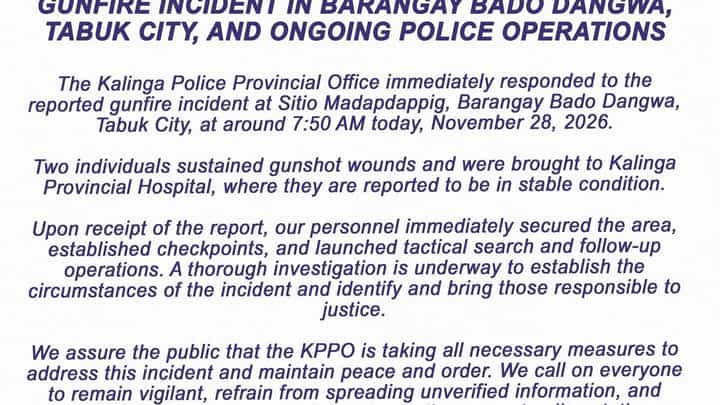
TABUK CITY, Kalinga — Two men from the Naneng tribe were wounded after gunmen believed to be members of the Tinglayan tribe opened fire at a wake in Sitio Madapdappig, Barangay Bado Dangwa, Tabuk City, on the morning of 28 November 2026.
Police identified the victims as a 58-year-old man and his 50-year-old brother-in-law. Both were brought to the Kalinga Provincial Hospital in Bulanao and were reported to be in stable condition.
Kalinga Police Provincial Office chief Police Col. Peter Ngabit Jr. said the suspects fired at the family to prevent them from burying their deceased relative on a disputed parcel of land.
Following the incident, the bereaved family decided to bury their relative in their own courtyard instead.
The KPPO said Calanan Sub-Station 3 received a report of gunfire in the area at around 7:50 a.m.
Responding police officers established checkpoints and launched search and security operations to identify the perpetrators.
Ngabit said police personnel, including a team from the Special Weapons and Tactics unit and another from the Kalinga Police Mobile Force Company, would remain deployed in the area to prevent further violence until the burial is completed.
Police also advised the public to avoid the Calanan-Bantay Road until further notice for safety reasons.
In Kalinga, burying a family member on a parcel of land is traditionally associated with establishing tribal or clan ownership over the territory. Disputes over burial sites and land access can therefore trigger armed confrontations, particularly when territorial boundaries are contested or a bodong, or peace pact, between groups breaks down.
Territorial disputes among Kalinga sub-tribes, including the Naneng of Tabuk City and groups from Tinglayan, have been linked to overlapping ancestral domain claims in areas such as Barangay Bado Dangwa. Such conflicts typically require mediation by tribal elders and local authorities.