
Seafarers' advocates seek Magna Carta reforms despite SC victory
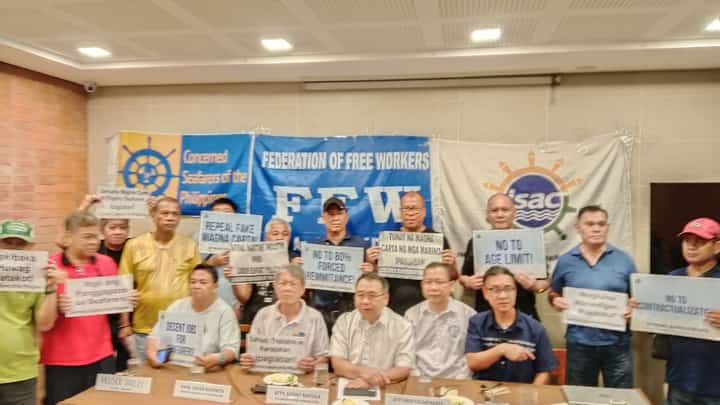
Seafarers and their lawyers, far right seated Atty. Dennis Gorecho of International Pro Bono Alliance, Atty. Neri Colmenares, Bayan Muna, and Atty. Sonny Matula of Federation of Free Workers.
Labor and human rights advocates on Friday called for a review of the Magna Carta of Filipino Seafarers, warning that some maritime workers could remain without adequate legal protection despite a recent Supreme Court ruling striking down a controversial bond requirement.
At a media forum on 20 November 2026, lawyer Dennis Gorecho of the International Pro Bono Alliance, former Bayan Muna Rep. Neri Colmenares and labor leader Sonny Matula questioned the law's scope and implementation, particularly its protections for seafarers who have yet to sign employment contracts or secure deployment.
Gorecho raised concerns that workers undergoing training, completing recruitment requirements or awaiting deployment could fall outside the law's coverage, leaving them vulnerable to potential abuses.
He also questioned provisions that could limit seafarers' access to legal remedies against employers, recruitment agencies and other entities.
The advocates argued that maritime workers should be protected from employment-related violations even before formal contracts are signed or deployment begins.
They warned that restrictive interpretations of the law could prevent workers from seeking redress simply because their employment arrangements have not been finalized.
The Magna Carta of Filipino Seafarers was enacted to strengthen labor rights, welfare protections and access to legal remedies for Filipino maritime workers.
However, the advocates maintained that its implementation must not undermine those objectives by excluding workers who have yet to enter formal employment.
They urged lawmakers and government agencies to revisit the legislation and consult seafarers to ensure its provisions adequately protect their rights.
Meanwhile, the International Seafarers Action Center (ISAC) and Concerned Seafarers of the Philippines (CSP) welcomed the Supreme Court's 11 November ruling declaring the execution bond requirement under Section 59 of the law unconstitutional.
The groups described the decision as a victory for seafarers who had opposed the requirement, which they argued imposed an additional financial burden on workers seeking to enforce favorable judgments.
"This is victory for Filipino seafarers. They should not be made to pay just to claim what has already been rightfully awarded to them. The SC decision recognizes the unfair burden placed on seafarers who are already fighting for justice against their employers," said ISAC president Edwin dela Cruz.
The decision, penned by Associate Justice Maria Filomena Singh, found that requiring seafarers who had won labor cases to post execution bonds violated due process and equal protection guarantees.
The Court ruled that the requirement imposed a financial barrier on seafarers that was not similarly applied to other workers.
Despite the ruling, ISAC and CSP maintained that other provisions of the Magna Carta remain unfavorable to maritime workers.
The groups called for further reforms to ensure the law provides comprehensive protection rather than creating additional obstacles for seafarers seeking justice.