
Nearly half of Davao learners struggle to read — EDCOM 2
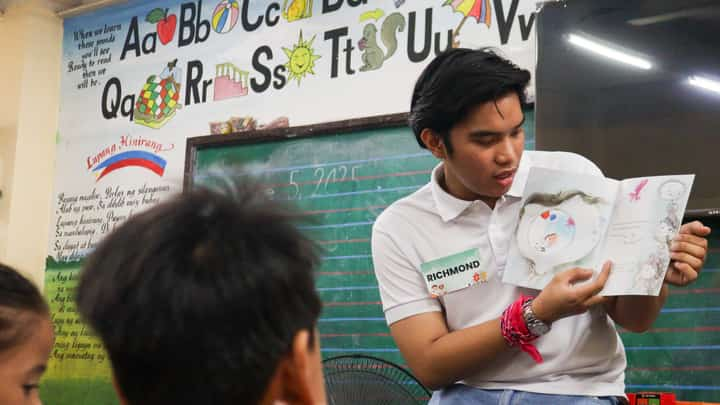
Generously giving back Scholars embody community spirit by actively participating in outreach initiatives like Brigada Eskwela, helping young students prepare for a new school year through a reading session.
PHOTOGRAPHS COURTESY OF ABOITIZ
Nearly half of learners assessed in the Davao Region struggle with basic reading skills, while thousands of senior high school students remain unable to read independently, the Second Congressional Commission on Education (EDCOM 2) reported Tuesday.
Data from the Department of Education's (DepEd) June 2026 literacy assessment showed that 48 percent of assessed learners in Davao Region and 45 percent in Davao City were classified as struggling readers at the start of School Year 2026–2027, compared with the national rate of 45 percent.
“The learning crisis did not happen overnight, it has compounded over the years. We must act now to address illiteracy, especially among children in Grades 1 to 3,” EDCOM 2 Executive Director Karol Mark Yee said.
Under DepEd's assessment standards, struggling readers include children who have difficulty recognizing letters and their sounds or decoding words appropriate to their grade level.
The literacy gaps persist into senior high school, with a separate assessment at the end of SY 2025–2026 showing that 45 percent of Grade 11 learners assessed across Davao Region were at the Frustration level, indicating serious reading difficulties.
Another 34 percent required instructional support, while only 21 percent were classified as independent readers.
In Davao City, 15,914 Grade 11 students, or 46 percent of those assessed, were at the Frustration level. Only 8,453 students, or 25 percent, could read independently.
Davao Oriental recorded the highest proportion of Grade 11 learners at the Frustration level among the region's provincial divisions at 63 percent, followed by Davao del Norte and Davao Occidental at 56 percent each.
“We are seeing Grade 8 students who struggle to read a sentence, and Grade 9 students who should be studying Shakespeare but still struggle to read a paragraph,” Yee said.
Earlier assessments covering Grades 1 to 3 also revealed wide literacy disparities across the region.
Davao Occidental posted the highest provincial rate of struggling readers at 18.5 percent, followed by Davao del Norte at 14.8 percent and Davao Oriental at 13.4 percent.
At the municipal level, Talaingod in Davao del Norte recorded the highest rate at 49.6 percent, equivalent to 1,184 struggling readers.
The commission also reported that national reading proficiency stood at 30.52 percent in Grade 3, declining to 19.56 percent in Grade 6, 0.74 percent in Grade 10 and 0.40 percent in Grade 12.