
Supreme Court honors retiring Justice Amy Lazaro-Javier for years of service
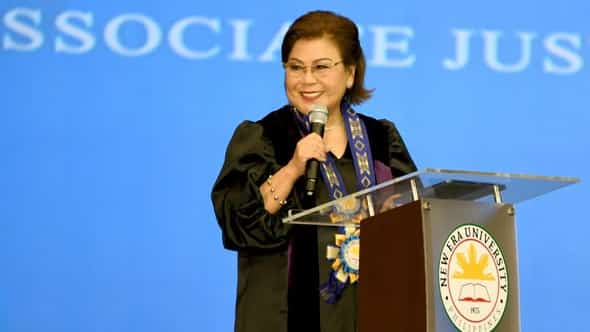
The Supreme Court (SC) En Banc paid tribute to retiring Associate Justice Amy C. Lazaro-Javier in a formal ceremony recognizing her distinguished years of service on the bench.
All incumbent Associate Justices took part in the event, reflecting the deep respect and esteem Lazaro-Javier earned from her colleagues throughout her judicial career. Senior Associate Justice Marvic M.V.F. Leonen served as master of ceremonies and led the High Court in honoring the retiring magistrate.
In her valedictory message, Lazaro-Javier reflected on the core values that shaped her life and legal career, emphasizing that love had served as the guiding force behind her public service and pursuit of justice.
Recalling her upbringing in a large household, she shared how her early family life instilled in her the values of compassion, generosity, and making room for others.
"I grew up in a humble home where food on the table was usually scarce, but in a family filled with love," Lazaro-Javier said. "Growing up in such a large family has taught me about our limitless capacity to make room for more love. Perhaps that is why I have moved through every season of my life powered by love. In every decision I make, I ask, is this coming from a place of love? Love runs in my blood and flows through my veins."
Lazaro-Javier noted that her commitment to service took root early in her professional life. After briefly teaching at a private institution, she transferred to the public school system in Manila.
There, she witnessed firsthand the daily challenges faced by underserved communities and recognized the need to extend greater support to those confronting systemic barriers.
"The children I encountered there had so much potential and were equally deserving of a good education, but they were limited by their circumstances," she recounted. "I realized then that those who have less are often those who need us to give more—not because they are less capable, but because they have more obstacles to overcome. I knew that I could not change the world for them, but if I gave them more of my patience, attention, and effort, I could give them hope and perhaps, even create a small difference in their lives."
She explained that the experience strengthened her resolve to pursue a life dedicated to public service, a commitment that eventually led her to serve in the Office of the Solicitor General (OSG), the Court of Appeals (CA), and ultimately the SC.
"Since then, my desire to give back and to open doors for others has become inexhaustible. You can no longer look away when you realize that you have the capacity to make a change. I am privileged to have served in institutions that are recognized for their hard work. Certainly, the public schools in Manila are not a walk in the park. And so is the work at the OSG, the Court of Appeals, and now the Supreme Court."
Throughout her tenure, Lazaro-Javier carried this philosophy of empathy and equity into her work in the judiciary, leaving a legacy of compassionate public service.
She officially retired on 16 November 2026.
As part of the ceremony, members of the SC presented Lazaro-Javier with a series of symbolic judicial tokens representing the values and responsibilities of judicial office.
These included the SC Flag, Philippine Flag, SC Pin, SC Timepiece, SC Seal, Coffee Table Book, Book of Decisions, SC Pen, Brass Shingle, SC Ring, Statuette of Judicial Excellence, Judicial Robe, Gavel and Mallet Set, Plaque of Recognition, Judicial Medal of Distinction, and the Chief Justice Jose Abad Santos Award.
Among the honors conferred upon her was the Judicial Medal of Distinction, one of the SC's highest recognitions of judicial excellence.
Awarded to retiring members of the SC who leave no cases undecided beyond the Constitution's prescribed 24-month period, the medal recognizes distinguished judicial service that helps sustain public faith and confidence in the Judiciary.
For Lazaro-Javier, the distinction carried special significance. Throughout her judicial career, she maintained a zero-backlog docket, first at the CA and later at the SC.