
China-ASEAN trade tops $1T as leaders push stronger ties
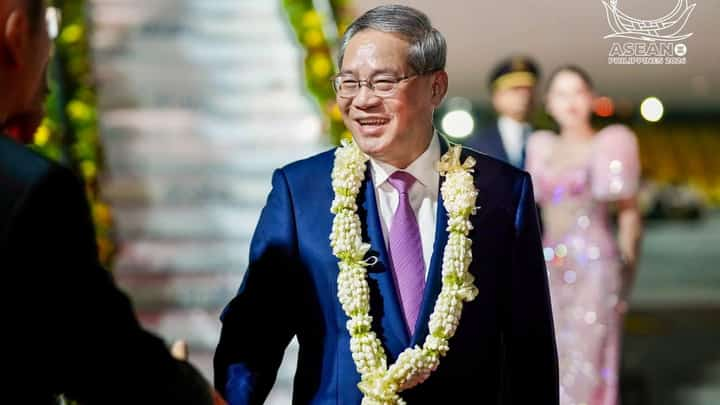
Chinese Premier Li Qiang on Monday highlighted the growth of economic cooperation between China and the Association of Southeast Asian Nations (ASEAN), with bilateral trade exceeding $1 trillion last year despite rising geopolitical tensions and protectionism.
Speaking at the ASEAN-China Summit in Manila, Li said cooperation between the two sides had maintained strong momentum over the past five years amid global uncertainties.
"As you can see, over the past five years, we have witnessed a growing counter-current of unilateralism and protectionism and recurring geopolitical conflicts on a global stage," Li said.
"Despite such a challenging environment, China-ASEAN cooperation has maintained strong momentum and scored encouraging achievements."
Li said bilateral trade exceeded $1 trillion in 2025, up 20.1% from 2021, while trade grew another 29.6% in the first 10 months of 2026.
"To date, two-way investment has exceeded US$500 billion in cumulative terms, an increase of over 50 percent compared with five years ago," he said.
He also cited rapid advances in cooperation on the digital economy, green economy and artificial intelligence.
Li highlighted the signing of the China-ASEAN Free Trade Area 3.0 Upgrade Protocol and the adoption of the ASEAN-China Comprehensive Strategic Partnership Plan of Action for 2026-2030 as major achievements in strengthening regional economic integration.
He also pointed to infrastructure projects, including the Jakarta-Bandung High-Speed Railway, China-Laos Railway and Pinglu Canal, alongside the implementation of an ASEAN visa program.
"The flow of personnel, capital, technology, and other factors has become more efficient across the region and generated greater economic returns," Li said.
China's second-highest-ranking official described the past five years of cooperation as "extraordinary," saying the achievements had not come easily.
He outlined three priorities for sustaining the partnership: preserving friendship and mutual assistance, upholding openness and mutual benefit, and promoting innovation-driven development.
"These experiences and inspirations are a valuable asset for us all. We must carry them forward and harness them to the fullest so as to keep writing new chapters of China-ASEAN cooperation," Li said.
Marcos calls for respect for international law
Meanwhile, President Ferdinand Marcos Jr. emphasized the importance of international law, mutual respect and peaceful dispute resolution as ASEAN and China marked 35 years of dialogue relations.
Marcos recalled China's accession to the Treaty of Amity and Cooperation in Southeast Asia in 2003, becoming the first ASEAN dialogue partner to do so.
"During this anniversary year, our shared commitment to international law and the peaceful settlement of disputes must be reflected in our actions, including through self-restraint, mutual respect, and practical cooperation," Marcos said.
He also cited progress in negotiations on a proposed Code of Conduct (CoC) in the South China Sea, stressing that the agreement must be consistent with international law, including the 1982 United Nations Convention on the Law of the Sea.
Marcos said ASEAN and China continued to pursue cooperation despite regional tensions, citing their joint statement on addressing the regional effects of developments in the Middle East and strengthening energy cooperation.
"As we mark these milestones, let us build on the achievements of our partners to advance peace, stability, and prosperity in our region," he said.
However, Foreign Secretary Ma. Theresa Lazaro said Sunday that ASEAN and China would miss their 2026 deadline for concluding the CoC negotiations.
Lazaro said about 80% of the draft agreement had been provisionally agreed upon, but differences over key provisions remained unresolved.
Negotiations will continue under Singapore's ASEAN chairmanship in 2027.
"I think there was not enough time," Lazaro said. "If we were given probably another five to six months, I think we can finish that."