
Senate sets evidentiary limits on prosecution’s unexplained wealth case
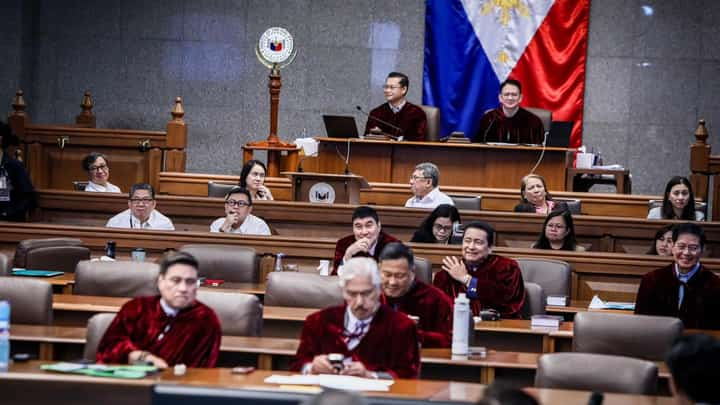
The Senate, sitting as an impeachment court, during the 28th day of the impeachment trial against Vice President Sara Duterte.
Aram Lascano / DAILY TRIBUNE
The Senate impeachment court formally admitted the evidence of the House Prosecution Panel for its case on Vice President Sara Duterte’s alleged unexplained wealth while establishing evidentiary boundaries ahead of the defense’s presentation of evidence.
Atty. Reggie Tongol, the court’s spokesperson, said that the court granted the prosecution’s bid to admit financial records that were presented during the proceedings, particularly the financial, tax, corporate, property, and Statement of Assets, Liabilities, and Net Worth (SALN) records of the Vice President.
It was pointed out, however, that Duterte could not be impeached based on actions that were committed prior to her assumption of office in 2022, citing the precedent established in the Supreme Court case of Duterte v. House of Representatives.
“The Court enforced the Supreme Court’s ruling in Duterte v. House of Representatives that an official can only be impeached for acts committed during her current term beginning June 30, 2022,” Tongol said.
It is worth noting that documents which predate the said time frame were still admitted to be used as a “starting financial baseline” for the case to identify which assets existed before Duterte became Vice President.
The evidence that was completely excluded by the court was records from the Commission on Audit (CoA) concerning the disallowances on the confidential funds of the Office of the Vice President and the Department of Education, which were included in Article I.
Aside from CoA findings, the court also excluded corporate records pertaining to JTC Group of Companies Philippines, Inc. and Pikimong Pikimong Philippines Corporation, as it pointed out that the companies were not connected to Duterte.
The court maintained that “withdrawn charges and unconnected corporations have no place in the adjudication of Article II.”
No ‘fishing expedition’
With its ruling on the admissibility of evidence, Tongol said that the court had likewise overruled “blanket attempts” of the defense to push back on records which were duly subpoenaed throughout the course of the trial.
It reportedly stressed that subpoenas were a “legitimate tool” which could be used to gather hard records that were needed to test the weight of a particular case, while maintaining that Articles of Impeachment were meant to state the “core charge.”
“The Court overruled the Respondent’s general objection that documents subpoenaed during the trial were a ‘fishing expedition’ or inadmissible simply because they were not attached to the original impeachment complaints,” the ruling reportedly read.
Admissibility does not prove allegations
In light of the court’s decision, Tongol clarified that admitting documents into evidence for the court's consideration was not a determination of whether the prosecution’s allegations were true.
He said that the decision on the weight of the evidence with respect to the ongoing trial was still up to the appreciation of all senator-judges.
“Admissibility simply means the documents met the legal standards to be placed on the table; how much weight they carry—and whether they prove or fail to prove Article II—belongs exclusively to the Senator-Judges at the end of the trial,” he said.
Tongol likewise confirmed that the defense would begin its presentation of evidence on Article II on November 9, when the trial is set to resume after a pause of over three weeks.
Sub-judice rule retained
The court spokesperson also said in his statement that the court has decided to re-impose its sub judice restriction for all Articles of Impeachment, regardless of whether the case was withdrawn.
He stressed that the decision was intended to disallow both parties from “litigating dropped charges in the media” while the court continued its proceedings on the remaining impeachment article.
“All parties, counsel, and covered persons are strictly enjoined from making public statements on the merits of the pending trial or any matter covered by the Articles of Impeachment, under pain of the strict penalties set forth in the August 26, 2026 guidelines,” he said.
In the said ruling, the impeachment court's presiding officer, Senator Francis “Chiz” Escudero, instructed both parties to refrain from dwelling on the merits of the case, warning that parties would be subjected to penalties such as admonition and fines.