
U.S. threats seen battering ICC trial
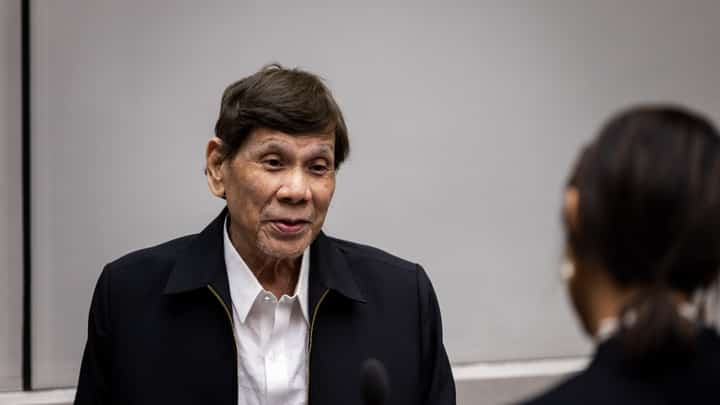
The 81-year-old ex-president Rodrigo Duterte was clad in a white button-down polo and a black collared jacket, with his face framed by a white third beard and eyebrows, as he appeared in the ICC courtroom for the third status conference on Wednesday, 16 September, before this trial in November.
International Criminal Court
Former President Rodrigo Duterte’s trial before the International Criminal Court (ICC) for crimes against humanity is set to begin 30 November, but the court’s ability to hold it could be hampered by a new round of United States sanctions, an expert in international criminal law said.
Lachezar Yanev told Agence France-Presse (AFP) that the sanctions, if they take effect, would significantly affect the ICC’s capacity
to conduct the trial of Duterte and the other cases before it.
Yanev, an associate professor of International Criminal Law at Vrije Universiteit Amsterdam (VU Amsterdam) and co-director of its Law in Society bachelor’s program, said the case involves insider witnesses who need protection and would have to travel to the Netherlands to testify.
If the court cannot carry out its day-to-day operations, including paying for the witnesses’ transport, arranging their accommodations in the Netherlands, and safeguarding their privacy and security, the trial may be unable to proceed until they can appear in court.
“The ICC has faced unprecedented turmoil, capped by the recent announcement of the fresh US sanctions against the tribunal,” he said.
Yanev said the trial carries wider significance for the court, which has long faced criticism that it is an “African court” that prosecutes only the military and political leaders of African states.
A case centered on a former Asian head of state, he said, would help counter that perception.
“We have arrest warrants issued against Putin, against Netanyahu, and we have somebody from Asia whom we are also currently prosecuting,” Yanev said.
Notify ICC, says SC justice
Meanwhile, the government can formally notify the ICC through a diplomatic note verbale if the Supreme Court declares the arrest and surrender of former President Duterte unconstitutional, according to recently retired Associate Justice Amy Lazaro-Javier.
In her 20-page concurring and dissenting opinion released alongside the High Court’s November 2026 ruling on the consolidated habeas corpus petitions, Lazaro-Javier argued that passing judgment on the legality of Duterte’s March 2025 arrest and transfer to The Hague would carry substantive legal weight rather than serve as a mere symbolic gesture.
While acknowledging that Philippine courts lack the coercive authority to compel an international tribunal to surrender custody of the former leader, Lazaro-Javier maintained that the petitions should not have been dismissed as moot.
She emphasized that the legal challenges questioned the domestic actions of Philippine law enforcement and executive officials — matters distinct from the ICC’s subsequent jurisdiction.
“Declaring Duterte’s arrest and surrender unconstitutional would establish the legal parameters that must guide the Executive’s subsequent actions concerning the former president,” Lazaro-Javier noted in her opinion, adding that the executive branch’s refusal to request Duterte’s repatriation remains subject to judicial review.
Her proposal to use a formal diplomatic note to inform the ICC of the Supreme Court’s constitutional findings drew support from fellow dissenter Associate Justice Ramon Paul Hernando, who argued that the government must clarify to the international tribunal that the country’s highest court has spoken on issues involving national sovereignty and due process.
Renewed threats?
For its part, the National Union of People’s Lawyers (NUPL) expects renewed threats and intimidation against families of extrajudicial killing (EJK) victims when the crimes against humanity trial starts.
NUPL president Atty. Ephraim Cortez said the group had yet to receive reports of new threats against the families in the days leading up to the trial but anticipated a possible resurgence based on their experience during the earlier confirmation of charges hearings.
He said most of the threats previously reported were made online, prompting the group to file a complaint with the National Bureau of Investigation (NBI). However, Cortez said the complaints remained unresolved.
“Unfortunately, the NBI has yet to issue a resolution,” he said, adding that security measures were being implemented for the victims’ families, both in the Philippines and those who traveled to The Hague, Netherlands, to attend the proceedings.
Cortez said the start of the trial was a source of relief for the families who had waited years for the case to reach this stage, tracing the process back to the filing of complaints in 2018.