
Budget moves, tempers flare: Extended session ends Senate debates
The chamber now moves to the amendment period, a vote on second reading, then the third and final reading.
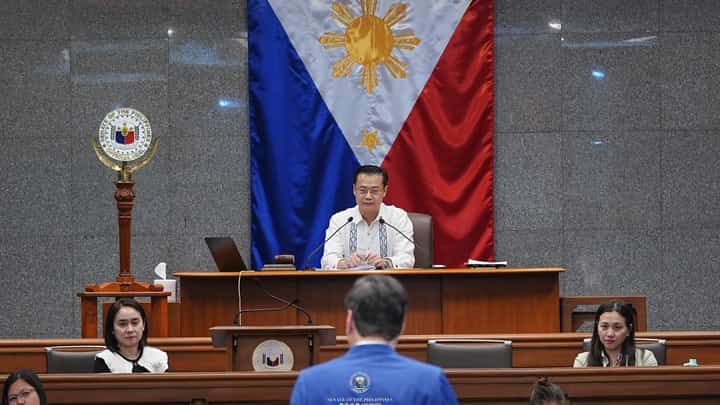
The Senate wrapped up its marathon deliberations on the proposed P7.2-trillion 2027 General Appropriations Bill early Saturday morning, with Senate Finance Committee Chairperson Joseph Victor “JV” Ejercito describing the Senate version as having gone “back to the basics” of food, health, education, employment and security.
“We know that many Filipinos have lost faith in the national budget process. That is why we need to know where the people’s money goes and whether it truly benefits the Filipino people,” Ejercito explained.
The chamber now moves to the amendment period, a vote on second reading, then the third and final reading. After that, the Senate version goes to the House for reconciliation at the Bicameral
Conference Committee, where budget watchdogs warn of possible attempts by House members to restore their pork projects.
Senator Panfilo Lacson, however, said the Senate version still needs more adjustments, flagging at least P241 billion in fragmented cash aid programs and thousands of multipurpose buildings as patronage spending.
Boiling point reached
Senator Robin Padilla lost his temper on the Senate floor early Saturday, claiming that someone had demanded P100 million to approve a long-stalled expressway project as the chamber was wrapping up its marathon plenary deliberations.
Padilla made the allegation during the debate on the Department of Public Works and Highways (DPWH) budget in the wee hours of 28 November.
Visibly livid, he demanded that DPWH officials explain why there was still no notice to proceed for the North Luzon East Expressway, a 200-kilometer project approved in 2007 under the Build-Operate-Transfer scheme.
Speaking in Filipino, Padilla said that since it was already dawn, the senators should speak plainly, adding that someone was asking for money and that his temper was up. He also invoked the residents of flood-hit communities in Pampanga and Bulacan, asking whether the government had a plan for them.
Ejercito responded that the project was still subject to legal and documentary requirements. He said its approval was pending before the Public-Private Partnership Center under the PPP Code of 2023.
The exchange came as the Senate concluded plenary deliberations on the GAB, which Ejercito sponsored on 23 November with proposed amendments totaling P204.634 billion.
The Senate budget version raised PhilHealth’s allocation to P94.2 billion and boosted spending for health, education, and agriculture, partly by cutting P97 billion in noncompliant projects from the DPWH budget that was approved by the House.
Ejercito said the Senate version had gone “back to the basics” of funding food, health, education, employment and security.
Senator Lacson, however, said the bill still needed further readjustment. He flagged at least ₱241 billion in fragmented cash aid programs and thousands of multipurpose buildings as patronage spending that would not revive a sluggish economy.
With the deliberations closed, the senators will now enter the amendment period before voting on the second and third reading. The approved Senate version will then go to a Bicameral Conference Committee to reconcile it with the House’s version, before being sent to President Ferdinand Marcos Jr. for his signature. The President retains the power to veto specific items.
Bias towards high-class
Debates also touched on first-class cities and municipalities cornering 67.48 percent of government-funded multipurpose buildings from 2012 to 2026, while the country’s poorest local government units (LGU) received just 1.2 percent.
Lacson said that of the 79,816 multipurpose buildings (MPB) recorded during the period, 53,865, or 67.48 percent, went to first-class LGUs, compared with just 976 to fifth-class cities and municipalities.
During the deliberations on the DPWH proposed 2027 budget, the disparity was raised, with figures that contradicted claims that multipurpose buildings were needed to address infrastructure gaps in poorer municipalities.
Second-class LGUs received 10,671 projects, third-class LGUs 8,167, and fourth-class LGUs 5,229. Another 908 projects had no identified income classification, according to Lacson.
The concentration was also evident among individual local governments. Quezon City, the country’s highest-income city with P31.533 billion in income, had 1,449 MPBs, while Taguig had 318. Santiago City in Isabela, meanwhile, had only three.
Among municipalities, Daraga in Albay, the highest-income municipality, had 135 projects, while Calayan in Cagayan had one.
The Senate budget version thus trimmed P28.1 billion in MPB allocations.
The Senate committee report reduced the DPWH’s proposed budget to P587.9 billion, P66.2 billion lower than the House version and P54.7 billion below the National Expenditure Program, according to the People’s Budget Coalition (PBC).
The PBC said the Senate removed or reduced about 3,480 DPWH projects that failed documentary requirements, including P28.1 billion in multipurpose buildings and P24.3 billion in access roads.
It also cited Lacson’s identification of at least 30 suspected ghost multipurpose buildings, underscoring concerns over the necessity and documentation of infrastructure projects.
The Senate required project-level disclosures and supporting documents, including certificates of implementability, programs of work, geotagged photographs, local development council approvals and project profiles.
Despite these cuts, Lacson said the allocation pattern remained evident in the Senate version, which included 26 MPBs for Quezon City and 25 for Lipa City in Batangas.
Descriptions lacking
Beyond the distribution of projects, Lacson questioned the transparency of the proposed allocations, flagging 2,806 items worth P41 billion that lacked specific descriptions of their intended functions.
Without these details, the lawmakers and the public could not determine whether the structures would serve as health centers, evacuation centers, sports facilities, or other public infrastructure.
Lacson cited an inspection in Castillejos, Zambales, where his staff found a public market and another structure within the same complex.
“We’re not against the construction, but for transparency there should be descriptions,” he said.
Ejercito said the DPWH would look into prioritizing fourth- and fifth-class municipalities in future MPB allocations.
The Senate panel had asked the department to identify the intended use of proposed multipurpose buildings, including whether they would serve as barangay halls, daycare centers, covered courts, or evacuation centers.
He also said that some projects receive funding from both the Local Government Support Fund and the DPWH when the initial allocation from one agency is insufficient to complete construction.
Complementation
“That does happen. Sometimes, when an agency receives insufficient funding, it asks another agency for additional funds to make up the shortfall and complete the construction project,” Ejercito said.
On proposed projects, the senator said lawmakers seeking appropriations must submit the required documents rather than only provide a project name and funding amount.
“Project names and amounts alone are not enough. There must be a program of work, a certificate of implementability, no objections, approval from the Regional Development Council, and geotagging,” he said.
“If you want something, work for it. Complete all the required documents. You cannot simply insert a project just because you are a congressman,” he added.