
Review: 'Mono No Aware' is a finely crafted slow burn
'Mono No Aware' leaves something to be desired, but remains a finely crafted film that further demonstrates Amparado’s range and confidence as a filmmaker.

BC Amparado’s Mono No Aware, the top full-length winner at the 2026 Puregold CinePanalo Film Festival, is a finely crafted slow burn that demonstrates a filmmaker with a strong visual sensibility, a clear sense of place and a particularly good instinct for actors.
The film dominated the awards night, taking nine prizes, including Best Film, Best Director for Amparado, Best Actor for Juan Karlos (JK Labajo), Best Supporting Actress for Japanese actress Momoko Kobayashi, Best Ensemble, Best Cinematography, Best Editing, Best Sound Design and the International Jury Award.
Amparado, whose 2024 Cinemalaya entry Gulay Lang Manong first put him on my list of directors to watch, takes a radically different tonal direction here. His earlier film was a sharp, dark social satire, using dark comedy and absurdity to tackle marijuana, the drug war, police corruption and medical-cannabis advocacy. Mono No Aware is far more contemplative, but the same confidence in visual storytelling and performance remains. Amparado clearly knows how to experiment with different styles of filmmaking without losing his directorial identity.
The film is a two-hander set entirely in Japan, centered on Ichi (Juan Karlos), a Filipino specialized cleaner who works for a company that handles the aftermath of unattended deaths, and George (Peri Dizon), a Filipino resident in Japan struggling with the devastating loss of his wife. Their friendship develops almost by accident, but the fact that they are both Filipino, and more specifically that they share a Bisaya background, becomes an important point of connection in an otherwise isolating environment.
The film recalls Janus Victoria’s Diamonds in the Sand, a much sharper and stronger Filipino film that also explores the Japanese phenomenon of kodokushi, or lonely death. Diamonds in the Sand develops its characters more fully and gives its central themes greater emotional and dramatic momentum. Mono No Aware has the ingredients for something deeper, but its screenplay does not always give those ingredients enough development.
Where Mono No Aware succeeds is in placing Filipino migrants directly inside the landscape of Japanese loneliness. Ichi works in a profession that requires him to enter the private spaces of people who have died alone. George, meanwhile, is alive but trapped inside his own grief. Their relationship allows the film to explore isolation from two different positions: one man encounters death as part of his job, while the other is trying to live with its consequences.
Amparado’s direction of his actors is the film’s greatest strength. Karlos is excellent as Ichi, essaying a level of intelligence and restraint in his craft that makes his performance impressive.
He plays Ichi as soft-spoken, compassionate and almost deceptively gentle. But he is also morally compromised, which gives the character an intriguing contradiction. He is capable of doing morally questionable things because he needs money to support his family in the Philippines.
And the film does not entirely excuse his behavior, but his circumstances make him difficult to simply condemn. Karlos gives the character enough warmth and vulnerability to make those contradictions believable. Karlos also makes his conversations with his wife feel exceptionally natural, with an ease that makes even ordinary exchanges feel lived-in rather than written.
Dizon’s performance is so committed that you can see the physical, unbearable and excruciating grief on his face. George spends much of his time at home, often sitting before a low table on his tatami, seemingly suspended in the aftermath of his wife’s death. There is an almost catatonic quality to his sorrow, and Dizon communicates it with remarkable restraint.
The limitation is that George remains largely defined by his grief. We do not need to know exactly how his wife died or to be given their entire love story. What is missing is a stronger sense of who George was before the loss, or what particular qualities made his relationship with his wife and his life uniquely his. We know that he is devastated and lonely, but beyond that, there is little for us to hold on to.
George sometimes feels like a character reduced to the essential image of grief. Ichi, by comparison, is given more complications: his family, financial problems, questionable choices.
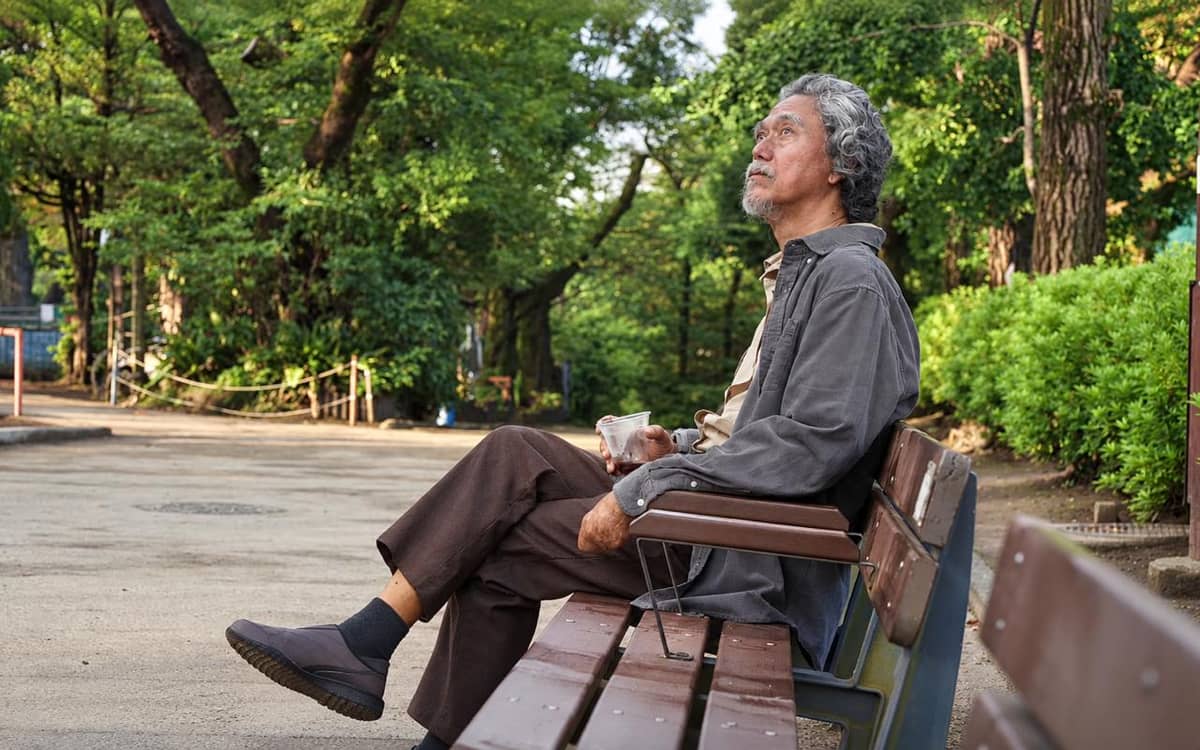
The chemistry between Karlos and Dizon benefits from their linguistic authenticity. Their conversations move naturally among Tagalog, Japanese and Bisaya, and the languages never feel like devices inserted merely to announce that the characters are Filipino. Their speech feels organic to who they are and where they are. The supporting performances carry the same naturalistic quality, which is another indication of Amparado’s ability to direct actors.
Kobayashi plays a third presence in the story as a volunteer welfare worker who checks on elderly people. Her character is intentionally written to be annoying, and she is effectively annoying. Yet her presence remains important to the film because she represents the very act of checking on people that becomes central to its treatment of kodokushi. Her performance is natural enough to fit the film’s understated acting style.
The film’s principal weakness is its pacing, specifically its momentum. I love a good slow burn, but slow cinema needs emotional accumulation. Even when very little happens, each scene should add another layer of feeling, or deepen the subtext, and not merely move the characters closer to a conflict or realization.
Mono No Aware sometimes loses that momentum. The plot itself continues to move, and there is enough curiosity to keep you wondering what will happen to Ichi and George. The problem is the emotional progression from one scene to the next. There are moments when a scene establishes a feeling or emotional beat, only for the following scene to move on without sufficiently carrying or developing what came before. Instead of allowing the feeling to accumulate, the transition can make it feel as though the film has moved directly to the next beat.
That distinction matters in a slow burn. The film does not need to move faster; it needs to sustain the emotional momentum of its slowness. Some scenes work beautifully on their own, but the feeling they create does not always carry into what follows.
There are also frames and sequences that feel recycled or repeated for additional length. Instead of reinforcing an image or deepening its meaning, some repetitions simply stretch the film. For a slow burn, repetition needs to create accumulation. Here, it occasionally creates drag.
The screenplay also introduces several sources of conflict around Ichi, particularly his financial problems and morally questionable decisions, but the consequences often soften too conveniently. The film creates the possibility of greater tension, then sometimes lets it dissipate before it has fully developed. This further affects the film’s momentum, even as the plot itself continues to progress.
Still, Amparado makes excellent use of the film’s limited locations, establishing a strong sense of place through streets, interiors and carefully composed shots. Japan never feels like a generic backdrop. Space, distance and silence become part of the film’s visual language, while the repeated establishing shots give the setting a distinct rhythm.
The specialized-cleaning sequences are particularly effective. The production design and practical details make the work feel unpleasantly tangible: flies, maggots, decomposition, dirt, bodily fluids and the remnants of death. The film puts us in the space with Ichi rather than merely explaining what his work entails. Some of the imagery recalls the visceral treatment of cleanup work in Diamonds in the Sand.
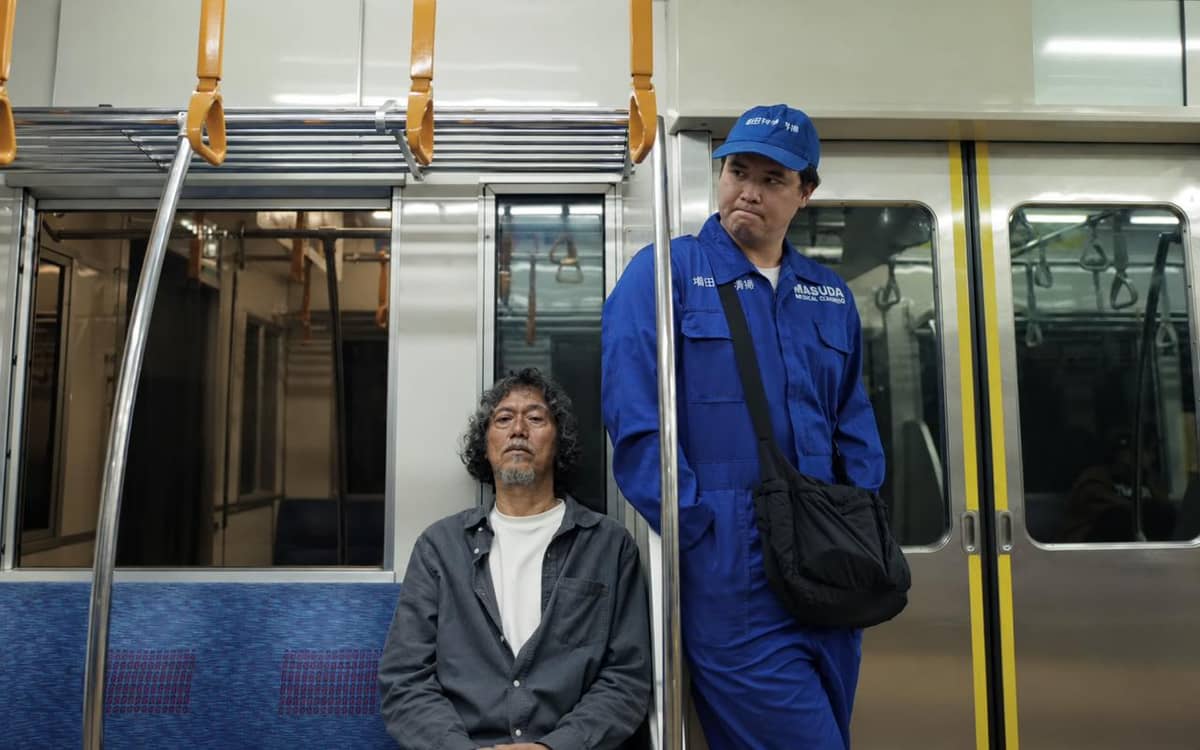
Amparado's tasteful shot is the recurring crow that functions as an evocative visual motif for mortality and impermanence. Its appearances amid images of decomposition can be read alongside Ichi’s own moral deterioration, with the physical decay he encounters at work paralleling the ethical compromises he makes in his personal life.
The sound is similarly controlled. The score does not overwhelm the scenes or dictate the audience’s response, and this allows the performances and environment to carry much of the emotional burden. This works particularly well in a film that depends heavily on pauses, faces, gestures and ordinary conversations.
At its center, Mono No Aware is interested in kodokushi and the importance of human connection. Death itself is universal, and everyone dies alone in the literal sense, but the circumstances surrounding that death can be profoundly different. When people are surrounded by family and friends, when someone worries about them, calls them, visits them or simply notices when they have disappeared, their absence can be detected.
For people who have become completely disconnected from their social networks, that safety net can disappear. Mono No Aware does not insist that every person who dies an isolated death must have been lonely because we cannot know the inner lives of the dead. Instead, it examines what happens when someone becomes disconnected from the social network that might otherwise notice their absence. The specialized cleaners exist because, by the time they enter these rooms, that connection has already failed.
The idea also gives the film its eventual sense of hope. Life is painful partly because it is impermanent. People disappear and circumstances change, sometimes in an instant. Yet connection can arrive unexpectedly. Ichi and George and the welfare girl meet through an unusual circumstance, but their relationship gives them something that was missing from their lives.
The film’s ending brings that idea into sharper focus. After all the grief, loneliness and moral complications, there is something genuinely touching about where Amparado takes the characters. Mono No Aware is not entirely bleak. Its central idea is not simply that life ends or that people are destined to be alone. It is that impermanence makes the connections we form along the way more important.
It is nice to see Puregold CinePanalo venturing into different kinds of genres and filmmaking styles. I have not yet seen all seven full-length competition films as of writing, so I would not make a sweeping judgment about the entire lineup. But Mono No Aware is evidence of a festival willing to give space to a slower, more contemplative kind of cinema alongside very different kinds of stories.
Mono No Aware leaves something to be desired, but remains a finely crafted film that further demonstrates Amparado’s range and confidence as a filmmaker.
Rating: ★★★½☆
The Puregold CinePanalo Film Festival runs until 4 October in participating cinemas.