
Unified Metro Manila flood control map bill passed at House
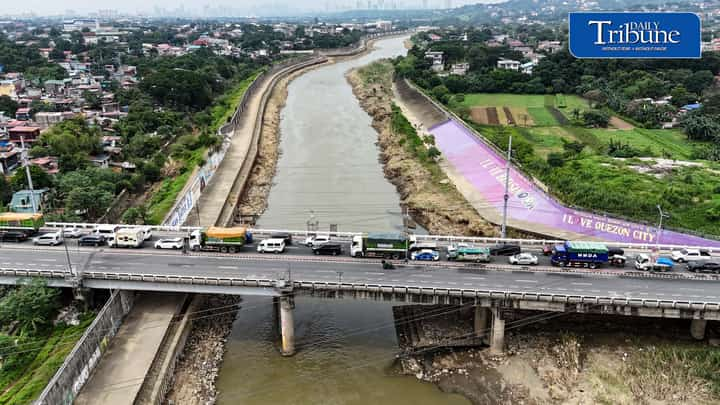
The flood control structure along the Marikina River, protecting San Mateo and Quezon City, seen from the Batasan–San Mateo Bridge last 25 August 2026.
Photo by Analy Labor
A proposal to establish a unified Metro Manila flood control and drainage system was passed at the House of Representatives on Tuesday, receiving an affirmative vote from 212 lawmakers.
The bill authored by 28 lawmakers sought to ensure that flood mitigation structures that were constructed within the National Capital Region (NCR) were interconnected and coordinated.
“This Master Plan shall harmonize and integrate the flood control and drainage network system master plans of all Metro Manila [local government units] to achieve a region-wide, integrated, data-driven flood management system,” the measure stated.
Unifying the approach to flood control was reportedly intended to ensure that resolving flooding in a particular area did not worsen or aggravate flooding in a different locality.
Aptly titled as the “Metro Manila Flood Control and Drainage System Act,” the bill set the Metro Manila Development Authority (MMDA), the Department of Public Works and Highways (DPWH), and the Department of Economy, Planning, and Development (DEPDev) as the implementing agencies.
MMDA would serve as the lead agency that would supervise and approve the master plan that would be formulated from an inter-agency and inter-LGU coordination.
The DPWH and DEPDev, meanwhile, will be concerned with planning, designing, execution, and the formulation of policies that would also conduct periodic reviews on the implementation of the master plan.
Other government agencies would also be tasked with roles such as providing technical weather studies for consideration in the plan and possible alternative measures to the construction of infrastructure such as urban wetlands, retention basins, green corridors, and upstream watershed management.
Aside from the different institutions of government, Congress will also be tasked with establishing a Joint Congressional Oversight Committee (JCOC) comprised of a total of eight lawmakers from both chambers of Congress, including the committee chairpersons for public works and economic affairs.
The committee will be tasked with ensuring that the master plan was complied and that the appropriated funds for the projects were fully utilized.
It would also be required to submit an annual report to Congress with respect to the progress of the master plan, including both structural and non-structural interventions that were made.
The development comes amid the recent restoration of funding intended for flood control projects under the proposed budget of DPWH for fiscal year 2027 amounting to P107.4 bill based on the National Expenditure Program.
The final amount has yet to be determined as both chambers of Congress have yet to craft the final version of the spending bill, with the Senate currently conducting deliberations on the P7.2 trillion government-wide budget proposal.