
PLCPD unveils mural in QC park for internally displaced persons
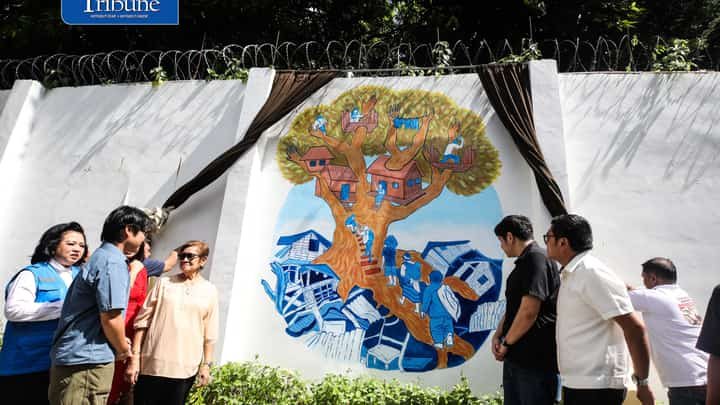
A mural unveiled highlights the dignity and resilience of internally displaced persons (IDPs) at Linear Park in Quezon City on Tuesday, November 24, 2026. Quezon City has expressed support of the House bill no. 2328 or the Rights of Internally Displaced Persons bill seeking to protect families displaced by disasters, armed conflict and violence. Artist Shamgar Espina and Quezon City District 2 Councilor Mikey Belmonte pose in front of a mural during the event.
Photographed by Analy Labor
The Philippine Legislators’ Committee on Population and Development (PLCPD) commissioned a mural unveiled Tuesday to highlight the dignity and resilience of internally displaced persons (IDPs), as part of a solidarity activity with the United Nations High Commissioner for Refugees (UNHCR).
The mural was unveiled at Valencia Linear Park in Quezon City, becoming the first mural installed in the green park. It also commemorates the 13th anniversary of Super Typhoon Yolanda, which displaced more than four million people in November 2013.
The Quezon City government, meanwhile, has expressed support for House Bill No. 2328, or the Rights of Internally Displaced Persons (IDP) Bill, which seeks to protect the rights of people forced to flee their homes due to disasters, armed conflict, violence, and other causes.
“We express our gratitude to the Quezon City Government for providing a space where art can serve as an avenue to communicate the importance of upholding the rights and dignity of IDPs,” PLCPD Executive Director Au Quilala said.
Quilala, who also convenes the Child Rights Network, stressed that children are among the most affected when disasters strike, highlighting the importance of protecting their rights and welfare amid the observance of National Children's Month.
The convenor said the country needs a national law that would establish a standard for protecting the rights and welfare of children and their families affected by displacement.
About the mural
Artist Shamgar Espina conceptualized the mural to portray internally displaced persons as ordinary Filipinos who are part of communities and society, rather than as people separate from the rest of the population.
“I think this is important in helping the public recognize that displacement is an issue that concerns all of us and that anyone can be affected by it,” he told DAILY TRIBUNE in an exclusive interview.
“Since the mural is located in a public park, I wanted its message to reach people even without them actively seeking it out. Hopefully, it encourages them to pause, learn about the situation of internally displaced persons, and understand why their rights need to be protected,” he added.
The fine arts graduate from the University of the Philippines (UP) stressed that while Filipinos often celebrate resilience, greater emphasis should also be placed on providing actual support and taking action to help displaced communities.
“I think we should also put greater emphasis on actual support and action. People should not simply be expected to endure displacement and rebuild their lives on their own. They deserve the opportunity to live normal lives, and those in positions of responsibility have a duty to help make that possible,” Espina said.
“I hope the artwork contributes to this conversation by encouraging solidarity and support for the rights of internally displaced persons,” he added.
Espina, along with mural assistants Mitch Mangalindan and Christian Asoy, painted a scene depicting internally displaced persons walking toward a large tree, with its branches shaped like hands to symbolize the Filipino value of being bukas-palad.
“The tree and its branches represent the collective support that should be extended to displaced communities, helping them rebuild their lives with dignity and security,” Espina said.
“On the tree are houses where people are shown doing ordinary activities, such as drinking coffee, studying, and rebuilding their homes. These scenes emphasize that internally displaced persons should have the opportunity to live normal lives even after experiencing displacement,” he added.
Espina said the people depicted in the mural represent different ages and backgrounds to emphasize that displacement can happen to anyone, including ordinary Filipinos and even the viewers themselves.
“At the bottom are houses that represent the homes these people were forced to leave. Some are destroyed, while others remain standing,” the mural artist said.
“Through these symbols, I wanted to emphasize that the bill is not just about addressing displacement, but also about protecting people's rights and providing the support they need to rebuild their lives,” Espina pointed out.
IDP Bill
The proposed IDP Act seeks to protect the rights of people forced to leave their homes due to natural hazards, armed conflict, widespread violence, human rights violations, and development projects that displace communities.
The measure seeks to institutionalize key protections, including safeguards against arbitrary displacement, access to basic needs and services, recovery and durable solutions, and accountability and coordination among government agencies.
It also provides for an inter-agency coordinating mechanism, with the Commission on Human Rights (CHR) playing a central role in monitoring and protecting the rights of IDPs.
In Quezon City, a proposed City Protection of Internally Displaced Persons Ordinance was filed by City Councilor Fernando Miguel Belmonte, together with the City Council Secretariat, alongside calls for Congress to pass the national IDP Bill.
The Municipality of South Upi in Maguindanao del Sur and the Province of Dinagat Islands have also adopted their own IDP ordinances, while the Bangsamoro region has enacted its own IDP law.
“Every Filipino forced to flee, wherever they are, deserves the same protection, and only a national law can give them that. I join our champions in Congress in calling for the swift passage of the IDP Bill,” Belmonte said.
In 2024, the Philippines had approximately 1.036 million people displaced by disasters and another 123,000 displaced by conflict and violence, according to the Internal Displacement Monitoring Centre (IDMC).