
China rocket launch prompts debris watch near Cagayan, Babuyan Island
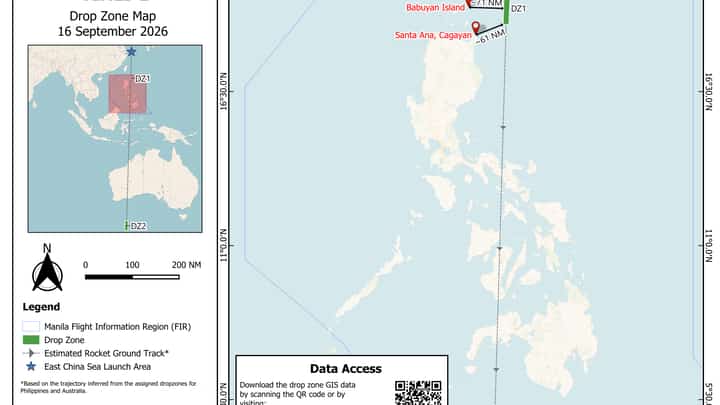
The Philippine Space Agency (PhilSA) confirmed the launch of China’s Yinli-1 rocket on Wednesday, with expected debris projected to fall within an identified drop zone (DZ) approximately 61 nautical miles (NM) from Santa Ana, Cagayan, and 71 NM from Babuyan Island.
The People's Republic of China (PRC) launched the Yinli-1 rocket from the East China Sea Launch Area in the eastern waters of Shanghai at around 6 a.m. Philippine Standard Time on 16 September.
PhilSA said the drop zone is within the Philippines’ exclusive economic zone (EEZ), where debris from the Chinese rocket could potentially fall.
“Details of the rocket drop zone were disclosed through a Notice to Airmen (NOTAM) warning of an “aerospace flight activity,” the space agency stated in its advisory, disseminating a pre-launch report to relevant government agencies and authorities prior to the launch.
Debris from rockets
PhilSA stressed that unburned rocket components, including boosters and fairings, are designed to be discarded as a rocket enters outer space.
“While not projected to fall on land features or inhabited areas, falling debris poses danger and potential risk to ships, aircraft, fishing boats, and other vessels that will pass through the drop zone,” PhilSA said in its advisory.
The space agency also warned that rocket debris could remain afloat in the area and eventually wash toward nearby coastal areas.
“Additionally, the possibility of an uncontrolled re-entry to the atmosphere of the rocket’s upper stages returning from outer space cannot be ruled out at this time,” PhilSA said.
The nation’s space authority noted that the increasing number of rocket launches worldwide has also raised concerns over debris generated during rocket staging and the uncontrolled re-entry of large rocket upper stages, which could pose hazards to spacecraft, civil aviation and populations on the ground.
The Philippines has called on international partners to explore coordinated regional protocols and capabilities to protect space assets and people on the ground.
PhilSA reiterated its advice to the public to immediately inform local authorities if suspected rocket debris is sighted.
The agency also cautioned the public against retrieving or approaching suspected rocket debris, as the materials may contain remnants of toxic substances, including rocket fuel.