
Shoot your international movie now—FDCP has grants ready
Yes. Your international film dreams just got FDCP backing.

Bianca Balbuena, co-founder and producer of Epicmedia Productions, speaks during an international co-production session, with FUSEE founder Will Fredo Manalang seated beside her.
ALL PHOTOS: Film Philippines/FDCP
Quit letting your screenplay rot on a hard drive. Producer Bianca Balbuena did not hold back at an international co-production session on 25 November in Intramuros: “We don't know how long it's gonna last. Do your films now. Super.”
Balbuena, co-founder of Epicmedia Productions and producer of Filipiñana, Viet and Nam, and A Lullaby to the Sorrowful Mystery, is hyping a golden window for local creatives as the Film Development Council of the Philippines pushes to get Pinoy stories in front of global audiences.
FDCP Chair Jose Javier Reyes says sticking only to the local market is a dead end. “We cannot be content alone with just the Philippines as our market. We have to expand,” Reyes said. “And the expansion of this market can only come through co-productions.”
Reyes warned that staying closed off and recycling the same tired formulas will empty out cinemas fast. “We cannot simply be insular. We cannot subsist on our own,” he said. “We cannot subsist with more of the same. Show more of the same and you're not gonna get your audiences inside the cinema.” Thinking the audience stops "from Batanes to Jolo" puts local cinema on "the eve of the dinosaur extinction."
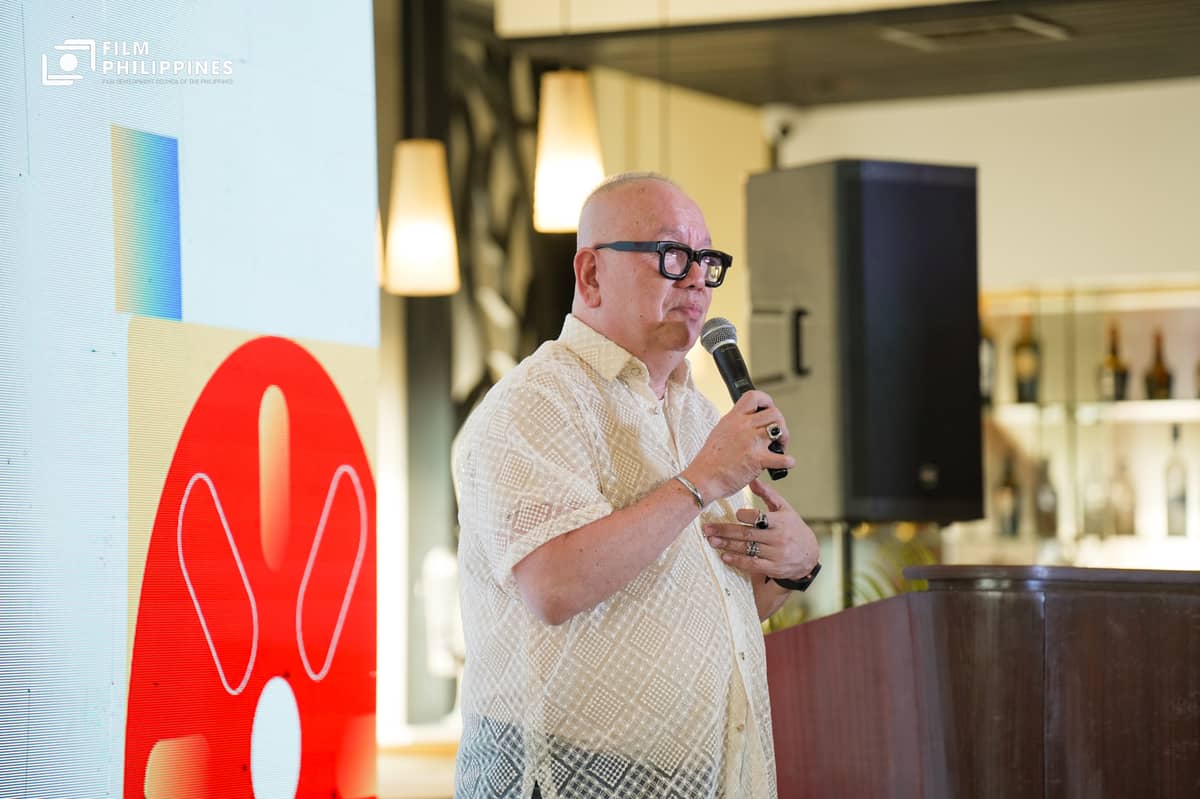
FDCP Chair Jose Javier Reyes speaks during an international co-production session in Intramuros on 25 November, urging Filipino filmmakers to expand beyond the local market.
Clout at the global table
Teaming up with foreign partners means splitting budgets, sharing crews, and unlocking global markets. FUSEE founder and former FDCP executive director Will Fredo Manalang, who executive produced the Japan-France-Philippines co-production Plan 75 alongside Blue Room, says even a small government grant gives your pitch instant clout.
“For me, actually, sometimes I say this a lot because it's important for the other countries to know that your government is supporting you,” Manalang said. “Because ibig sabihin, you're not the only one believing in your project. There's your government actually believing in your project.”
Balbuena added that state backing keeps local producers from getting sidelined on their own stories. “It's empowering producers. Now we have a bigger stake in the pie. Now we can make decisions,” she said. Other government agencies can also back international campaigns and distribution after wrap, which is crucial when an Oscar campaign alone can burn through millions of dollars.
Even when a Pinoy producer holds the smaller slice of a foreign-led movie, Daluyong Studios producer Alemberg Ang (Plan 75, Renoir) notes that local cinematographers, editors, and sound crews get to work on international sets and bring new workflows home. Under FDCP supervision, the Film Philippines Office helps connect foreign producers with local crews and clears government permits for shoots and post-production here.

Daluyong Studios producer Alemberg Ang.
Secure the bag
The FDCP’s upgraded International Co-Production Fund, or ICOF, offers non-recoupable grants—meaning qualified recipients do not have to pay the grant itself back.
Under the Minority Track, holding at least 10 percent equity unlocks up to ₱7 million for features and series, or ₱3 million for documentaries and shorts. Under the Majority Track, holding the highest share at a minimum of 20 percent raises the ceiling to ₱13 million for features and series, or ₱5 million for documentaries and shorts.
Eligible ASEAN co-productions can score a ₱1 million bonus, while projects that pass the cultural test can get up to ₱2 million extra for features and series, or ₱1 million for documentaries and shorts. Both tracks require Filipino talent in key creative or technical roles plus a solid distribution plan covering international release for minority projects, and both local and global releases for majority ones.
Meanwhile, the Film Philippines Office runs the Film Location Incentive Program, offering cash rebates to foreign projects that hire local companies for line production, animation, or post-production. Executive director Joierie Ann Pacumio said inquiries are already coming in from Europe, the U.S., Australia, and Japan. “Based on benchmarking with our regional neighbors, the Philippines really has the strongest co-production support offered in the region,” Pacumio said.

Joierie Ann Pacumio, executive director of the Film Philippines Office, discusses the Philippines’ co-production support and incentives for international film projects.
Do the boring stuff
Free grants still require serious paperwork. Reyes admitted the requirements are heavy because FDCP has to account for public funds to the Commission on Audit. “There are a lot of requirements, admittedly, and that's not necessarily a caprice of FDCP,” he said. “Because we are part of a government agency, we're also answerable to other government agencies, including the Commission on Audit.”
Still, you do not need a big studio logo to win. “There are a lot of independent producers who can get grants,” Reyes said, noting some major studios have not received funding. “Right now, whether you're a big studio or an independent producer, we all need help.”
Dodging the budget axe
Balbuena’s urgency makes even more sense given what the agency is up against. Cultural agencies are taking a hit from steep budget cuts, sending Reyes to the Senate to pitch for more money with help from Senator Robin Padilla while two senators prepare to interpellate.
“Well, on Friday, I’m going to do a song-and-dance number in front of the Senate, OK,” Reyes said in an ambush interview after the session. “Because there has been a major budget slash on all cultural agencies. And understandably so because of the present economic and world condition, hindi ba?”
Reyes laid out three priorities that need funding: more grants so Filipinos can invest in foreign co-productions and grow the local economy, film preservation, and film education. “We cannot upgrade the quality of our products if we do not have the facility to improve education,” he said.
Why the hustle pays
In a country where people struggle with food, healthcare, transit, education, and housing, spending public money on movies always draws side-eye. Cinema does not replace basic needs, though Article XIV of the Constitution mandates the state to support arts and preserve cultural heritage.
Film shoots also create real jobs for drivers, caterers, carpenters, makeup artists, location teams, and post-production houses while bringing foreign spending into the country. Preliminary Philippine Statistics Authority data shows the broader creative economy accounted for 7.6 percent of GDP in 2025 and employed 8.71 million people, and FDCP is teaming up with the British Council to measure the film sector's exact economic impact.
Beyond money, movies archive Filipino languages, communities, and real life for future generations. Reyes wants local cinema to outgrow its current market, while Balbuena’s advice remains urgent: “Do your films now.”