
Trump touts 'biggest' trade deal with Philippines, but details remain unclear
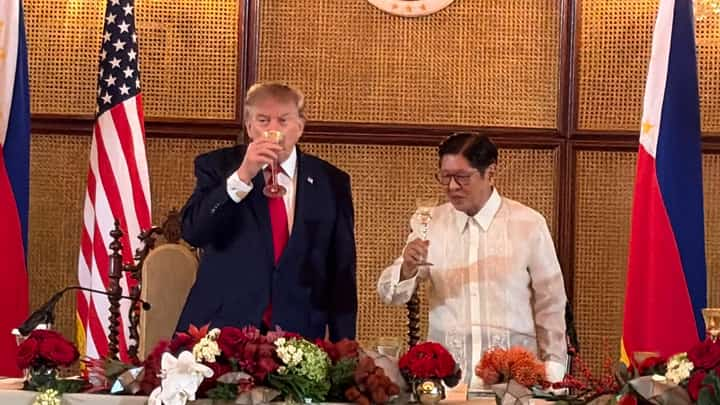
The Philippines and the United States have reached an understanding on key areas of economic cooperation, particularly energy and food security, following bilateral talks between President Ferdinand Marcos Jr. and U.S. President Donald Trump at Malacañang on Wednesday, 18 November.
Trump announced what he described as a major trade deal during his state visit, although neither government immediately disclosed the agreement's value, terms or implementation timetable.
“And we've just consummated a very big trade deal, the biggest trade deal we've ever made by far. And it's a fair deal for both countries, and we're very happy with it. And we didn't know that that was going to take place, but it took place very quickly, and it's a magnificent deal for both,” Trump said in a speech.
“So today, under the leadership of President Marcos and myself, I'm proud to say that we're making the alliance between the United States and the Philippines much stronger than it's ever been before, especially with the consummation of this deal,” he added.
Philippine Ambassador to the United States Jose Manuel Romualdez clarified that the discussions centered on cooperation to diversify the country's food and energy supplies.
“The US offered for us to diversify our food supply and energy requirements,” Romualdez said.
Malacañang characterized the outcome as an understanding on economic cooperation rather than a finalized trade agreement.
The Palace said representatives from both countries would continue negotiations to translate the commitments into specific projects and initiatives.
“Moving forward, trade representatives from both countries will work closely to translate these commitments into concrete initiatives that will strengthen bilateral trade, enhance supply security, and deliver long-term economic benefits for both nations,” Malacañang said.
The discussions also covered nuclear energy, defense and military cooperation, alongside efforts to strengthen bilateral trade and investment.
The talks came amid concerns over U.S. tariffs imposed on Philippine exports.
In July, Washington imposed additional tariffs of 12.5 percent on covered Philippine products following an investigation into the country's policies on prohibiting imports produced using forced labor.
Trade Secretary Cristina Roque had earlier expressed interest in discussing the tariff issue with her U.S. counterparts during the bilateral meeting.
However, neither government immediately confirmed whether the latest understanding would affect the existing tariff measures.
Trump's characterization of the agreement as the biggest trade deal ever made also remained unsubstantiated by publicly disclosed figures.
Marcos heads to China for APEC
Following his meeting with Trump, Marcos departed for Shenzhen, Guangdong province, China, to attend the 33rd Asia-Pacific Economic Cooperation (APEC) Economic Leaders' Meeting.
In his departure message, Marcos said the Philippines would seek to expand market access for Filipino products and talent, accelerate digital transformation and attract investments that generate quality employment.
He also emphasized the importance of constructive engagement with China while protecting Philippine interests.
“On the sidelines, I look forward to meeting fellow leaders and engaging with the business community to deepen trade ties and attract investment. We will engage China constructively on expanding trade, investment, and people-to-people exchanges that benefit our peoples, even as we remain steadfast in upholding our national interest,” Marcos said in a video message.
“Our message is clear: the Philippines is open for business. Invest in the Filipino. I am confident that our participation in Shenzhen will produce concrete outcomes that bring us closer to that goal,” he added.
APEC represents approximately 37 percent of the world's population, 61 percent of global gross domestic product and 46 percent of global trade in goods and commercial services.
The region's economies are projected to grow by 3.4 percent in 2026, supported partly by investments in digital technologies and artificial intelligence.
Marcos said the Philippines would use the regional gathering to deepen economic partnerships, strengthen trade ties and promote the country as an investment destination.