
Marcos sees 1M Filipinos in Canada as bridge to stronger trade, security ties
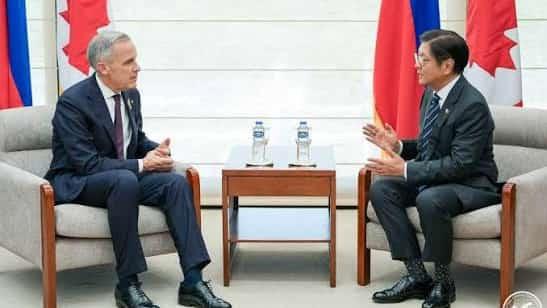
President Ferdinand Marcos Jr. is counting on the nearly one million Filipinos living in Canada to help strengthen bilateral relations as Manila and Ottawa expand cooperation in trade, investments, employment and maritime security.
During his recent bilateral meeting with Canadian Prime Minister Mark Carney, Marcos emphasized the Filipino community's role in advancing the Philippines-Canada Strategic Partnership, which was established on 2 July 2026.
"Our strong people-to-people ties, particularly the nearly one million Filipinos in Canada, remain a vital foundation of our partnership and a new bridge between our two countries," Marcos said.
Carney also acknowledged the contributions of Filipino Canadians to the country's economy and society, describing the community as a "driver of all that's good in Canada."
Filipinos constitute one of Canada's largest immigrant communities, with significant representation in health care, technology, skilled trades and service industries.
Both leaders consider these people-to-people connections a foundation for expanding economic cooperation and strengthening diplomatic relations.
Free trade negotiations concluded
The two countries have taken a major step toward deeper economic integration after concluding negotiations for the proposed Philippines-Canada Free Trade Agreement (FTA) on 14 November.
The announcement followed a bilateral meeting between Marcos and Carney on the sidelines of the 49th ASEAN Summit and Related Summits in Metro Manila.
The negotiations, which were already more than 90 percent complete in September, have now been finalized, although the agreement still requires signing and implementation.
Once implemented, the FTA is expected to improve market access, encourage investments and expand commercial opportunities for businesses in both countries.
The Philippines sees potential investments in agricultural logistics, infrastructure and supply chains, which could improve the movement of agricultural products from farms to markets and generate employment.
Canadian companies earlier pledged approximately US$2.5 billion in investments during Marcos' visit to Canada in July.
Ottawa also committed an initial C$2 million to support projects aligned with the Luzon Economic Corridor, particularly infrastructure, supply chains and clean energy development.
Canadian Minister of International Trade Maninder Sidhu has emphasized Canada's capacity to support Philippine development priorities, including digital infrastructure, critical minerals and energy technologies.
Speaking at the ASEAN Business and Investment Forum, Sidhu highlighted opportunities for collaboration in advanced data centers, semiconductor supply chains and small modular nuclear reactors.
"Data centers are the factory of the 21st century, and this region is building them at remarkable speeds. Canada knows how to build them," Sidhu told business leaders.
These areas could support the Philippines' digital transformation and efforts to attract technology-related investments.
Maritime security cooperation
Beyond economic ties, the strategic partnership also seeks to strengthen maritime security and defense cooperation amid evolving security challenges in the Indo-Pacific.
Canada has committed to extending the Philippines' access to its Dark Vessel Detection (DVD) program until 2033.
The technology helps authorities identify and monitor vessels that may be operating without conventional tracking systems, supporting efforts to combat illegal, unreported and unregulated fishing.
The two countries have also expanded cooperation in energy, labor mobility, tourism and cultural exchanges.
During the ASEAN Summit, Canada announced additional assistance worth C$26 million for initiatives involving nuclear safety and security, climate-resilient agriculture, community resilience, food security and infrastructure.
The commitments reflect both governments' efforts to translate their strategic partnership into projects supporting economic development and regional security.
Bilateral merchandise trade reached C$3.4 billion in 2025, underscoring the commercial significance of the relationship.
"In a world of uncertainty, trust has become the scarcest resource in the global economy, and Canada has that in surplus," Sidhu said.
With negotiations for a bilateral free trade agreement concluded and cooperation expanding across several sectors, Manila and Ottawa are seeking to build on their longstanding relationship.
For Marcos, the Filipino community in Canada remains central to that effort, providing a strong foundation for closer economic, diplomatic and security ties between the two countries.