
No green thumb
The sector’s average daily basic pay is P395, compared with the national average of P714, while poverty among farmers sits near 27 percent, and among fisherfolk at 27.4 percent.
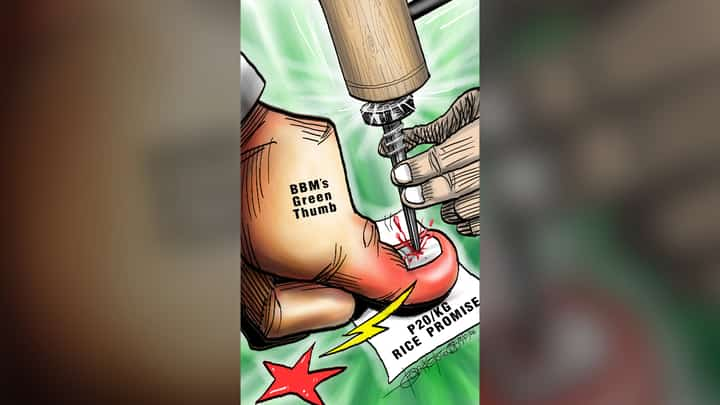
When Ferdinand Marcos Jr. took over as head of the Department of Agriculture (DA) in 2022, he promised to boost production and lower farm product prices.
It was a sweeping promise. By placing the agency responsible for a chronically underperforming sector under his direct supervision, the President left little room for shifting the blame elsewhere.
Four years later, the results appear to have fallen short of that pledge.
An infographic by think tank IBON Foundation illustrates the sector’s declining share of the economy. Agriculture’s contribution to the gross domestic product (GDP) fell from 8.9 percent in the first half of 2022 to 7.8 percent in the same period of 2026. Crop production shrank by five percent and fisheries by 6.7 percent. IBON counted 1.3-million jobs lost in agriculture, forestry, and fisheries since 2022.
The sector’s average daily basic pay is P395, compared with the national average of P714, while poverty among farmers sits near 27 percent and among fisherfolk at 27.4 percent.
The farmgate price of palay reflects an unpredictable market. Ibon put it at P17.06 in September 2022, P22.43 in 2024, and P15.60 in 2025.
Thus, a farmer who planted at the 2024 price and harvested in 2025 lost a third of his income in one season. No one can plan a planting in that kind of environment.
The official numbers, of course, are less grim than IBON’s. The Philippine Statistics Authority reported that farm output grew 2.9 percent in the second quarter, reversing a 0.3-percent contraction in the first quarter, with palay output at a record 4.63-million metric tons.
In the first six months, output rose 1.3 percent, slower than the four percent in the same period in 2025.
The DA expects fertilizer prices, driven up by the Middle East conflict and a prolonged dry spell, to weigh on output from the fourth quarter into next year.
Thus, a sector that depends on good weather to post a respectable quarter has not been fixed; it has only been lucky.
Then there is smuggling, the crime Marcos tagged his enemy from the start. In 2023, he said that shortages and rising prices were due partly to the “nefarious acts of smuggling.” He distributed confiscated rice to the poor and promised to hunt the importers. He said hoarders would not get away with it — but they did.
Congress passed the Anti-Agricultural Economic Sabotage Law, and the government promised to target the entire supply chain.
In July 2025, Customs held 59 container vans at Subic suspected of carrying smuggled onions and fish — which Marcos said was carried out by misdeclaring cargo as processed food.
Weeks later, 13 vans of onions and carrots shipped from China sat rotting at the ports. Authorities seized the goods, but they did not name the people behind them.
The smuggling rings were likened to Philippine Overseas Gaming Operators (POGO) which had foreign bosses and Filipino accomplices within the government. Like the online gambling racket, not one smuggler has been jailed. The farmers’ group KMP put it more bluntly: the government knows who the masterminds are but is not acting decisively to catch them.
The government’s remedies reflect the same pattern. After the President acknowledged that the rice import ban had little effect on retail prices and supply but significantly affected palay farmgate prices, the government extended the 2025 import ban through year-end.
The policy suggested that imports could be restrained to support farmgate prices without significantly hurting consumers. But the broader question remains whether such measures can address the structural problems plaguing agriculture.
For two years, Marcos served as both President and agriculture secretary. The DA had every advantage a government agency could hope for, including a direct line to the country’s highest office. Yet smuggling persisted, prices fluctuated, and farmers continued to struggle.
The numbers cannot explain how a President comes to terms with a failure for which he bears direct responsibility.
Perhaps he will understand when the people who work the land stop believing the next promise.