
DOJ brings justice services closer to communities
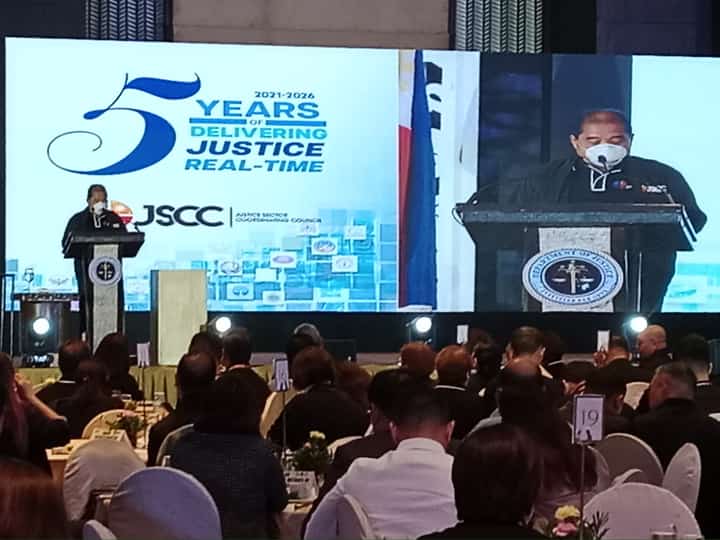
Justice Undersecretary Raul Vasquez read the message of Justice Secretary Frederick Vida during the two-day Justice Sector Coordinating Council (JSCC) on Monday at Manila Hotel. Alvin Murcia
The Department of Justice strengthens programs to bring justice services closer to communities as government agencies moved for greater coordination in delivering justice at the grassroots level, Justice Secretary Fredderick Vida said Monday.
The staterment was made by Vida during the two-day Justice Sector Coordinating Council (JSCC) Summit in Manila, where the Supreme Court, DOJ, Department of the Interior and Local Government and other justice-sector stakeholders are assessing efforts to improve coordination, cooperation and communication in the justice system.
The summit, which runs from 21 to 22 Sept., highlighted the accomplishments of the country's 20 Justice Zones, where justice-sector agencies and other government institutions work together on programs addressing local justice concerns.
The DOJ was pursuing initiatives intended to make its services more accessible to people at the community level.
“This is similar in essence to what we, the DOJ, are doing, and that is to bring justice to the ground level and make access to justice much easier,” Vida said in his message read by Undersecretary Raul Vasquez.
The department and its attached agencies were working to ensure that people could access government justice services without having to rely solely on central offices.
The DOJ has also regionalized its Action Center, which handles complaints, requests for legal assistance and queries from walk-in and telephone clients. Regional DOJ Action Centers are staffed by personnel from the National Prosecution Service and the Public Attorney's Office.
The remarks of Vida complement the JSCC's broader effort to strengthen coordination among institutions whose mandates are separate but interconnected.
The DOJ has described its justice-sector reform agenda as focused on delivering “real justice for all, in real time,” including reforms intended to modernize the justice system and bring services directly to communities.
The JSCC itself recognizes that justice-sector institutions remain independent and have distinct mandates but also have interdependent functions and shared interests that require a coordinated approach to justice-sector policy, planning and operations.
It T also provides a venue to assess the Justice Zones, which are designed to translate such inter-agency coordination into services at the local level.
Bringing justice to the ground level was an important part of the DOJ's responsibility to the public, said Vida.
The initiative comes as the justice sector continues to pursue reforms aimed at reducing delays and making government legal services more accessible to Filipinos, particularly those who encounter the justice system at the local level.
The two-day summit is led by Chief Justice Alexander Gesmundo, Vida and DILG Secretary Juanito Victor “Jonvic” Remulla, together with justice-sector stakeholders.