
Review: 'Mapanakit!' wears its heart on its sleeve
YPC Stage’s maiden production showcases lively performances and Biñan talent, even as its melodramatic writing leaves little room for subtlety.


Note: Seen at its opening matinee on 25 July.
There are many ways to be hurt by love.
In Mapanakit! Mga Dulang Bittersweet, the maiden production of Biñan-based YPC Stage, directed by BJ Borja, heartbreak takes three different forms: a relationship complicated by a teacher-student dynamic, a love forbidden by the boundaries of two distinct communities, and a romantic entanglement in which love collides with responsibility.
Staged in the intimate black box theater of IBG KAL Theater at UP Diliman, Mapanakit! brings together three one-act plays, all written by Eljay Castro Deldoc. It also puts recognizable theater performers such as Phi Palmos, Gab Pangilinan, Kokoy de Santos, and Ross Pesigan alongside talent from Biñan—a worthwhile way for an emerging theater company to introduce its local performers to a wider audience.
And the performers are, to a person, competent. In fact, the production’s greatest strength is often its actors, who keep the evening lively even when the material itself does not always offer enough depth.
"Ang Liknayan ng Ating mga Katawan"
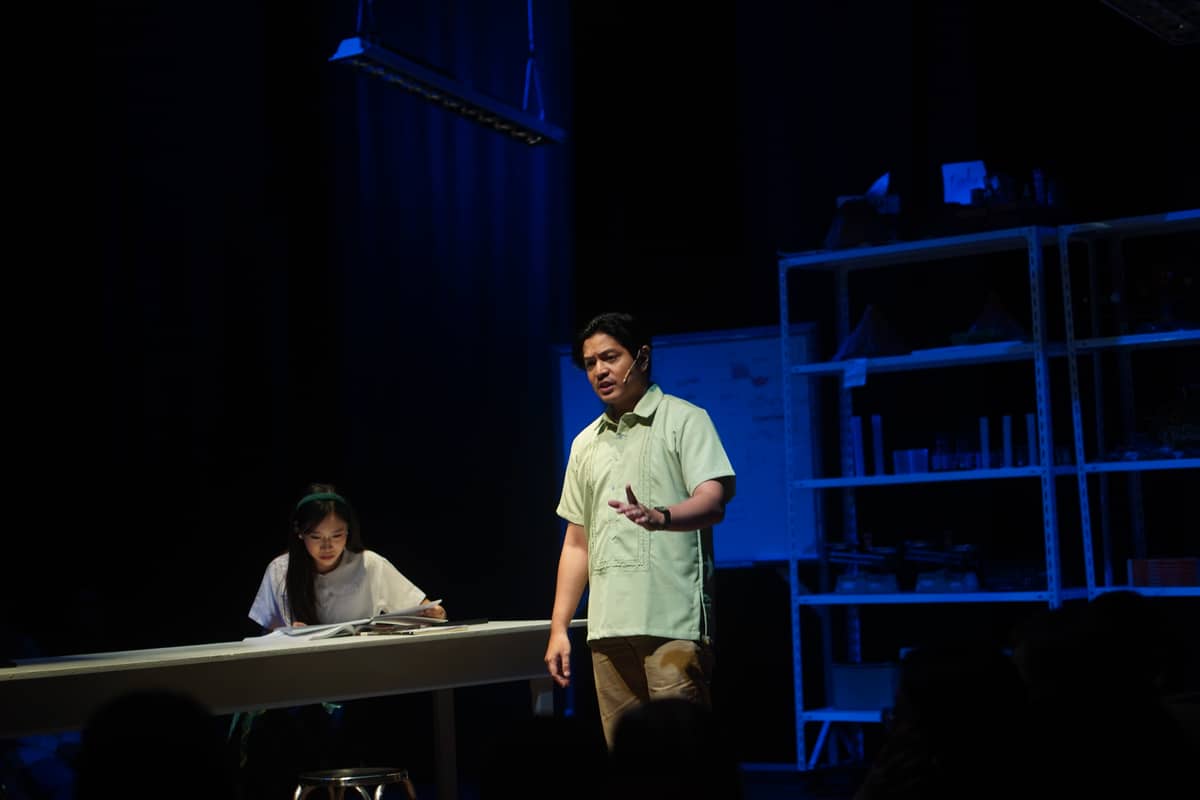
Ang Liknayan ng Ating mga Katawan.
The first play centers on a student-teacher relationship (Jury Sanchez, Pesigan). There is something inherently unsettling about the premise, and the play takes a while before it gains momentum. Its treatment of the relationship is also excessively hysterical and melodramatic, with emotions often pushed to the foreground rather than allowed to develop more naturally.
The premise itself is disturbing enough without requiring quite so much emotional amplification. Still, the situation has a certain uncomfortable relevance: relationships that cross boundaries are unfortunate realities that happen.
"Ilihan at Kalingaw: Ang Lihim na Istorya ng mga Buringkantada"
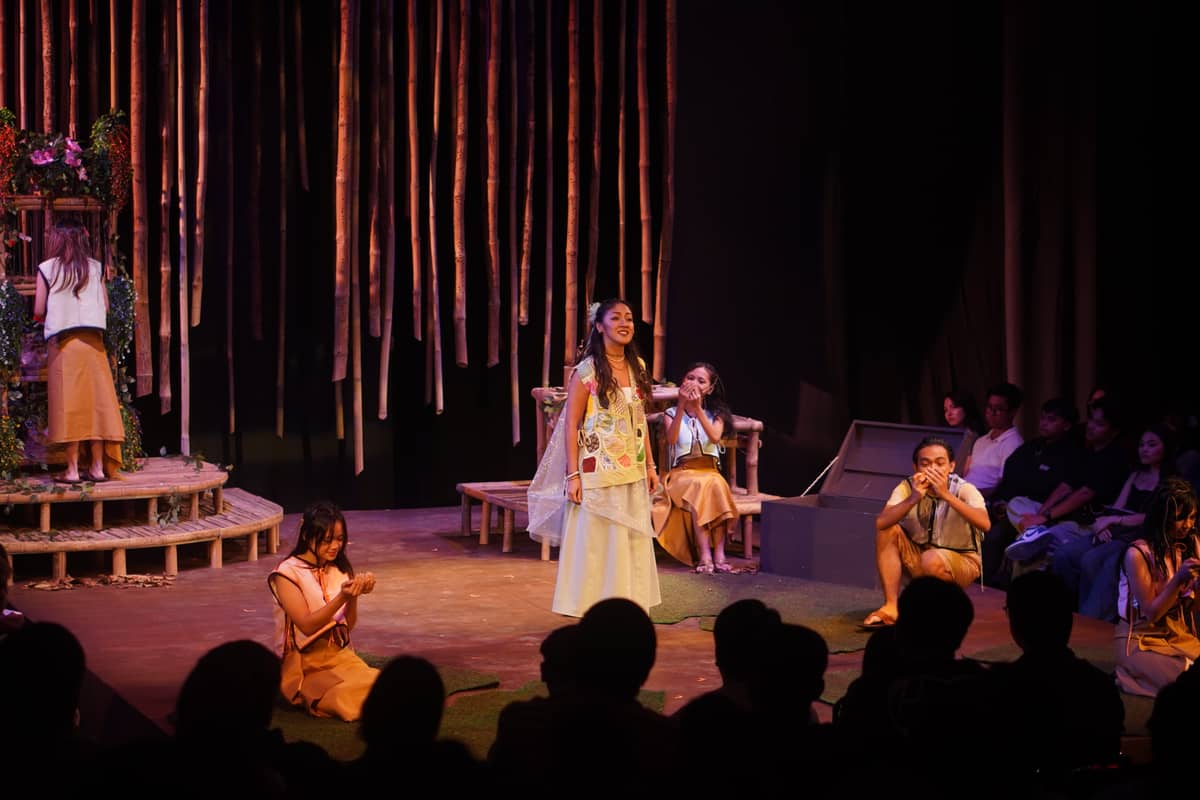
Ilihan at Kalingaw.
The second play takes a considerably more fantastical route. Written with an archaic, poetic quality, it revolves around forbidden love between two figures (Euden Moje, Pangilinan).
Its mythical setting distances it from the everyday world of the other plays, but its central conflict remains recognizable: the desire to love someone whom tradition, community or an established worldview says one should not love.
That makes the play’s fantasy applicable beyond its own world. Its conflict can evoke contemporary situations in which relationships are challenged by differences in religion, culture or deeply held beliefs.
Of the three, this is also the prettiest piece in terms of its theatrical presentation. The compact staging makes the most of the black-box space, creating a world that feels suitably removed from ordinary reality.
Pangilinan’s delivery, though, is particularly difficult to connect with. Her diction can sometimes sound as though she has a piece of candy in her mouth, making some lines difficult to catch, while her voice lacks the projection and resonance expected in a theatrical performance.
"Ganito ang Pinangarap Kong Kasal"
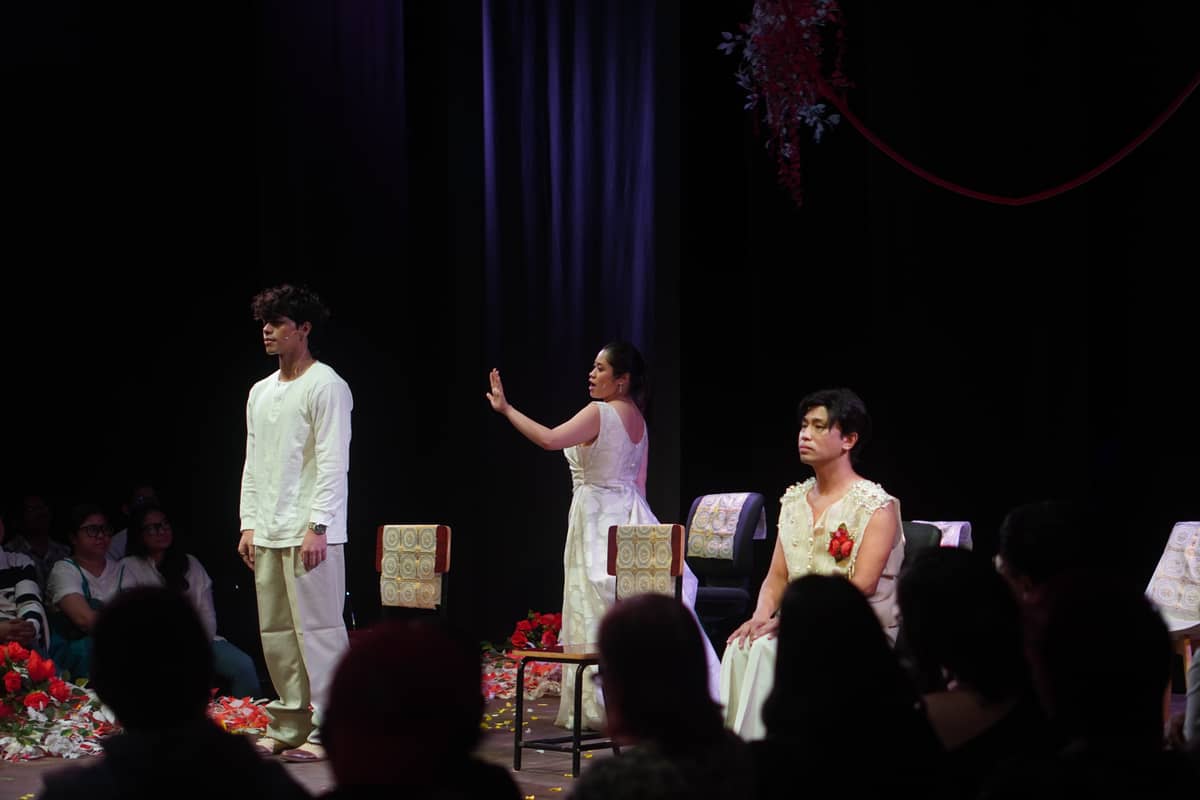
Ganito ang Pinangarap Kong Kasal
The third play centers on a complicated love triangle involving friendship, queer love and a heterosexual attraction (Palmos, de Santos, Loudette Barias), eventually forcing its characters to confront questions of love, responsibility and the expectations that come with them.
The problem is not simply that the situation is complicated. Complication can make for good drama. The problem is that the conflict does not feel sufficiently convincing.
The play introduces a contemporary queer relationship, but the dramatic direction it eventually takes feels oddly conventional. It raises questions about whether responsibility necessarily has to conform to traditional expectations, but the writing does not sufficiently interrogate those expectations or make the resulting dilemma feel organically earned.
As a result, the central conflict feels weak. The emotional stakes are there, but the writing does not fully persuade us why the characters must arrive at the choices placed before them. Phi Palmos stands out for his comedic timing, which gives his scenes a particularly lively energy.
Overall
Overall, although not all of them are equally effective, all the scenes are particularly lively. The ensemble keeps the pieces moving and prevents their more obvious emotional beats from becoming inert. The performances provide the kind of immediacy that the writing itself sometimes lacks. There is rarely a dull moment, but much of that credit goes to the performers.
This is also where the limitations of Mapanakit! as a collection become apparent. Deldoc’s plays are intentionally direct and accessible. Their characters express their feelings plainly, and their conflicts are readily understood. There is little ambiguity about what the characters want, what hurts them or what stands in the way. Everything is melodramatic here, but the evening remains engaging.
That accessibility can certainly be a virtue, particularly for audiences who want an immediate and emotionally recognizable theatrical experience. But for viewers looking for greater subtlety, subtext or thematic complexity, the plays can feel too straightforward. The ideas are often presented directly rather than allowed to transpire beneath the dialogue.
That may make Mapanakit! more immediately accessible to a mass audience, but it also limits how deeply the plays linger.
Final Show Date: 9 August 2026 (Shows at 2:00 PM and 7:00 PM), IBG-KAL Theater, UP Diliman.