
BCDA meeting with Capas LGU on Pax Silica ‘smooth’ — Palace

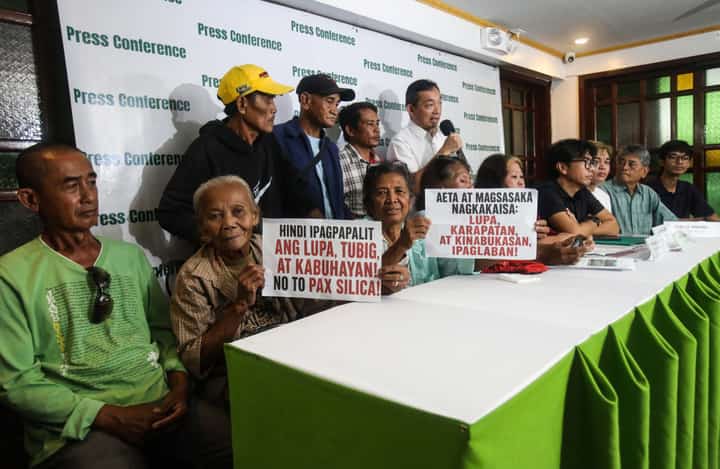
Indigenous Aeta leaders and farmers from Capas, Tarlac speak during a press conference with petitioners and environmental advocates at Kamuning Bakery Cafe in Quezon City on Thursday, 6 August 2026. They are calling for the cancellation of the controversial Pax Silica project, citing its alleged impact on indigenous communities, farmlands and the environment.
ANALY LABOR
Bases Conversion and Development Authority (BCDA) officials said it met with the local government of Capas, Tarlac on Wednesday to iron out differences and issues hounding the project.
“The Bases Conversion and Development Authority on Wednesday, 5 August, met with the municipal government of Capas, led by Mayor Roseller Rodriguez, to continue discussions on the vision for the proposed Pax Silica innovation ecosystem in New Clark City, Tarlac, and the initiatives meant to support its balanced and responsible development for the environment and for the benefit of local communities,” the BCDA statement said.
The statement was read by Palace Press Officer and Presidential Communications Office Undersecretary Claire Castro during a press briefing on Thursday.
At the said meeting, Castro said the BCDA outlined how the proposed hub can attract advanced industries and high-value investment to New Clark City while creating quality jobs and new opportunities for local businesses.
“The state-run firm also presented plans for modern agriculture projects and livelihood initiatives that will benefit residents and farmers within New Clark City,” she said.
Welcomed the innovation hub’s job generation potentials
Further, Castro said the municipal government of Capas expressed its appreciation for BCDA’s plans and welcomed the innovation hubs’ potential to generate long-term economic opportunities and improve the lives of Capaseños through sustainable and inclusive development.
“BCDA and the Capas LGU also agreed to continuously pursue joint activities to engage barangays and local communities, provide updates as plans progress, and help residents better understand the proposed development and its potential benefits for Capas,” according to Castro.
“Moving forward, BCDA and the Capas LGU will continue working closely in conducting community consultations and promoting a balanced and responsible approach to the project’s development, ensuring that its benefits translate into lasting opportunities for Capaseños,” she added.
Opposition
On Tuesday, Aeta chieftain Petroniza Capriz-Muñoz of Sitio Sapang Kawayan and farmers from nearby communities in the municipality of Capas aired their grievances and opposition to the proposed Pax Silica project and to publicly reaffirm the defense of their ancestral domain.
“We walked and came here to reveal to the whole world that we will stand by our land because the evidence we have shown us how important our mountains are,” Capriz-Muñoz said in a press conference in Quezon City.
“Many projects have already been built in our community, and we have spoken many times with the BCDA. We have also been coordinating with the NCIP. So why, despite this major problem, are the BCDA and the NCIP allowing the Pax Silica project in our ancestral domain?” the indigenous leader added.
Muñoz then appealed to President Ferdinand Marcos Jr. to listen to the voices of the Indigenous Peoples, saying that the land belongs to them and not to other nations.
The IP leader revealed that burial grounds of Aetas would be affected by the proposed Pax Silica hub, noting that the BCDA was aware that portions of the project site would cover the community's ancestral domain.
Threat to freshwater sources
A farmer from Barangay Sta. Lucia in Capas, Tarlac, said their community has abundant sources of clean water, including a river where residents bring their livestock to drink and deep wells that provide potable water for household use.
“In our barangay, we have good water sources there, such as our river, which has very clear water. That is where we bring the animals we raise to let them drink,” Miriam Ventura said.
“The water from the pumps we use for drinking is really very good,” the farmer added.
She, however, questioned what would happen to the community's clean water sources if the proposed Pax Silica project proceeds, noting that the rivers and deep wells are their primary sources of clean and fresh water.
The farmer confirmed in an ambush interview with DAILY TRIBUNE that aside from Aetas, other indigenous groups also opposed the Pax Silica.
Meanwhile, an Aeta senior who attended the press conference said she cultivates hectares of land in Sitio Sapang Kawayan, Barangay Aranguren in Capas, with vegetables, rice, sweet potato, chili, corn, and peanuts, while another farmer from Sitio Binyayan, Barangay O'Donnell said he primarily plants bananas.
Strongly opposed
Ernesto Cabieza strongly opposed the proposed Pax Silica project, saying it would affect the Aeta community, other Indigenous Peoples, and the area's natural resources.
“There is a [municipal] mayor and a [barangay] captain. They should go through them first before coming to us,” the farmer said, pointing out that the proposed project must initially consult local government officials before the affected groups and communities.