
Review: 'The Odyssey' — IMAX vs. regular screen
How the film changes when stripped of the IMAX experience.


I rewatched The Odyssey last night—this time on a regular screen. Not as Nolan intended.
My first viewing was on IMAX (see my review here), seated at the perfect distance from the giant screen. While my overall review remains generally the same, I noticed several things on a second viewing.
But here's the surprise: no theater in the Philippines can currently present The Odyssey exactly as Christopher Nolan intended. Nolan shot the film entirely on IMAX 70mm (15-perf) cameras for projection on a full-height 1.43:1 IMAX screen.
Philippine IMAX theaters use digital laser projection and generally present the film at 1.90:1—still larger than a standard widescreen presentation, but not the full IMAX image. If you truly want to experience The Odyssey as Nolan intended, your nearest option is IMAX Melbourne in Australia, one of the few theaters in the world still equipped to project IMAX 70mm film.
Even SM Mall of Asia's IMAX, the biggest in the country, projects digitally at a maximum aspect ratio of 1.90:1 rather than Nolan's preferred 1.43:1 IMAX 70mm presentation.
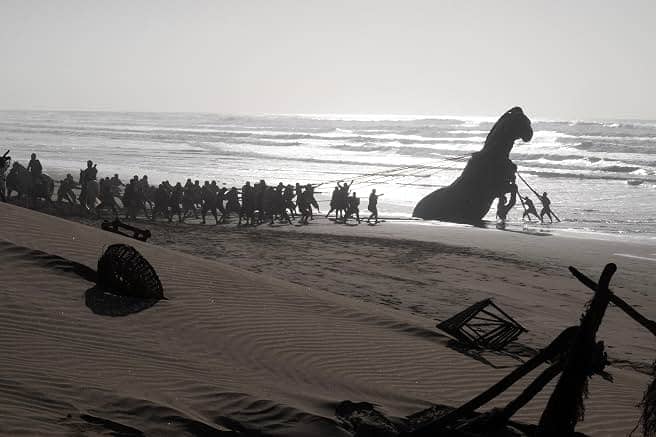
On a regular cinema screen, the film loses the vastness of its locations. The television feel is heightened. I also became more aware of the crude editing and abrupt transitions—they felt rushed. The inconsistent, rough pull focus, which was already noticeable on IMAX, is less distracting in a smaller cinema screen.
Nolan's experimental editing process
As reported by CBS, Nolan and editor Jennifer Lame first assembled the film by editing high-resolution scans of the IMAX footage on a computer. Once the movie reached picture lock, they generated an Edit Decision List (EDL)—a text document listing every cut, clip, timecode, and transition needed to recreate the final film.
Only then was the original IMAX camera negative physically cut and spliced by hand at FotoKem. Nolan explained that every cut in the finished film is literally glued together by hand.
I wonder if this experimental process contributed to the film's technically rough-around-the-edges feel. It convinced me this won't make the Oscar nomination.
The IMAX cameras—and the score
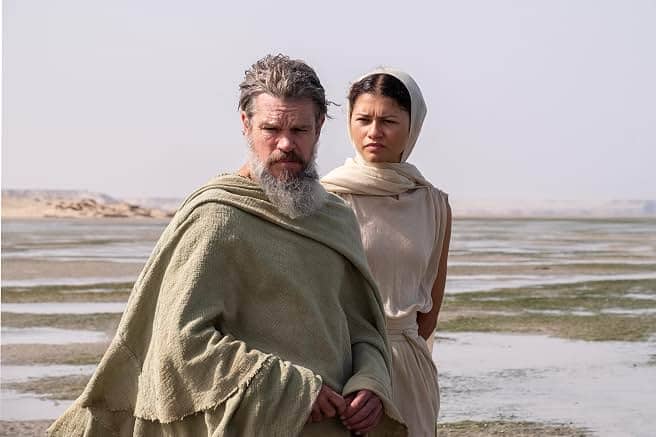
Nolan also became even more technically experimental here, shooting entirely on the new 70-kilogram IMAX cameras under Hoyte van Hoytema.
The original IMAX cameras were notoriously loud—Matt Damon compared them to "a sewing machine in a fight with a stapler." Nolan eventually asked IMAX to redesign the camera, reducing the noise to what he described as a "gentle purr."
I highly suspect that "gentle purr" was still affecting dialogue scenes, and Nolan compensated by filling almost every scene with Ludwig Göransson's score.
I am in love with Göransson's music—an experimental, percussion-driven soundscape that blends reconstructed ancient Greek instruments, bronze percussion, synthesizers, and expressive vocals into an immersive musical world unlike a traditional orchestral epic.
But the score is inserted into practically every scene. On my second viewing, it became almost relentless and exhausting.
Combined with the snappy editing, with nearly every sequence building toward a crescendo, it reinforced my original impression that the film feels fragmented and episodic. Yes, Homer's epic poem is episodic. But this is cinema, and I was expecting a more unified cinematic experience.
A blockbuster first
Released during the summer, and very much an experiment in Nolan's evolving craftsmanship, this remains, as I said in my original review, a blockbuster.
Today, news reports also covered Emily Wilson's angry reaction to the film. Wilson is the acclaimed 2017 translator of The Odyssey.
While I agree that Odysseus lacks the deeper internal agony I mentioned in my first review, this is clearly a blockbuster—a superhero movie, in many ways.
Combined with Nolan's plainspoken dialogue, the characters sometimes drift toward soap opera. Still, Matt Damon's physical presence and those wise eyes compensate for the relatively shallow characterization.
Still unmistakably Nolan
I also sensed a great deal of The Dark Knight's visual language here, although Christian Bale's Batman possesses far more psychological complexity than Nolan's version of Odysseus.
Nolan, as we all know, is an auteur blockbuster filmmaker. He is still a commercial, mainstream director making films for wide audiences, but with a distinct artistic identity—most famously his preference for practical filmmaking over CGI.
He makes high-concept mainstream cinema. Mainstream nonetheless.
His films are designed to entertain, and The Odyssey is entertaining despite feeling unpolished. It certainly helps that the cast is immensely attractive. And yes, I agree with the casting of Lupita Nyong'o as Helen of Troy.
He's not a pure blockbuster filmmaker like Michael Bay or Zack Snyder. But he's also not an art-house director in the tradition of Michael Haneke or Apichatpong Weerasethakul.
Would I adjust my rating? No.
It's still 3.5 out of 5 stars for me.