
Beyond the realm of politics
The SC has primary jurisdiction to determine ‘whether our national laws were observed in effecting the arrest and surrender’ of Duterte.
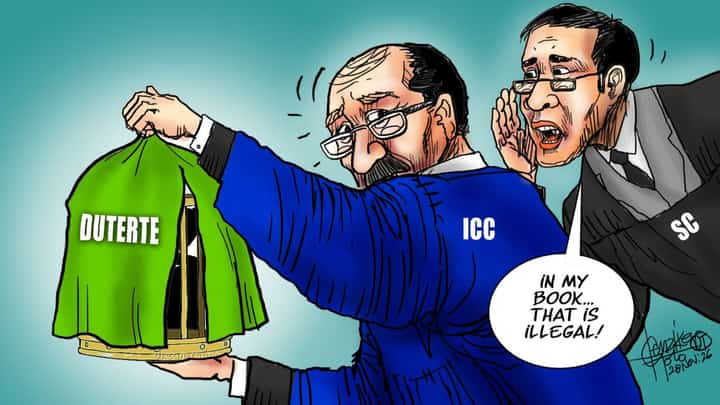
The International Criminal Court (ICC) opens the crimes against humanity trial of former President Rodrigo Duterte on Monday, which places the spotlight on the Supreme Court’s recent dismissal of the habeas corpus petitions on his behalf and the dissenting opinions of several magistrates.
Associate Justice Henri Jean Paul B. Inting, in his dissent, argued that Philippine courts must still determine whether Duterte’s arrest complied with domestic law, stressing that the issue was legal rather than purely political.
By declaring the petitions moot simply because Duterte was no longer in the country, the court of last resort left unresolved the central legal question raised by the petitions: whether his arrest and surrender complied with Philippine law.
Inting said a case is moot only when a ruling would have no practical use, which is not the situation in Duterte’s surrender to The Hague.
The SC can still decide, and should have decided, whether Duterte was validly arrested. If the arrest was illegal, the Court cannot order his release from The Hague. But it can still declare the arrest invalid.
Inting also warned about the implications of the moot ruling. He said a respondent in a habeas corpus case “could easily avoid litigation simply by delivering the detainee to a place beyond the court’s jurisdiction.”
Inting said the ICC itself leaves the question of the arrest procedure to Philippine authorities.
Under the Rome Statute, he said, arrests must follow the laws of the country where the person is held. That country’s courts are best positioned to apply those laws.
In his words, the SC has primary jurisdiction to determine “whether our national laws were observed in effecting the arrest and surrender” of Duterte. He added that the ICC “cannot be expected to have technical knowledge or expertise” in the Constitution and Philippine laws.
The ICC may still review a Philippine ruling, Inting noted. But its review would be limited. It would check only whether the ruling had a legal basis and was not arbitrary. Thus, he said, a Supreme Court ruling would carry great weight.
The magistrate also asserted that an SC ruling could matter when the trial begins. He pointed to the “abuse of process” doctrine, under which the ICC will stop a case if the accused was brought before it through serious violations of his rights.
The ICC’s own rulings link this doctrine to human rights, including freedom from arbitrary arrest.
Inting cited a British case in which a man was illegally taken from South Africa and the court refused to try him.
He said an invalid arrest in the Philippines “could taint the entire proceedings” before the ICC.
The SC’s findings may help the ICC decide whether the doctrine applies, he pointed out.
The government also argued that the decision to refer Duterte to the ICC was a political question and that the courts cannot review such questions, which Inting agreed with in part.
The President has wide power over foreign relations and over prosecuting crimes. The Court cannot tell the President to file a case. It also cannot stop the President from working with the ICC.
But that power has limits, as the Executive must still follow the Constitution and the law when it acts, and the High Tribunal can check that.
Another issue Inting delved into was the government’s claim that Duterte had expressed his willingness to face the ICC, which the associate justice rejected as proof that he had consented to his arrest and surrender.
He pointed out that Duterte filed his own petition on the day he was arrested, an action that, in Inting’s view, showed he had not voluntarily submitted to the authorities’ actions.
“Accordingly, I vote for the Supreme Court to resolve the issue of whether former President Rodrigo R. Duterte was validly arrested and detained by the Philippine authorities on 11 March 2025, when he was surrendered to the jurisdiction of the International Criminal Court,” Inting said.
Coming from a member of the High Court, such a forceful legal position deserves serious consideration and a substantive response.