
1.5 is virtually dead. What happens now?
Ours is an overheating planet. The heat will grow more frequent and severe. Storms will hit harder. Seas will keep rising. Poor countries will bear the brunt.
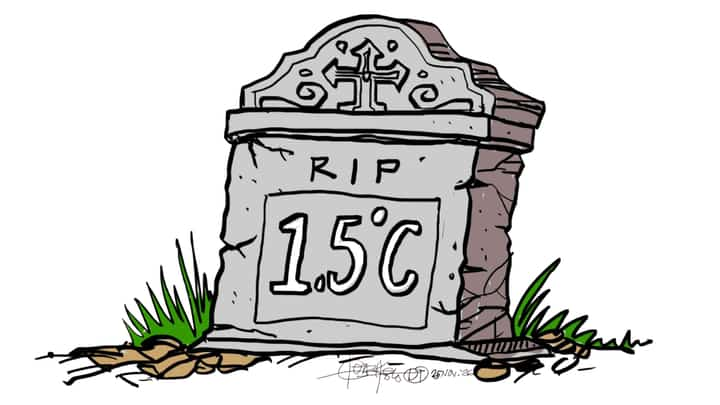
It was the climate movement’s unifying slogan for the past decade: “Keep 1.5 Alive,” referring to the main vision of the Paris climate agreement of 2015, with nearly all of the world’s states making a commitment to limit global warming to 1.5 degrees Celsius.
A decade after the objective was set, 1.5 was virtually in rigor mortis. Today, just 11 years after, 1.5 is effectively dead.
Scientists now say that without drastic efforts to reduce greenhouse gases, it is very likely that the planet will warm at least 2.6 degrees Celsius, or 4.7 degrees Fahrenheit, by the end of the century.
At COP31, the United Nations climate summit held in Antalya, Turkey, from 9 to 22 November, diplomats who spent so long championing the 1.5-degree target lamented the abrupt setback.
“The world has no chance of holding to 1.5 degrees,” said Chris Bowen, Australia’s minister for climate change and energy, who led the negotiations.
What happens now with the cold reality of a world unable to keep the dream of 1.5 alive?
Ours is an overheating planet. The heat will grow more frequent and severe. Storms will hit harder. Seas will keep rising. Poor countries will bear the brunt. Nepal’s glacier collapse, Brazil’s floods and Europe’s estimated 50,000 heat deaths are previews.
The loss and damage fund is where the failure turns concrete. Its board is hosted here in the Philippines, which made it a point of national pride. But a fund is only as real as its money, and nothing in Antalya strengthened the case for paying in.
Developing nations sought a $120-billion adaptation target that barely survived the first round.
With energy prices soaring and the Middle East war straining budgets, the reading is that pledges will be the first casualty. A fund without money is a plaque on a wall.
For the Philippines, its fate is not apocalypse but accumulation. We are an archipelago of more than 7,000 islands, with most of our people living near the coast, in the typhoon belt.
Yolanda in 2013 showed what a supercharged storm can do. Every season now raises the bill: lost harvests, drowned fishing grounds, flooded barangays, displaced families. The poorest, who have the least to cushion a blow, will take it hardest.
Meanwhile, money spent on recovery is money not spent on classrooms, clinics and jobs. This is how climate injustice works: the least responsible pay first and longest.
The deeper indictment is of the Paris Agreement itself. Its pledges were voluntary, its enforcement nonexistent, and its consensus rule hands a veto to anyone with fossil interests to protect.
Signatories promised ambition and delivered communiqués. Accountability, the thing this crisis needs most, was never built in.
Yet we cannot only point abroad. Adaptation money is worthless if it vanishes the way flood control billions vanished into ghost projects.
Our continuing coal dependence undercuts our moral authority, and our climate commitments mean little without a credible, transparent plan to meet them.
Manila should demand that rich emitters pay what they owe, loudly and in every forum. But it must also make sure that every peso of climate finance protects a community rather than enriches a contractor.