
Not worth the wait
The government, not the detainee, was duty-bound to bring Duterte before a Regional Trial Court, and need not have waited for a habeas petition.
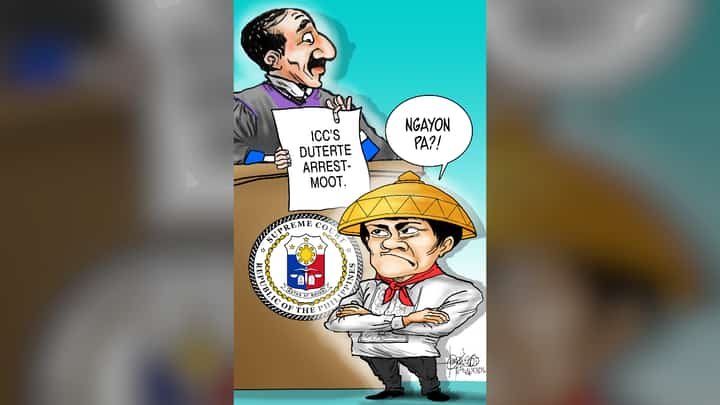
A recent Supreme Court ruling declaring petitions challenging former President Rodrigo Duterte’s arrest and surrender to the International Criminal Court (ICC) moot failed to settle lingering questions about the legal process governing the handover of suspects to the foreign tribunal.
Senior Associate Justice Marvic M.V.F. Leonen said the dismissal of the consolidated habeas corpus petitions left unresolved how the government may arrest and surrender a person to the ICC, warning that the issue was “capable of repetition, yet evading review.”
On 24 November 2026, the Supreme Court dismissed the consolidated petitions challenging Duterte’s arrest and surrender to the ICC in March 2025.
In a concurring and dissenting opinion dated 11 November, Leonen agreed that the petitions should be dismissed because the ICC has competence to determine its own jurisdiction. Still, he dissented from the Court’s decision to treat the cases as moot without issuing guidelines for judges, lawyers, and law enforcers.
“Our silence can be interpreted as complicity in a violation of the Constitution,” Leonen wrote.
Leonen said Duterte was arrested at Ninoy Aquino International Airport on 11 March 2025 on the strength of the ICC warrant and an International Criminal Police Organization (Interpol) diffusion, and was flown to The Hague that night. He was never brought before a Philippine court.
Article 59(2) of the Rome Statute requires an arrested person to be brought “promptly” before a competent judicial authority in the custodial state, Leonen noted.
That judge decides only whether the warrant applies to the person, whether the arrest followed proper process, and whether the person’s rights were respected. Article 59(4) bars the judge from reviewing the warrant’s validity.
The Constitution, he added, requires a judicial warrant for arrests. He said an ICC warrant may satisfy that requirement only if ICC jurisdiction is shown and Article 59(2) is observed.
“The principal constitutional defect lay not in the absence of a fresh determination of probable cause,” Leonen wrote, but in “the total absence of any judicial review.”
He said the government, not the detainee, was duty-bound to bring Duterte before a Regional Trial Court, and need not have waited for a habeas petition.
Because Duterte was arrested and surrendered the same day, Leonen said, he had no chance to ask for interim release under Article 59(3) or to raise a ne bis in idem, or double jeopardy, challenge.
Duterte filed his jurisdictional challenge before the ICC on 1 May 2025, and an urgent request for interim release on 12 June 2025. The ICC Pre-Trial Chamber I rejected the release request on 26 September 2025, citing a flight risk, and ruled on 23 October 2025 that the ICC had jurisdiction.
Questions on the warrant’s validity and the doctrine of male captus, bene detentus, under which an irregular arrest does not defeat a court’s jurisdiction, are for the ICC to decide, according to the magistrate.
Leonen rejected the argument that the arrest was justified by Philippine commitments to Interpol, which President Ferdinand Marcos Jr. cited, saying Interpol’s own rules make its requests a matter of persuasion, leaving each member state to decide their legal weight.
At most, Leonen said, those commitments gave “an additional basis” for the arrest. They did not change the duties imposed by Articles 59(2) and 89(2).
Leonen said the Philippines’ withdrawal from the Rome Statute took effect on 17 March 2019. Still, Article 127(2) preserves obligations incurred while it was a party, citing the 2021 ruling in Pangilinan v. Cayetano, which held that acts up to that date remain within the ICC’s reach.
The ICC itself has not settled the question. In July 2023, the ICC Appeals Chamber declined to rule on the effect of withdrawal because it had not been raised. Two of its five judges dissented, arguing that jurisdiction was lost because no investigation was authorized before the withdrawal took effect.
Duterte “alone did not commit the alleged atrocities imputed to him,” and his alleged co-perpetrators remain in the country. They could be seized and surrendered in the same manner, he said.
Section 17 of Republic Act 9851 allows the government to surrender suspects to an international tribunal, he noted, but does not say how, but Leonen said surrender “cannot be the whole of accountability.”
“Most of those who pulled the triggers, and most of those who made people disappear, have not been made to answer,” he wrote, adding that some cases “can and must be prosecuted here.”
Given the considerable time the Supreme Court took to hand down its ruling, it should have been comprehensive enough to settle all outstanding questions, rather than leave loose ends.