
Ridon: Voluntary payments not ‘permanent fix’ to outstanding debt
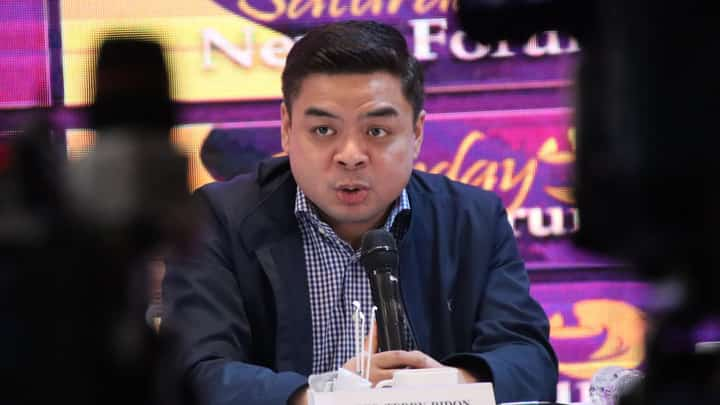
Bicol Saro Party-list Rep. and House prosecution panel member Terry Ridon attends the Saturday News Forum at the New Dapo Restaurant and Bar in Quezon City on 25 July.
Photo courtesy of Saturday News Forum
The proposal of Senator Alan Peter Cayetano which urges capable individuals to chip in funds to pay for the near P20 trillion debt of the Philippines could move the needle in terms of reducing the amount but does not entail a permanent solution to the outstanding national issue, a lawmaker said.
Bicol Saro Rep. Terry Ridon said that Cayetano’s bid was something that the government could consider but maintained that there were likely better solutions given the fact that the country’s debt was not necessarily an individual burden on all Filipinos.
He further explained that while the payments could be helpful in the short-term, it did not necessarily erase the fact that borrowing was still an integral way to support the development agenda of a country like the Philippines.
“I don’t think we should kid ourselves here that our debt would be resolved just because the people are volunteering to pay it,” Ridon told reporters.
The lawmaker similarly pointed out that the parameters for an individual deciding to pay his supposed “share” of the trillions worth of debt should be clear in indicating that it would not entail that they would be exempted from paying taxes.
Ridon would, however, acknowledge public sentiments regarding the proposal, particularly Filipinos who have raised concerns on the daunting implications that the P170,000 share could have on an ordinary worker.
He clarified that Cayetano was likely referring to individuals that were financially capable of paying the amount.
“Ultimately, the individuals subjected to pressure are not ordinary Filipinos. In reality, there is no mechanism for the public to chip in to the debt burden except, of course, through the taxes that we pay. The burden and the pressure is all on the wealthier citizens,” he stated.
In view of matters relating to debt, Ridon said that a different approach that could be taken was to impose a wealth tax which was a matter he stressed had long been discussed in Congress.
The lawmaker explained that such a tax would be similar to the proposed move for citizens to directly pay for the Philippines’ outstanding debt, but would involve a mechanism that was implemented into law and on a national scale.
“The richest Filipinos should really be paying a higher rate of tax, because eventually it would be the same thing. It will be the same P100,000 that will be paid by the wealthier Filipino citizens,” he expressed.
Ridon’s sentiment came as a direct response to the proposal that Cayetano lodged during the first day of the Senate’s budget hearings on the proposed P7.2 trillion budget for 2027.
The senator directed the question to Senator JV Ejercito, inquiring if there was a way that any “willing” Filipino could make a payment.
In an interview after the Office of the President’s budget deliberations, Executive Secretary Ralph Recto quipped that Cayetano could submit his payment either to the Bureau of Treasury or the Bureau of Internal Revenue.
“Perhaps the BIR would be better so there would be an official receipt,” Recto said.
The Malacañang on Tuesday challenged the senator to “lead by example” on his proposal.