
St. Leo the Great: A shepherd of faith and courage
Today’s Thoughts to Live by, 10 November, 32nd Week in Ordinary Time, St. Leo the Great, Pope and Doctor of the Church.
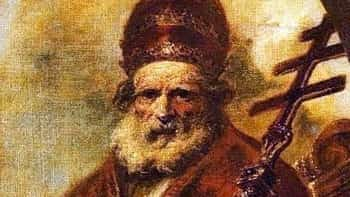
Some Notes on St Leo the Great — The pontificate of Pope Leo I spanned the middle of the 5th century (440-461). Next to that of St. Gregory I, Pope Leo I is the most significant and important figure in Christian antiquity.
His era was marked by great disturbances in the world and in the Church. The Church faced the disintegration of the Western Empire and the troublesome dogmatic controversies in the East. It was Pope Leo I who guided the destiny of the Roman and universal Church with far-seeing sagacity and wisdom. He was the 1st Pope to be named Leo and the first of three Popes to be called “Great”, alongside Gregory I and Nicholas I. He is the 1st Pope whose sermons, belonging to the finest and most profound in patristic literature, have come down to us.
He was a native of Tuscany and was well educated. He became a deacon under Pope Celestine (422-432), and occupied an important position with St. Cyril of Alexandria. Emperor Valentinian III sent Leo to Gaul to settle a dispute and reconcile Aetius, the chief military commander of Gaul, and Albinus, the chief magistrate. While Leo was in Gaul, Pope Sixtus III died (440) and Leo, still a deacon, was acclaimed by the people to succeed him. Leo was consecrated as Pope on 29 September 440. He governed the Church for the next 21 years (440- 461).
Not long after his becoming Pope, he required bishops, deacons, and clerics who had not left the heresy of Pelagius to abjure Pelagianism publicly and to confess the true faith. Next he confronted the heresy of Manichaeism. Its adherents had settled in Rome after their defeat by the Vandals. At his instigation, Emperor Valentinian III issued an edict punishing the heretics. Pope Leo next confronted the heresy of Priscillianism. He instituted a thorough inquiry to ascertain bishops tainted with the heresy and excommunicated them. To establish union with Rome and papal primacy, he took away the power and authority of St. Hilary, Bishop of Arles, over other Gallic dioceses and limited him to his own diocese. St. Hilary later reconciled with Pope Leo.
Pope Leo did a similar reorganization of othe ecclesiastical jurisdictions, such as the Archdioceses of Vienne and Thessalonica. Papal primacy was also exercised in the reform of ecclesiastical and moral discipline as he wrote letters to bishops to institute strict clerical adherence to the canonical and moral law.
But it was in the Christological quarrels that Pope Leo the Great showed his wisdom, brilliance, and firmness of faith. Flavian, Patriarch of Constantinople, had excommunicated Eutyches, who had promoted the Monophysite belief that Christ had only one divine nature, essentially denying his humanity. Pope Leo wrote a letter to Flavian (Leo’s “Tome”) and concisely set forth the doctrine of the Incarnation and the union between the divine and human natures in the one divine person of Christ.
In 451, the 4th Ecumenical Council of Chalcedon (modern Kadiköy, Turkey) solemnly affirmed the view of Pope Leo the Great as the true expression of the Catholic faith concerning the person of Christ.
Despite his shepherd’s concern for the whole Church in the East and West, the Pope did not forget Rome. When Attila and his Hun forces threatened Rome after a large part of northern Italy had fallen, the Pope met Attila at Mincio, in the vicinity of Mantua. The cities of Aquileia, Padua, and Milan had been sacked and razed to the ground. The Pope persuaded Attila to withdraw his forces. Three years later in 455, the Pope met Genseric when his Vandal forces captured Rome. He convinced him to spare the Archbasilica of St. John Lateran and the Basilicas of Sts. Peter and Paul. Though Rome fell, thousands of innocent people were saved when they took refuge in the basilicas.
Pope Leo the Great died on 10 November 461. His remains are now enshrined in St. Peter’s Basilica, the 1st Pope to be enshrined there. In 1754, Pope Benedict XIV exalted him to the dignity of Doctor of the Church, “Doctor unitatis Ecclesiae”.
Prayer — O God, you never allow the gates of hell to prevail against your Church, firmly founded on the apostolic rock. Grant her, we pray, that through the intercession of Pope Saint Leo, she may stand firm in your truth and know the protection of lasting peace. This we pray, through our Lord Jesus Christ your Son and our Savior. Amen.