
Solemnity of the Body and Blood of our Lord Jesus Christ

The Feast of Corpus Christi was established in Liège, Belgium in 1246 as a result of a vision of Juliana of Cortillon (ca. 1193-1258). In 1208, Juliana reported a vision of a full moon with a dark spot sullying it. This was interpreted as Jesus lamenting the absence of a particular feast, focused on his sacramental presence on the altar. Her vision started discussions on the presence of the Lord in the Blessed Sacrament.
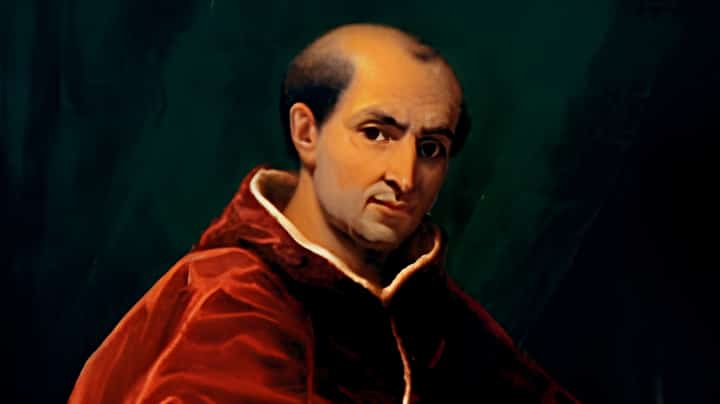
The Feast was proposed by St. Thomas Aquinas to Pope Urban IV in order to create a feast focused solely on the Holy Eucharist, being the Body and Blood, Soul and Divinity of Jesus Christ. Having recognized the authenticity of the Eucharistic miracle of Bolsena, in 1264 Pope Urban IV established the Feast of Corpus Christi and extended it to the universal Church, later reconfirmed by Pope Clement V.
Some of the new texts for the liturgy of the Feast were composed by St. Thomas Aquinas. Thus, the Mass Sequence, “Lauda Sion Salvatorem,” and the hymns: “Panis Angelicus,” “Pange Lingua,” “Tantum Ergo,” and “O Salutaris Hostia.” The Eucharistic procession after the Mass contributed to the popularity of the Feast through the 14th century.
God gives us daily bread at our tables. But infinitely more, God gives us Bread at the Mass table, Bread that does not perish — his own Body and Blood — food for our journey toward heaven.
“Whoever eats this bread will live forever.” In this Bread, Jesus lets us partake of his love. He nourishes us with it. We are to live the Eucharist, live a style of life, centered on loving Jesus and walking together with our neighbor toward heaven, nourished by the Bread of eternal life.
Prayer: O God, in this wonderful Sacrament, you left us a memorial of your Passion. Grant, we pray, so to revere the mysteries of your Body and Blood that we may experience in ourselves the fruits of your redemption, who live and reign with God the Father in the unity of the Holy Spirit, one God, forever and ever. Amen.