
Teodoro: Cooperation key to protecting Philippine maritime domain

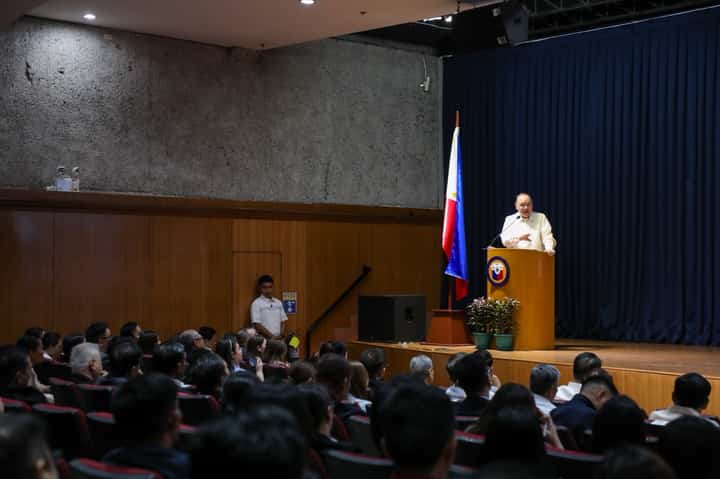
Department of National Defense (DND) Secretary Gilberto Teodoro Jr. on Thursday underscored the importance of national convergence and regional cooperation in upholding and protecting the Philippines’ maritime domain.
Speaking at the Third Balangay Forum at Asia Pacific College (APC) as part of the 2026 Maritime Archipelagic Nation Awareness Month (MANAMo), Teodoro reaffirmed the country’s push for stronger and more comprehensive maritime governance to support the development of the blue economy.
“We have to use all the resources within that maritime domain in order to support our population on land, which admittedly is growing. Coupled with the fact that [we] have challenges of climate change, development, and food production,” Teodoro said in his keynote address.
“[We] have to rely increasingly in the maritime domain in order to augment [our] sustenance and probably even habitation,” he added.
Teodoro said the Armed Forces of the Philippines (AFP) remains critical to defending the country’s maritime domain and its entitlements amid evolving security challenges.
“That is why we are developing the capacity of the armed forces to enforce, in coordination with our law enforcement agencies in a sustainable and logistically secure and sound manner, the laws of the Republic of the Philippines and the norms that we have agreed to in international treaties, particularly and principally the UN [United Nations] Charter,” he said.
The Defense chief also emphasized the importance of defense engagements with partner countries in advancing humanitarian activities, economic development, regional stability and maritime deterrence, while upholding sovereign rights under a rules-based international order.
“We have to work with like-minded countries to open international routes, sea lanes of communication, that the world knows, because there are attempts to change the narrative. And a big example of changing the narrative is China’s nine-dash line,” he said.
“We saw what happened in Mischief Reef, where they claimed — no less than their foreign minister — very theatrically claimed, that they will never militarize it, [that] it’s only for peaceful purposes. And now, you see a heavily militarized artificial island,” Teodoro added.
Teodoro also cited the need to develop the Philippine Navy into an expeditionary force capable of protecting Philippine interests on the high seas.
“We need an expeditionary navy to be able to protect Filipinos, seafarers, and Filipino vessels in the high seas, alike and alongside like-minded countries,” he said.
He said collective efforts to develop the blue economy would benefit both present and future generations by protecting maritime rights, resources and livelihoods.
“The blue economy is our future. The blue economy is our link to sustainability, to development, and to prosperity. We need the sea in order to secure supply chains that are essential for our daily life and essential also for productivity. Without these supply chains, then we constrict our economic base, we imperil our society, and we imprison future generations,” Teodoro said.
The Third Balangay Forum, themed “The Philippines as the Archipelagic Sentinel: Advancing the Blue Economy, Safeguarding Shared Seas, and Fostering Partnerships,” brought together government officials, policymakers, maritime experts, industry representatives, academics and other stakeholders.
The forum was hosted by Waypoints Project in partnership with the DND, APC, University of Asia and the Pacific, Foundation for the National Interest, FACTS Asia, the Australian government and Friedrich Ebert Stiftung Philippines.
Discussions focused on coastal sustainability, the Philippine blue economy, emerging security concerns and regional maritime cooperation.