
Enforcement alone not enough to address drug problem—Marcy Teodoro
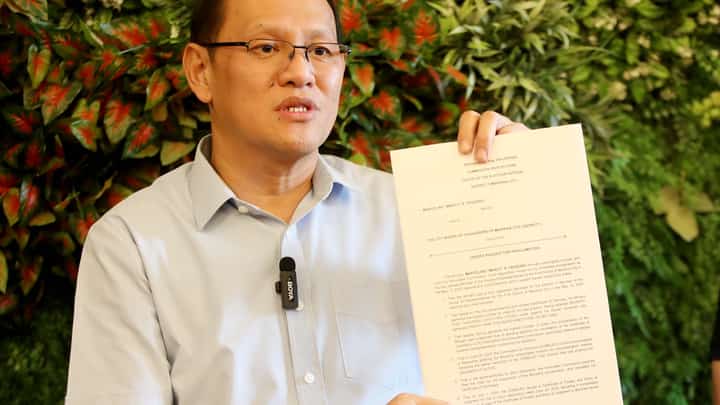
(July, 01 2025) Newly elected Marikina City 1st District Representative Marcelino “Marcy” Teodoro, show a copy of urgent request for proclamation filed with the City Board of Canvassers of Marikina City District 1, following the Commission on Elections (Comelec) en banc's declaration on the finality and immediate executory effect of its resolution reinstating his candidacy. Photo/Analy Labor
ANALY LABOR
The government’s response to the illegal drug problem should go beyond enforcement, according to Marikina 1st District Rep. Marcelino "Marcy" Teodoro, stressing that it must also focus on prevention, treatment, rehabilitation, and reintegration.
Teodoro issued the pronouncement as he sponsored the proposed P526.546-million budget of the Dangerous Drugs Board (DDB) for 2027 during the second day of plenary deliberations on the proposed P7.2-trillion national budget.
He noted that the proposed DDB allocation is P71.624 million, or about 12 percent, lower than the agency’s P598.170-million total budget for 2026.
"A serious anti-drug policy cannot end with enforcement. It must also ask what happens before addiction takes hold, what happens when a person needs treatment, and what happens after rehabilitation when that person tries to return to family and community," said Teodoro, also the Vice Chairperson of the House Committee on Appropriations.
“May magulang na hindi naghahanap ng huhulihin. Ang hinahanap niya ay tulong para sa anak niya,” he added, stressing that the government must address not only the supply of illegal drugs but also the underlying factors and needs related to prevention, treatment, rehabilitation, and recovery.
Of the proposed DDB budget, P169.182 million is allocated for the Drug Abuse Prevention and Control Program. This includes P111.694 million for policy formulation, surveys, research and studies; P32.845 million for advocacy and information programs; and P24.643 million for capacity building.
Teodoro said research and evidence-based policymaking are crucial in guiding the government in determining where treatment and community-based programs are most needed, where prevention efforts should be strengthened, and which interventions are producing results.
“Kung hindi natin alam kung nasaan ang problema, paano natin malalaman kung saan ilalagay ang pera? Kung hindi natin alam kung aling programa ang gumagana, baka taon-taon lang tayong gumagastos dahil nakasanayan na,” Teodoro pointed out.
“That is why data matters. Research has value when it guides actual decisions to guide us for future allocation of resources. It should help identify where more treatment is needed. It should show where community-based programs should be expanded. It should guide where prevention should be strengthened. And it should help Congress and the Executive identify which interventions are producing the best results," the lawmaker added.
For Teodoro, the effectiveness of the government’s anti-drug efforts should ultimately be measured by whether services reach the families and communities that need them and whether those struggling with drug dependence are given a real opportunity to recover and rebuild their lives.
“Doon dapat makita ang halaga ng pondo: umaabot ang serbisyo. Kung may nanay sa probinsiya na gustong ipagamot ang anak niya, dapat may malinaw siyang mapupuntahan. Kung natapos ang rehab, dapat may support sa pagbalik sa komunidad,” Teodoro stressed.
The DDB serves as the government’s policy and coordinating institution, connecting the work of the Philippine Drug Enforcement Agency on enforcement, the Department of Health on treatment and health services, local governments on community-based programs, and other agencies involved in social support and reintegration. NEIL ALCOBER