
SMFI’s Angeles takes public service to heart
After years of public service, she has grown so accustomed to the rhythm that she no longer considers it a job.

Public celebrity Connie Angeles is not the kind of person who knows what to do with an idle day.
At 6 a.m., she is already checking her schedule, preparing for medical missions, facility turnovers, community visits and the travel that comes with bringing healthcare beyond the walls of hospitals.
After years of public service, she has grown so accustomed to the rhythm that she no longer considers it a job.
“I don’t even consider this work. For me, this is a way of life,” Angeles said during DAILY TRIBUNE’s Straight Talk.
As executive director for health and medical programs at the SM Foundation Inc. (SMFI), Angeles oversees programs that bring free medical services to communities across the country, including geographically isolated areas where access to healthcare can be difficult.
Before joining SM Foundation in 2001, Angeles was already familiar with the needs of Filipinos seeking medical help.
She was part of a public service television program where viewers could raise medical concerns and receive answers from doctors and medical practitioners featured on the program.
The program, which began in the 1970s, gave Angeles an early look at how people turned to public service platforms when they needed help.
She later entered politics, serving two terms as a Quezon City councilor and one term as vice mayor. In all, she spent nine years in politics before moving to SM Foundation.
Shared path
For Angeles, the two worlds shared a common thread.
“It’s both service,” she said, describing politics and her work in the foundation as different forms of public service.
But she found greater fulfillment in what she does now. “I just feel that you can do public service even without getting into politics,” Angeles said.
At SM Foundation, that belief translates into bringing healthcare closer to communities.
The foundation conducts around 85 medical missions a year across the country, with roughly 10 to 12 missions held each month.
Five mobile clinics support these missions, carrying services such as ultrasound, electrocardiograms, X-rays, lipid profile testing, and blood sugar testing.
Doctors visit communities, and patients receive prescribed medicines. Angeles said the foundation also tries to provide diagnostic results before patients leave the medical mission.
The work is designed to address one basic problem: People cannot always reach healthcare facilities.
“We have to bring healthcare within reach,” Angeles said. That means going beyond the usual centers of activity.
The foundation also serves geographically isolated areas and communities affected by disasters, including those hit by earthquakes, typhoons and heavy rains.
For Angeles, healthcare outreach is not a one-time intervention.
The medical missions are institutionalized and planned in advance.
By November, her team begins plotting the following year’s activities and preparing the budget, with implementation starting in January.
The foundation also works with local government units, which Angeles describes as strong partners, as well as the Department of Social Welfare and Development, to identify beneficiaries.
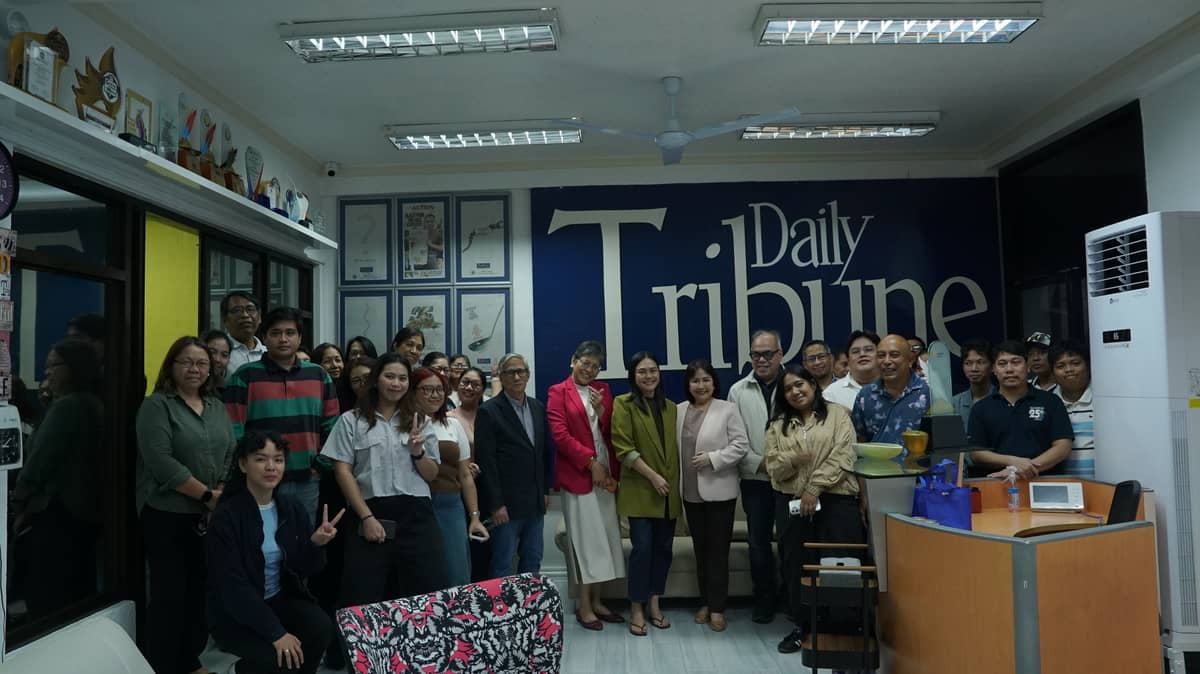
SHE won crowd SM Foundation Inc. executive director for health and medical programs Connie Angeles (center) brought the house down at the Daily Tribune office, as the entire staff left their workstations to take a snapshot with her.
The scale of the missions can be significant.
By holding some medical missions at SM malls, the foundation can centralize services for nearby communities.
Angeles said a single mission can serve around 800 to 1,000 patients in a day.
The arrangement also helps avoid disputes among neighboring communities over which barangay gets served. “Everybody’s welcome,” Angeles said.
A relatively small core team runs the programs. Angeles said she has around 10 regular staff members working with her, while volunteers, LGUs and medical societies provide additional support during medical missions.
For all the services the foundation provides, however, Angeles said its biggest challenge is not funding or medical supplies.
It is people.
“Medical personnel, medical practitioners,” she said.
The foundation relies on local government units (LGUs) and medical societies to provide doctors because more medical practitioners mean it can serve more patients.
The availability of specialists can also determine what services it can offer. Angeles said the foundation provides basic services during its medical missions, while it may offer specialized procedures when volunteer doctors are available.
Dental care, in particular, remains an area Angeles sees as important.
Patients who come to medical missions with painful teeth may have limited choices, especially when the mobile setup lacks equipment for procedures such as fillings. In such cases, extraction can become the practical option.
For Angeles, that is one example of the difficult choices people with limited access to healthcare may face.
Her work also extends beyond medical missions.
SM Foundation helps rehabilitate and improve health facilities serving the Army, Navy, Air Force and Coast Guard. It also works on hospitals, pediatric and intensive care units and community health centers.
Some of these improvements are intended to help facilities secure PhilHealth accreditation and expand the services they can provide to their communities.
Much of Angeles’ work therefore happens away from her desk.
She goes to the office and checks what is on top of the day’s schedule, but her responsibilities can take her to different parts of the country. She attends facility turnovers and inaugurations and checks on medical missions, particularly when communities are affected by disasters.
Life’s calling
It is a demanding routine, Angeles admitted, but she does not describe herself as overwhelmed by it.
The programs are already planned and scheduled, she explained, and she has been doing this for a long time.
“It’s just your life,” she said.
That philosophy is perhaps most visible in the way Angeles continues to draw people into the work through her own networks.
Angeles believes public service does not necessarily require a political position. It can happen through healthcare missions, volunteer work, stronger community health facilities or simply making services accessible to people who otherwise struggle to reach them.
And after years of doing exactly that, she has developed a relationship with service that goes beyond professional obligation.
For Angeles, the strange part is not how much she works. It is what happens when she does not.
“I’m getting tired when I’m not doing anything,” she said.
For someone who has spent decades moving toward where people need help, perhaps an idle day was never really the point.