
Senate’s 2027 purse steward gets busy
Against the backdrop of his long experience in local government and as a legislator, his handling of the 2027 budget must be read.


LONG road for the Good One The road to becoming one of the Senate’s most dependable members has been anything but a bed of roses for Senator JV Ejercito. His work often means long hours, tedious reviews and digging through the details that rarely make headlines.
Photograph courtesy of JVEjercito/IG
Although the Senate has seen no shortage of budget chairpersons who assumed the post with decades of appropriations experience behind them, Senator Joseph Victor “JV” Ejercito took over the Finance Committee leadership under the direst conditions no veteran would have chosen.
The flood-control scandal left the public deeply suspicious of the Congressional budget process. He has said that few moments could be more difficult for a finance chairperson than the one immediately after that scandal, and that the task now is to win back the people’s trust in the budget process.
It is a candid admission, and it explains why a man long identified with health, infrastructure, and housing legislation now stands at the front of government’s most scrutinized document.
His path to that position began in San Juan’s political household, where he was born in 1969 to actor-turned-politician Joseph Estrada and businesswoman Guia Gomez, a year after his father, then mayor-elect, won an electoral protest and gave him his given name, Joseph Victor.
Ejercito built his own record, first as San Juan mayor for three consecutive terms from 2001 to 2010, a period during which the city’s revenue climbed from P300 million to P1.2 billion and it was converted into a highly urbanized city in 2007.
Those years earned him recognition, including a Ten Outstanding Young Men award, and they gave him the managerial instincts that now mirror his remarks on the budget.
From City Hall, he moved to the House in 2010, where he chaired the Committee on Metro Manila Development, and then to the Senate in 2013, where, as chairman of the health and urban planning panels, he principally sponsored both the Universal Health Care Law and the law creating the Department of Human Settlements and Urban Development.
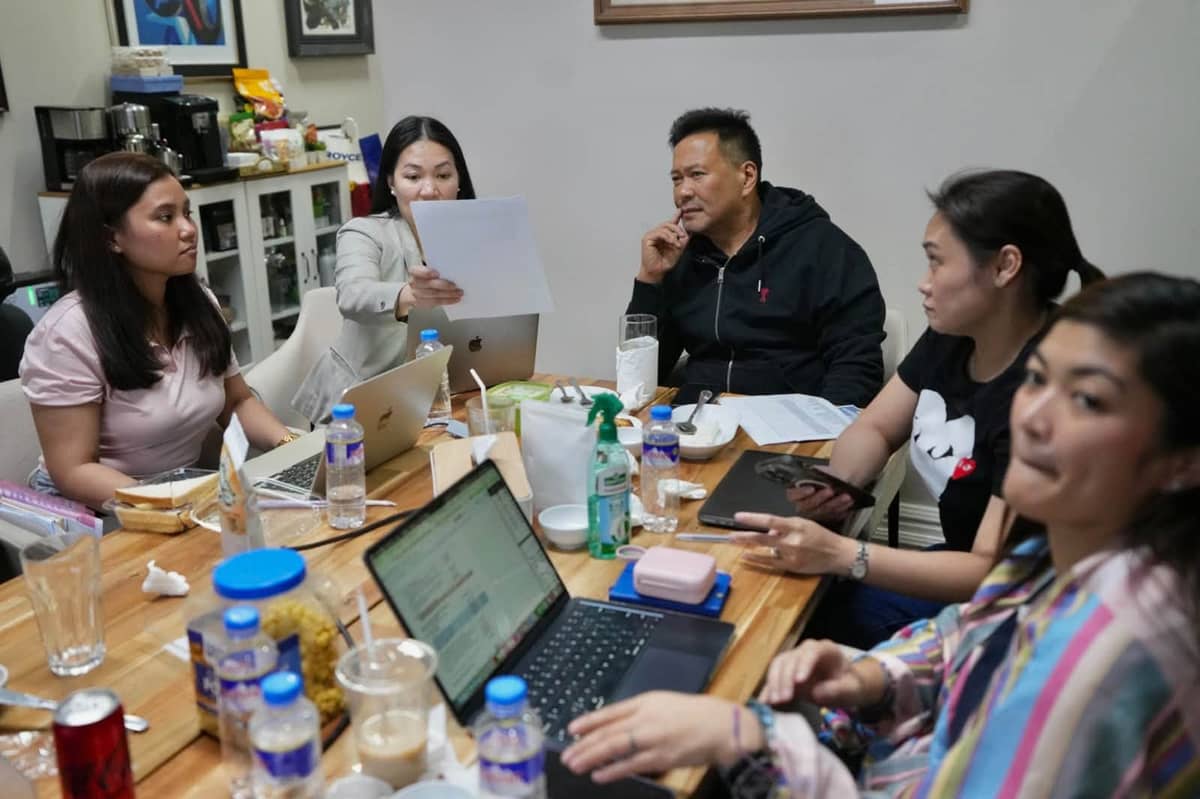
PORK hunting season Senator JV Ejercito and his indefatigable staff pore over the 2027 national budget, combing through its provisions and amendments in search of allocations they consider pork barrel.
Photograph courtesy of JV Ejercito/FB
That first Senate stint ended in 2019, but he returned in 2022, and his rise to the finance panel chairmanship came as the Senate’s new leadership under Senate President Win Gatchalian reorganized itself.
Against the backdrop of his long experience in local government and as a legislator, his handling of the 2027 budget must be read in context.
A day after the House transmitted the General Appropriations Bill, he laid out his findings with the brisk fluency of someone who had spent the night studying the documents, noting that roughly P206 billion had shifted between the National Expenditure Program and the House version, so that, as he put it, very little remained for institutional amendments by the Senate.
Rather than complain, however, he turned it into a mandate for scrutiny, insisting that the bicameral process exists precisely so nothing is accepted at face value.
His chief alarms fall into three groups, and each reveals something about his priorities. On health, his lifelong advocacy, he pointed out that although P23.9 billion was added to the Medical Assistance Program, about P4 billion was removed from immunization and another P2 billion from health promotion, a pattern he finds puzzling.
The Universal Health Care Law, which he helped write, rests on strengthening prevention so that people never reach the expensive stage of hospitalization.
On public works, he questioned why flood-mitigation structures in major river basins lost P4.6 billion while other similar structures gained about P8 billion.
On foreign-assisted projects, he warned that removing P130 billion, including P19.7 billion from the Metro Manila Subway and P15 billion from the North-South Commuter Railway, would only deepen the country’s obligations, since delays bring commitment fees and inflation and strain relations with Japan and other creditors.
It must be maintained that the budget is a balancing act, so that the social programs needed in a crisis, whether Assistance to Individuals in Crisis Situation (AICS), the Tulong Panghanapbuhay sa Ating Disadvantaged/Displaced Workers (TUPAD), or medical assistance, must coexist with the long-term infrastructure that creates jobs.
He compares the Philippines with Vietnam, Thailand, Malaysia and Indonesia. These neighbors invested heavily in railways and ports two or three decades ago and now reap the returns, while the Philippines, which once stood level with or ahead of them, has been left behind. “People should not have to depend on aid for their entire lives,” he argued.
What distinguishes him from earlier finance panel chairpersons is the procedural discipline he has pledged to impose. He has vowed to prevent last-minute insertions and even post-enactment interventions, open the bicameral conference to the public, and publish budget documents online so changes can be traced from the proposal to the final bicameral version.
The senator has also said the controversial “small committee” that reportedly realigned allocations in earlier years will be done away with, and he has scheduled 25 and 26 October for civil society groups, academics and watchdogs to present their red flags before the committee report is drafted, having hired seven additional staff to help comb through the line items.
The calendar he described is punishing: the committee report must be prepared during recess, sponsorship is set for 23 November, and two weeks of plenary debate are meant to precede a third reading in early December, all while the impeachment court resumes on 9 November and competes for the same hours.
He confessed his own frustration with that overlap, observing that the three months consumed by the trial might otherwise have gone to budget hearings, even as he declined, as a senator-judge, to criticize the proceedings or to say more than that both sides ought to be heard.
“The public will be able to see the final bicameral output,” he vowed.
A budget is only as credible as the process behind it, and Ejercito has staked his reputation on proving that the Senate’s power of the purse can still be a public trust.