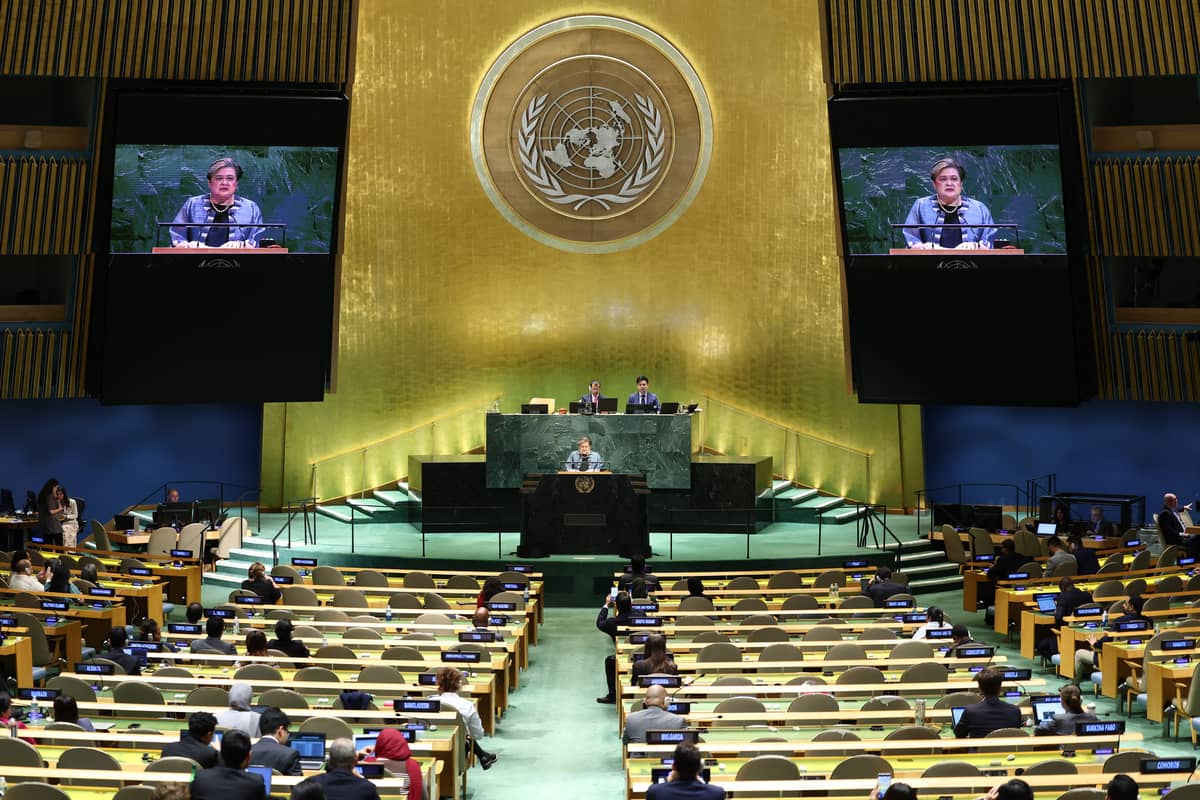
A life in diplomacy: SFA Tess Lazaro’s journey from Maryknoll to the world stage
For Lazaro, the experience taught her what it meant to represent the country abroad. Diplomacy required more than knowledge of international affairs. It demanded the right demeanor, sound judgment, and the ability to communicate the Philippine government’s position clearly.

FROM a student of international studies to the country’s top diplomat, Tess Lazaro’s journey has been guided by hard work, discipline and service to the Philippines.
Long before Maria Theresa “Tess” Lazaro became the Philippines’ Secretary of Foreign Affairs, she was a young woman wanting to understand issues beyond the Philippines while still remaining rooted in her home country.
This ambition eventually led her to the foreign service, where she has spent more than four decades representing the country across continents.
For Lazaro, the foundations of that journey were laid at Maryknoll College, now Miriam College, where she earned her degree in International Studies.
Coming from a conservative school, she found Maryknoll’s liberal education a different experience. It introduced her to new perspectives and encouraged women to take on leadership roles. The education was pragmatic and responsive to changing times, extending even to discussions of liberation theology.
“It’s ahead of its time,” Lazaro said of the school’s approach, which she credits in part to the Maryknoll sisters’ distinct view of the world.
That emphasis on women’s leadership stayed with her as she entered a profession where confidence and assertiveness are essential. After graduating at 19, Lazaro pursued law at the University of the Philippines while waiting to meet the age requirement for the Foreign Service Officer’s examination. She took the exam at 23 and entered the foreign service at 25. By 27, she was assigned to her first overseas post.
Her first posting in Bangkok, Thailand, became an important introduction to the realities of diplomacy. The country’s development challenges reminded her of those in the Philippines, but she also witnessed how a developing nation could move toward progress.
For Lazaro, the experience taught her what it meant to represent the country abroad. Diplomacy required more than knowledge of international affairs. It demanded the right demeanor, sound judgment, and the ability to communicate the Philippine government’s position clearly.
As a woman in the foreign service, she encountered challenges but did not consider them insurmountable. She believed diplomats had to learn to assert themselves, particularly when conveying instructions to their counterparts and reporting their responses to headquarters in Manila.
Over the years, her assignments took her to Sydney, New York, Madrid, Geneva, Bangkok and ASEAN, among other diplomatic posts. She also served as the Philippines’ ambassador to France, Monaco and Switzerland, as well as its permanent delegate to UNESCO.
Across these different settings, one principle remained central to her work: understanding the people and countries on the other side of the negotiating table.
Respect, Lazaro explained, means looking beyond a country’s actions to understand its culture, motivations, and national interests. Immersion in local customs and language is essential to effective diplomacy because cooperation becomes easier when countries understand why others act as they do.
Yet, regardless of where she was assigned, Lazaro said her decisions always came back to one question: What serves the Philippines’ national interest?
For her, that means considering the welfare of Filipinos, whether through trade, economic opportunities, skills development, or the protection of their rights. She applies the same principle to the country’s position on the West Philippine Sea, emphasizing the importance of international law, multilateralism, the United Nations Convention on the Law of the Sea, and the 2016 arbitral award.
She also believes diplomacy must leave room for dialogue. Even amid geopolitical tensions, she said, disputes should be addressed through discussions and peaceful settlement.
The world Lazaro entered as a young diplomat has changed considerably. But she believes the purpose of foreign policy remains constant: agreements, treaties, and institutional reforms must ultimately benefit people.
That people-centered perspective echoes the education she received at Maryknoll. Lazaro remembers the school as a place that introduced women to leadership and gender issues at a time when these were not emphasized in every educational institution.
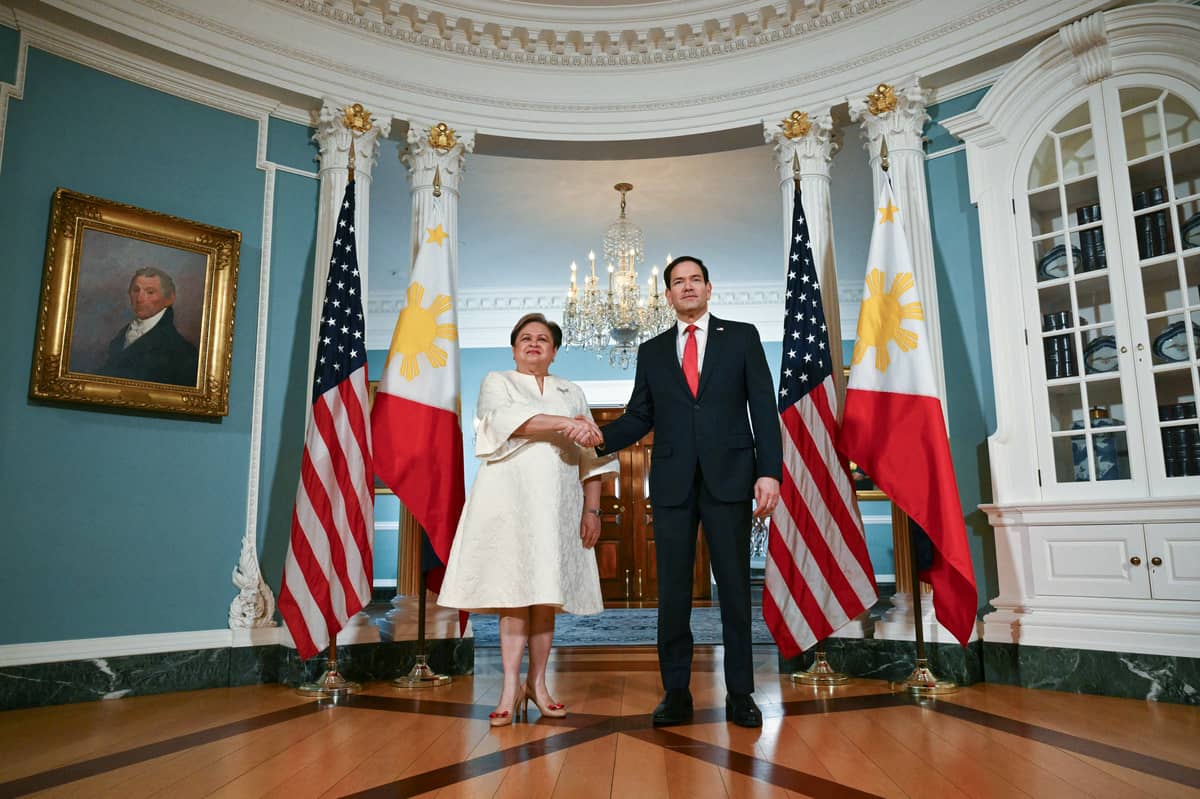
US Secretary of State Marco Rubio (right) shakes hands with Philippines’ Foreign Minister Theresa ‘Tess’ Lazaro as they appear briefly for the press before their meeting at the State Department in Washington, D.C. on 5 June 2026.
As Miriam College celebrates its centennial, she hopes young women will draw confidence from their ambitions and pursue the paths that matter to them.
“Study, work hard, really work hard,” she advised. “There’s nothing that you can get for free.”
For Lazaro, dreams require discipline, persistence, and a commitment to doing one’s best. Her own journey, from a student exploring international affairs to the country’s top diplomat, reflects those values.
“I really thank Maryknoll for the Maryknoll education that I got,” she said.
Decades after leaving its classrooms, Lazaro continues to carry that education into the work of diplomacy where understanding others, standing firm on national interests, and keeping the Filipino people at the center.