
Rebuilding Marawi through education
‘Our priority is not simply to restore what was (lost), but to modernize the university.’

PEACE, prime agenda Upon taking office, MSU president Paisalin Tago introduced a Nine-Point Agenda aimed at reinforcing the top university in the south’s mandate as a National Peace University while elevating its academic, research and community extension programs.
Photo courtesy of Paisalin Tago/FB.
Nine years after the liberation of Marawi City, the scars of the 2017 siege remain visible, not only in structures awaiting rehabilitation but also in communities still struggling to recover.
For Mindanao State University (MSU) System president lawyer Paisalin Tago, rebuilding Marawi goes beyond restoring infrastructure. It means giving young people education, opportunities, and a sense of purpose to help secure Mindanao’s future.
Speaking on DAILY TRIBUNE’s Straight Talk to mark the ninth anniversary of Marawi’s liberation on 17 October, Tago reflected on the devastation left by the conflict and the university’s continuing role in the city’s recovery.
“October 17th is more than just a date in our history. What happened to Marawi reminds us of the sacrifices, the lives lost, the property damage, the dreams shattered, and most importantly, the resilience of the people of Marawi,” he said.
While the siege marked a defining moment for the city and its people, Tago acknowledged that recovery remains unfinished.
“Marawi may have been liberated, but its recovery is not yet complete,” he lamented.
“We cannot allow the tragedy of the past to define or to dictate our future. As an educational institution, our responsibility is not only to produce graduates, but to develop future leaders who will become instruments of peace, unity and progress.”
University rises from adversity
Established in 1961, MSU has served as an educational institution that brings together students from different religious, cultural and ethnic backgrounds across Mindanao.
However, the siege and the Covid-19 pandemic disrupted university operations, affecting enrollment and public confidence.
Tago recalled that enrollment declined between 2017 and 2021 as the university grappled with both crises.
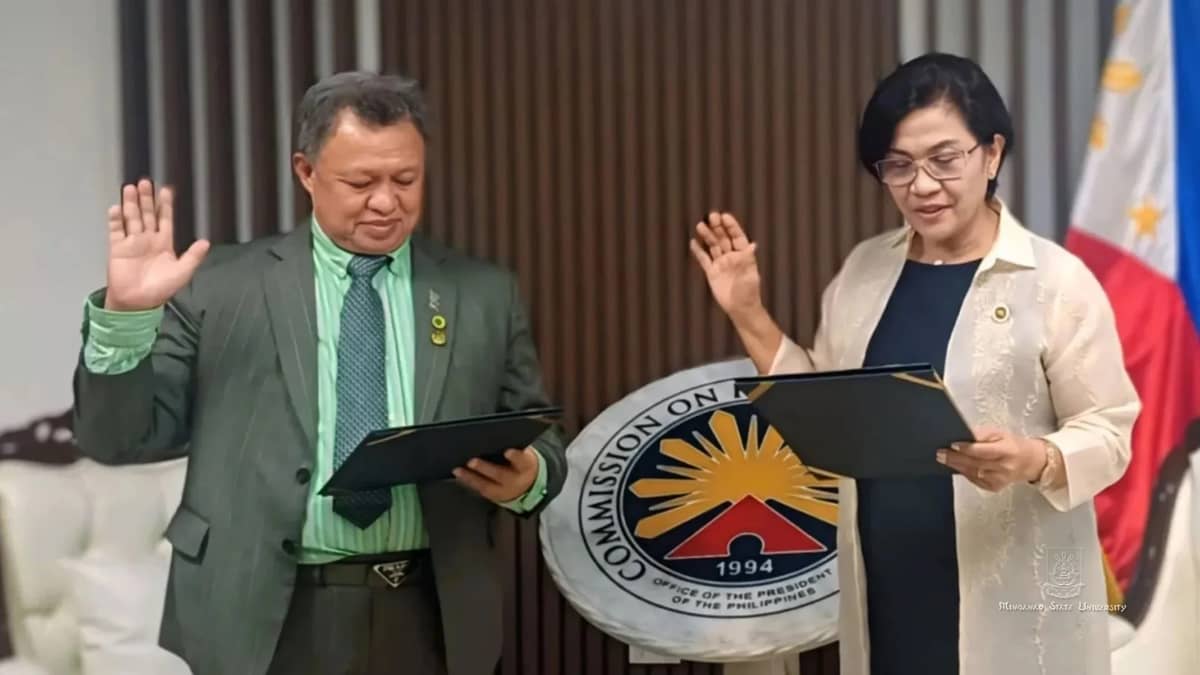
MSU turns new leaf A new era dawned for Mindanao State University system as reformist lawyer Paisalin Tago assumed the presidency on 1 July last year in a ceremony marked by simple solemnity before Commission on Higher Education chairperson Shirley Agrupis.
Photograph courtesy of MSU
Although other MSU campuses have largely recovered, the main campus in Marawi continues to rebuild its academic community.
Part of that effort involves encouraging students, particularly non-Muslims and Indigenous peoples, to return.
Restoring confidence, Tago explained, is essential to preserving MSU’s identity as an institution serving Mindanao’s diverse communities.
Beyond enrollment, aging infrastructure remains a major challenge.
When Tago assumed leadership, he found that many buildings at the Marawi campus had deteriorated after decades of use.
Some structures date back to the university’s establishment in the 1960s, while its library has occupied the same building since the 1970s.
“We continue to recover and move forward. We recognize that much needs to be improved, particularly our classrooms, laboratories, dormitories and other essential facilities,” he shared.
“Our priority is not simply to restore what was (lost), but to modernize the university.”
The ambition comes with financial constraints.
According to Tago, the MSU System operates 13 campuses and more than 14 laboratory schools, with an existing budget exceeding P6 billion.
However, much of the allocation covers salaries and operational expenses, leaving insufficient resources for infrastructure development.
While acknowledging government support, the MSU head emphasized that institutional success depends on responsible financial management.
“Success will not only be measured by the size of the budget, but also by the proper, transparent, and responsible use of it. Our commitment is to strengthen financial management, improve project implementation, and ensure full accountability,” he explained.
Keeping dreams alive
Beyond infrastructure, Tago is confronting another challenge: ensuring that disadvantaged students do not abandon their education because of poverty.
He expressed concern about reports that students are considering dropping out because their families can no longer support their studies.
Acknowledging delays in scholarship assistance, Tago said his administration is working to improve support mechanisms while encouraging local government units and development partners to provide additional scholarships.
He also personally urges financially struggling students to continue studying, reminding them that education is essential to their future.
For Tago, keeping students in school is as important as rebuilding university facilities.
While infrastructure projects restore physical structures, education provides young people with opportunities to help rebuild their communities.
Education as a foundation for peace
For a city that endured months of armed conflict, Tago believes education carries a responsibility beyond academic achievement.
He considers young people particularly vulnerable to radicalization and sees universities as important institutions in preventing extremist influences.
Tago said radical influence within MSU has been declining, while the university continues engaging students through dialogue, education and programs that promote peace and understanding.
The university president highlighted existing peace and development initiatives, alongside Islamic studies programs, as instruments for strengthening community relations.
His long-term ambition is to establish MSU as the country’s first national peace university, promoting peacebuilding, interfaith understanding and responsible citizenship.
Campus security also remains a priority.
With more than 15,000 students at the Marawi campus, MSU maintains regular coordination with the Philippine National Police and other security personnel.
Surrounded by seven barangays, the university relies on cooperation with neighboring communities to maintain a safe learning environment.
For Tago, restoring public confidence in campus safety is necessary to encourage more young people to pursue higher education in Marawi.
Beyond the classroom
Tago’s vision extends beyond academic development to Mindanao’s economic future.
Recognizing Marawi’s natural resources, he wants MSU to strengthen research initiatives that support local industries and create opportunities for surrounding communities.
His priorities include agriculture, forestry and fisheries, which he believes could stimulate regional economic activity.
He has directed university researchers to explore opportunities in these sectors and discussed plans for a research institute focused on Lake Lanao.
Tago also sees tourism and sports as ways to promote Marawi beyond its association with the siege.
One example is MSU’s golf course, which he said is accessible at no cost.
He disclosed plans for a golf academy that could train young athletes and potentially prepare them for international competitions.
These initiatives reflect his ambition to position MSU as a catalyst for regional development rather than solely an academic institution.
The unfinished journey
Nine years after Marawi’s liberation, Tago recognizes that rebuilding the city requires sustained government support, community participation and investment in young people.
For MSU, the challenge is modernizing aging facilities, supporting disadvantaged students, and
maintaining its role as a place where Mindanao’s diverse communities can learn together.
His administration continues to emphasize accountability, responsibility and transparency while pursuing programs intended to strengthen the university.
Above all, Tago believes students must remain at the center of its priorities.
“So we have to protect and support the welfare of our students. Because they are the ultimate heroes to
us,” he stated.
For Tago, Marawi’s liberation marked the end of a devastating battle, but not the end of its struggle to recover.
Nine years later, that rebuilding continues in classrooms and communities where young people are preparing to shape Mindanao’s future.
Through education, MSU hopes to ensure that the next generation inherits not the divisions of the past, but opportunities for lasting peace and progress.