
Ten years on, memory holds the line
‘Dekada ng Sama-samang Pag-alala’ marks 10 years of the war on drugs and gathers photographs, artworks, personal belongings, and testimonies that restore names, faces and humanity to the victims, and turn remembrance into a continuing demand for justice.


A recreation of a family room filled with clothing, photographs and personal belongings that recall the victims through the lives they lived.
Photographs by Roel Hoang Manipon for DAILY TRIBUNE
In the latter half of 2016, I woke up in a country — and among a people — I no longer recognized. Or perhaps an aspect of the country had simply come to light, one I had not known, or had refused to imagine. Soon after his inauguration as the 16th president of the Philippines, Rodrigo Duterte put Oplan Double Barrel into motion, the principal mechanism of his so-called “war on drugs.” In the years that followed, reports of killings wove themselves into the fabric of daily life. Almost every day, as I scrolled through social media, I saw photographs of bodies sprawled on streets and alleys. They were dismissed as drug users or pushers, killed without due process, most of them in impoverished communities. Eventually, government critics and activists were killed as well.
More horrifying still, many Filipinos applauded. Duterte’s supporters insisted that the killings were for the common good and accused those who objected of overreacting. I went through each day with a silent scream lodged in my throat, wondering how one could continue living with such brokenness inside. Over the years, estimates of the dead climbed into the tens of thousands.
On a bleak afternoon in late August 2026, during a spell of rain that seemed as inconsolable as grief, I visited Dekada ng Sama-samang Pag-alala (A Decade of Collective Remembrance) at the University of the Philippines Fine Arts Gallery in Diliman, Quezon City. The exhibition opened on 14 August and was originally scheduled to close on 29 August, before being extended to 5 September. It marked 10 years since the beginning of one of the gravest human-rights crises in recent Philippine history.
I can’t believe it has been 10 years, I said under my breath at the entrance. Photojournalist Raffy Lerma, whom I had just met, shared the sentiment. He has documented the bloody and misguided drug war from its early days. His photograph of Jennilyn Olayres cradling the body of her partner, Michael Siaron, after he was shot dead — widely described as a modern-day Pietà and published on the front page of the Philippine Daily Inquirer on 24 July 2016 — became one of the campaign’s defining images. Other works by Lerma appeared in the exhibition, of which he was also one of the organizers.
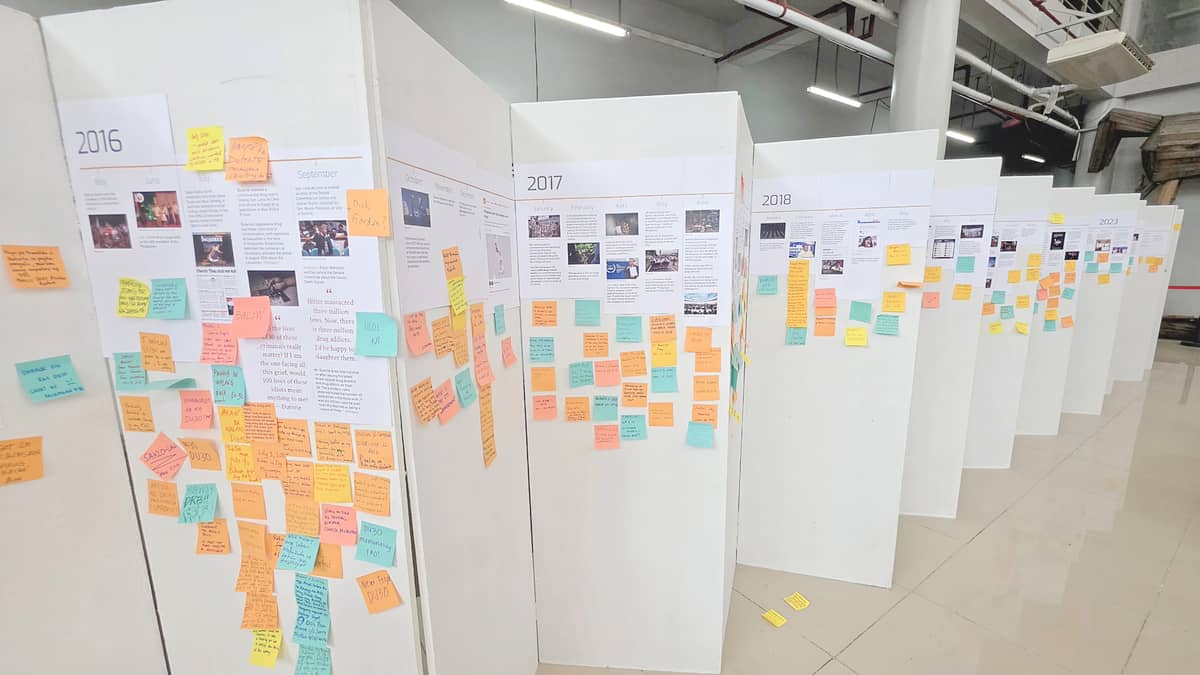
An interactive timeline chronicles a decade of killings and resistance, with visitors adding messages of anger, remembrance, solidarity and hope.
He continues to document the drug war and its extrajudicial killings, including the pursuit of accountability before the International Criminal Court in The Hague. In April 2026, the ICC confirmed three counts of crimes against humanity against Duterte.
A few years ago, I told Lerma, I had thought Duterte’s arrest by the ICC impossible. Lerma had thought so, too. When it finally happened, he said, the victims’ families were overcome with emotion and renewed hope.
Yet 10 years have passed, and justice remains elusive. Protests have been mounted; exhibitions, literary works, films and other forms of art and media have denounced the drug war; organizations have built programs to support survivors and bereaved families. Dekada, together with Patayin Talaga Kita! The Visual Regime of Duterte’s Drug War, presented by the UP Third World Studies Center at Palma Hall from 24 to 28 August, formed perhaps the most extensive exhibit yet on the crisis.
Julie Luch’s ‘Spoliarium in the Regime of EJK’ (marble and acrylic, 2020).
Portraits of extrajudicial-killing victims hang in a towering memorial installation, restoring individual faces and lives to the overwhelming death toll.
Dekada occupied the gallery’s atrium and spilled into Gallery One and the Multipurpose Hall, almost engulfing the building. It was also part of a multisite, multidisciplinary series of exhibitions, film screenings, discussions and public interventions running from July to December 2026.
Lerma described it as the largest gathering yet of advocacy groups and institutions seeking justice for victims and protesting the killings. Artists, journalists, academics, lawyers, church groups and human-rights defenders took part, as well as the families affected by extrajudicial killings.
According to Lerma, its impetus came from the families themselves, who reminded organizers that the tenth anniversary was approaching. Asked what they wanted to do, they said they wished to gather and remember. Hence the title — and their deep involvement in assembling the exhibition.
Harrowing exhibition
Dekada described itself as “a living archive, never final,” curated and created by a community that had witnessed the slaughter carried out under the name of a war on drugs. At its heart was a reclamation of humanity: the lives of people whom Duterte’s government had treated as less than human.
Relatives of the dead served as exhibition guides, telling visitors their stories and making the experience more immediate, personal and painful. Through these first-person accounts and its immersive environments, Dekada became one of the most heart-wrenching exhibitions I had encountered in years. Its forms were diverse: traditional artworks and interactive stations, monumental installations and intimate mementos, printed matter and audiovisual works.
At the center of the atrium stood Julie Lluch’s Spoliarium in the Regime of EJK (marble and acrylic, 2020). The sculpture echoes a central image in Juan Luna’s famous painting — a man dragging a fallen body by a rope — and speaks across time of brutality, degradation and abuse.
Nearby, accordion-fold panels carried a 10-year timeline of the drug war. It sought to ensure “that 10 years of destruction are neither sanitized nor forgotten” and to ground “our collective remembrance and unbroken pursuit for justice and accountability.” Visitors affixed handwritten messages on multicolored notes to the predominantly white panels, registering anger, solidarity, grief, and the desire for healing.
Among the largest installations was Samael Pascual’s Humihingang Lansangan (2026), a graffiti work on patched corrugated-iron sheets. It bore his short poem “Pauwi,” spoken in the innocent voice of a child who does not understand that he has been killed. He addresses his mother as though he were merely coming home after playing, transforming the promise of return and embrace into a final, unfulfilled farewell.
In Archie Oclos’ installation Papag (2025), candle wax from Silingan Candle Makers — a group composed of relatives of EJK victims — was pressed against the surfaces of places where violence had occurred, taking impressions of their cracks, abrasions and textures. Nearby, candles burned above a bust of Duterte, their wax dripping steadily onto his likeness. Over time, the face would be obscured and burdened by the same material used for mourning and remembrance.
The work of photojournalists Lerma, Ezra Acayan, Rico Cruz, Kimberly dela Cruz, Vincent Go, Eloisa Lopez, Hannah Reyes Morales, Basilio Sepe and Br. Jun Santiago, CSsR, appeared in Pagsubaybay, a collection that countered the abstractions of policy and statistics with the vivid realism of documented lives.
In Karapatan’s towering memorial installation, portraits of victims hung like rain, transforming an overwhelming death toll into individual faces, names, and lives.
The deeper one moved into the exhibition, the darker and more heartbreaking it became.
On one wall hung a cast of a simple white dress: Nikki Luna’s Cast Dress of Charlie Jean, made of resin and first exhibited in This Is How to Be a Woman of the World. Its stillness belied the violence behind it.
“Charlie Jean was fourteen when a twenty-nine-year-old man began grooming her; by fifteen, she was pregnant and living in his home,” Luna wrote in the accompanying note. Her mother gave her the dress for her birthday on 30 September 2017. Three weeks later, police stormed the house. Bullets tore through Charlie Jean’s arms, stomach and body as she begged for her life and that of her unborn son, already named Jesus.
Police later claimed that she had been holding a grenade, “a fabrication that turned a 14-year-old survivor of grooming into a headline of guilt,” Luna wrote. Before the raid and the label, however, Charlie Jean was a seventh grader who had just received a birthday dress from her mother. “This dress is what remains of the girl beneath the story — cast in permanence so that her life, not the accusation, is what endures.”
The installation DekadaTV recreated a typical Filipino sala, or living room, with a television showing films about the drug war’s harrowing effects. It restored the sala as a communal space: one in which people could sit together, choose what to watch, discuss what they had seen, and perhaps recover the pakikipagkapwa eroded by the campaign’s language of suspicion and dehumanization.
A larger installation recreated an entire room, complete with furniture, clothes, personal belongings and handwritten notes, many contributed by the victims’ families. Visitors were invited to enter as they would the home of a relative, and to encounter the humanity of people whom propaganda had portrayed as irredeemably bad — even monstrous.
What remains
A message from the families read: “Like visiting a friend’s house, we want you to see them not only through the way they died, but through the way they lived — with names, faces, dreams, families and homes to return to. Here are traces of people who loved, dreamed, worked, cared and were loved.” Against the long-repeated claims that the dead were “bad” or that they had fought back — “nanlaban sila” — the families insisted: “Not everyone who was killed was a bad person. There were good people who once lived among us. And now, they are gone.”
Recreated objects sat beside actual mementos. Among them were the gravestones of Luis Bonifacio and his son Gabriel, retrieved from Manila North Cemetery by Luis’ wife, Mary Ann Domingo, after their remains were exhumed when the lease on their niches expired. The stones had marked their deaths; in the gallery, they became witnesses to lives and to a family’s continuing demand for justice.
There were many more works to see and contemplate, and still more stories to hear. The exhibition deserved several visits, although each one would exact an emotional cost.
I asked Lerma whether photojournalists had followed the police during operations. He said they were usually called only after the killings and then allowed to photograph the scene. In the presence of police officers, shocked relatives were often too afraid to speak. It was at the funerals that journalists could finally talk with them.
Lerma later realized that the photographs had been welcomed partly because the killings themselves were being publicized to spread fear. The victims were made examples of what Duterte could — and would — do. But the images escaped that intended use. They opened many eyes to the campaign’s impunity and inhumanity and eventually became part of the body of evidence marshalled in the pursuit of accountability. The photographers resisted having their craft turned into an instrument of terror. Their images became, instead, instruments of resistance and remembrance — an insistence on truth, and perhaps a path toward justice.
I thanked Lerma for continuing to hold the line before stepping outside, where the rain had softened to a drizzle, as though leaving room for hope.