
Galilea’s sea of possibilities
On Panglao’s quieter side, a new hotel weaves Boholano hospitality into the expe rience of a stay.

Away from the hubbub of Alona Beach, on the quieter northwestern side of Panglao Island, Galilea Hotel Bohol opens onto a landscape that still feels provincial. Here, the pleasures of an island holiday come with an invitation to look more closely at the place one has come to visit.
The welcome begins with a large tapestry-like wall art depicting a gumamela or hibiscus, its familiar bloom, and other images rendered in saguran, woven young leaves of the buri palm. It is a fitting introduction to a hotel that wants Bohol to be felt in its interiors and encounters, as much as discovered on an excursion. Beyond the reception area, a sinuous swimming pool winds through clusters of buildings named after Bohol towns, separating them while gathering them into one restful space. Beyond the buildings, the property is ensconced by coconuts and other trees.
Soft-opened on 16 October, the property in the barangay of Looc joins the accommodation choices of an island province whose attractions range from the Chocolate Hills and heritage churches to tarsiers, living craft traditions, and white-sand shores. Located in the central Philippines and designated the country’s first UNESCO Global Geopark in 2023, Bohol offers a particularly rich meeting of natural history and old traditions. Panglao is among its busiest gateways; Galilea proposes a gentler place from which to explore it.
Its bright green and white buildings frame a blue courtyard of water. White spirals curl across the pool floor, echoing its bends, while white loungers occupy a shallow shelf. Balconies overlook the water, some spilling into the pool themselves; at night, warm light from the rooms softens the crisp geometry of the façades. The pool becomes the property’s common ground, a view shared across floors and a place around which the day can comfortably unfold.
Within the rooms, the mood turns quieter. White bed linen, wooden furniture, and neutral curtains allow the woven accents to hold attention. Pendant lamps cast delicate shadows, while the wall decor made with saguran introduces color and texture, bringing Bohol’s weaving traditions from Tubigon and Inabanga into the room. The saguran details, together with solihiya (sunburst) patterns, give the contemporary interiors a tactile connection to the province’s and the country’s craft heritage.
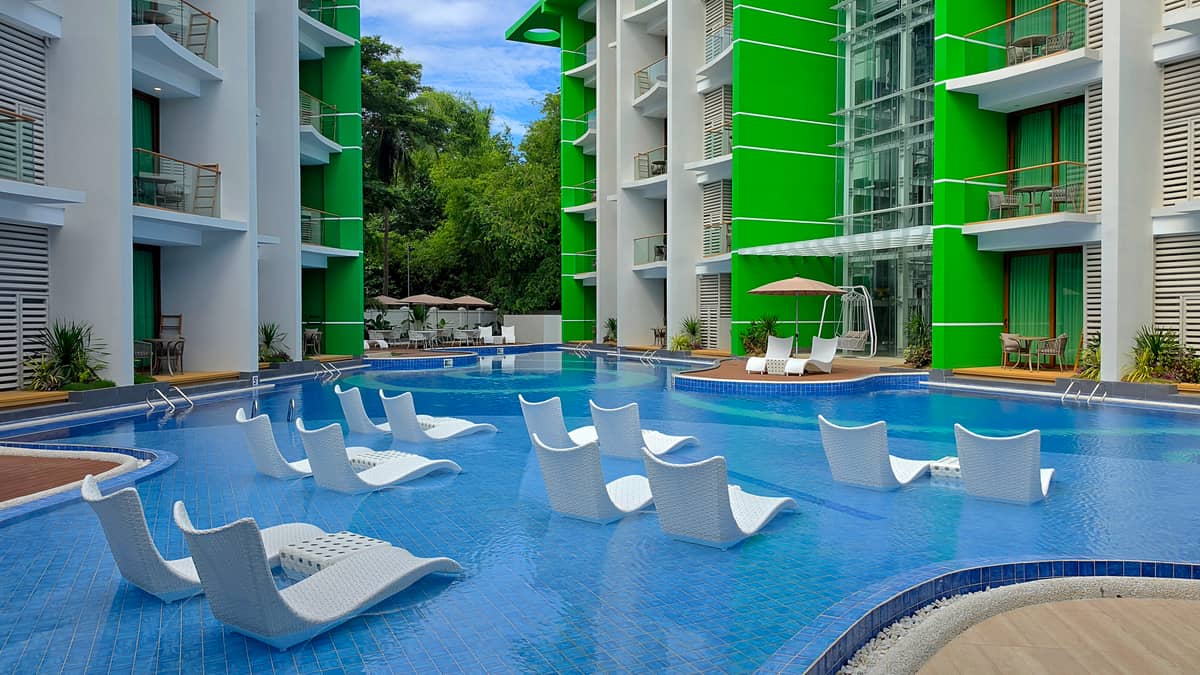
White loungers on a shallow pool shelf invite guests to slow down and soak in Galilea’s relaxed atmosphere.
For general manager Grace Bartolome, these objects are also beginnings of conversations. She hopes eventually to bring local weavers into the hotel for demonstrations and lessons, allowing guests to discover something of the skill behind the decorations. Saguran and rattan weaving are among the activities she envisions, alongside experiences that introduce Bohol’s ube and other local traditions.
This attention to local identity began before the opening. King Aces Travel and Tours chairman Luis Ramon de Leon, who is part of the board of ACDI and Prime Acers Holdings Corporation, recalled consultations with Bohol’s cultural offices and local artists during the planning stage. The team had looked into colors, building forms, and the designs that would eventually appear in the rooms. The intention is to let visitors meet Bohol through people and practices, extending their acquaintance beyond the familiar sightseeing route. These activities were still being developed at the opening, but they suggest how the hotel hopes to deepen its sense of place.
Even its emblem carries that intention. In her opening remarks, Bartolome explained that the gumamela-inspired logo incorporates earth, water, sun, wind and culture, connecting the hotel’s identity to its surroundings and roots.
“Just as the gumamela opens its petals, we open our doors with warmth and sincerity,” she said.
Galilea itself has taken time to bloom. Its history began with a local cooperative establishing the Galilea Center for Education and Development in 2007, with facilities including a six-room bungalow, spaces for dining and seminars, and a chapel. Retreats, workshops, and student programs gave the property its early purpose. Plans for a hotel followed in 2018, with groundbreaking for the expanded development in 2019. Today, it is owned by ACDI and Prime Acers Holdings Corporation, and managed by Enderun Hotels.
Retired Major General Gilbert S. Llanto, ACDI chairman, recalled that the original religious purpose broadened as Panglao’s tourism developed. The ambition became one of supporting a wider tourism ecosystem while promoting the distinctiveness of each destination. That cooperative background also informs the project’s promise to its host community.
“We want Galilea to buy local, hire local, support local enterprises, and grow together with the community,” Llanto said at the opening. “May it remain Boholano in heart, cooperative in spirit, and excellent in service.”
Enderun Hotels business development director Carlo Librea said the hotel hires mostly Boholanos, including its executive chef. For a property presenting itself through local hospitality, that places the people of the province at the center of the experience.
Galilea began operations with 63 guest rooms in its Loboc and Carmen wings. Bartolome said another wing would bring the planned inventory to about 122 rooms. The wings’ names bring the province’s geography into the everyday language of a stay, making even a room location a small reminder of the island beyond.
Five room categories accommodate different traveling companions. Superior Twin rooms suit friends or colleagues, Deluxe Queen rooms accommodate couples, and Deluxe Triple rooms provide a double and a single bed for small families or groups. Premier Queen and Premier King rooms offer direct pool access, bringing the water to the edge of a private outdoor sitting area. Room sizes range from 27 to 31 square meters.
Meals and gatherings give guests other reasons to linger. Hikay Restaurant, the all-day dining venue, pairs international fare with Boholano culinary offerings, while Lipay Pool Bar provides a place for a drink between outings or as evening settles over the courtyard.
The property also courts the meetings and celebrations market. Its Danao Ballroom and Lila Plenary Hall provide venues for professional and social gatherings, with the 380-square-meter convention space accommodating approximately 200 guests banquet-style or 300 theater-style. The Saint Thérèse of the Child Jesus Chapel preserves a visible connection to Galilea’s beginnings and adds a setting for prayer and religious celebrations.
Together, these facilities allow a family occasion, company gathering, or retreat to unfold within the property. They also connect its present ambitions with its longstanding role as a place where people assemble, learn, and spend time together.
The larger idea behind the welcome is what management and local officials call the “Sandugo Way.” Drawing inspiration from the blood compact associated with Bohol’s history, the hotel interprets it as a commitment to friendship, trust and shared community.
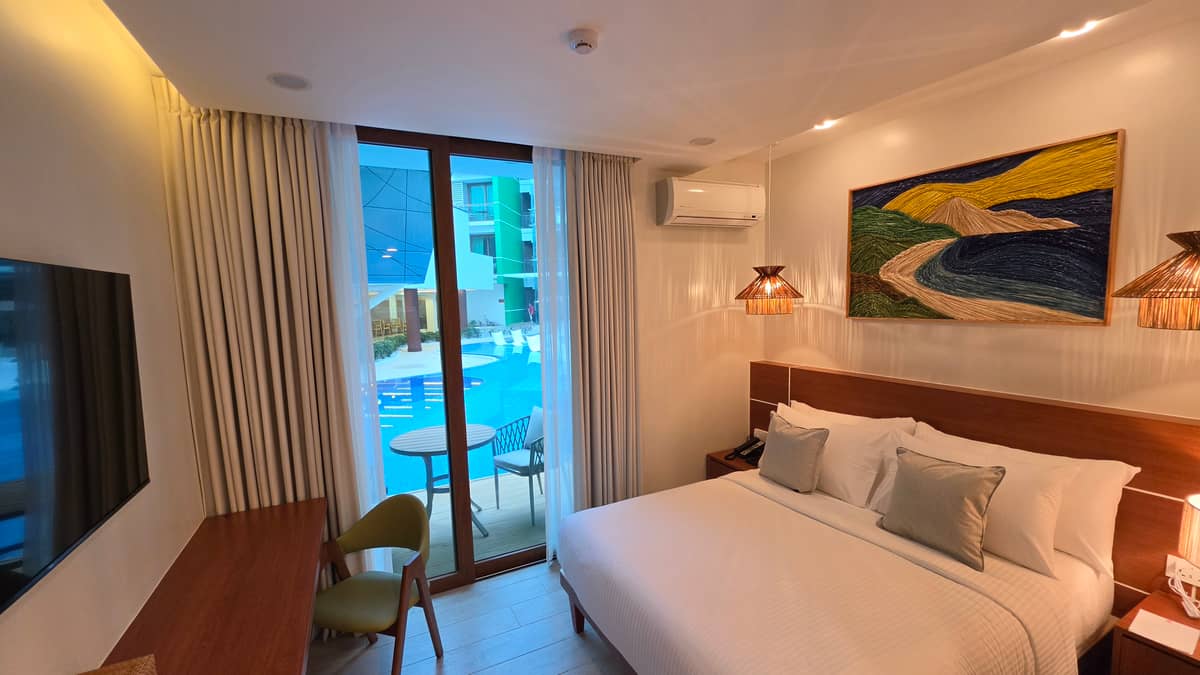
A poolside guest room brightened with saguran accents
Bartolome described this in more everyday terms: “We start hosting our guests, not as guests, but as friends. Sometimes, we treat them like family.”
Her model is the Bohol fiesta, when a household’s welcome reaches beyond its immediate circle. “The door is open for everybody,” she said. “Everything we do is coming from the heart.”
That open door may eventually become part of the itinerary. Llanto hopes to develop opportunities for visitors to experience actual community fiestas, encountering the food, music, and social life that make these celebrations important to Boholanos. The proposal remains a future undertaking, with the fiesta envisioned as a chance to share in the province’s traditions of welcome.
The corporation’s King Aces Travel and Tours, provides a link between accommodation and exploration through its travel services and land transportation. Llanto also spoke of a longer-term ambition to improve connections between island destinations through the group’s aviation resources. For now, these plans indicate the breadth of the vision of the people behind Galilea.
There is already plenty to discover beyond Galilea’s doors, such as Alona’s beach scene, Panglao’s marine attractions, and excursions into Bohol’s countryside. The hotel’s travel desk can assist with tours and transportation, allowing guests to shape their days around their interests and return to the poolside afterward.
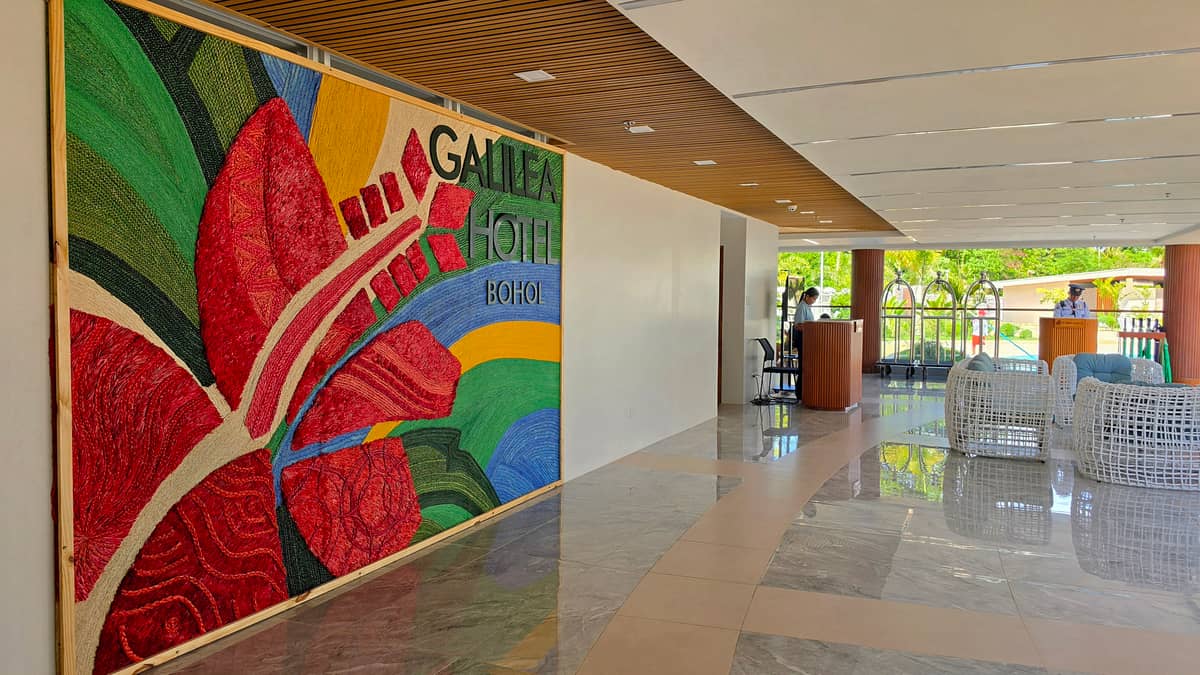
A large saguran tapestry depicting a red gumamela welcomes guests with an expression of Bohol’s weaving heritage.
But some of the most promising encounters may begin much closer: with a woven landscape above a bed, a conversation about a hometown fiesta, or a member of staff sharing a place remembered with affection. These modest exchanges can give an island its human dimensions, making a destination more particular and a visit more personal.
At Galilea Hotel Bohol, the river-like pool gathers the buildings around it and even connects people like the way rivers connect communities in Bohol and the Philippines, especially during the olden days. Threads of local craft and hospitality also provide another way to relate with the province. Its promise will find its fullest expression in those everyday connections. The welcome Bartolome offered at the opening is a good place to begin: “Dayon kamo”—come in, make yourselves at home.