
Who keeps the conglomerate in check?
A closer look at the board, risk safeguards and sustainability decisions overseeing one of the country’s largest conglomerates
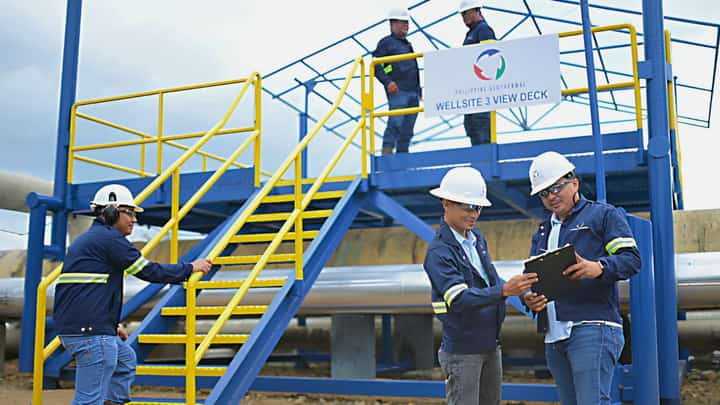
PHILIPPINE Geothermal Production Company personnel inspect the Wellsite 3 facility as the SM Group develops new geothermal sites in Luzon with the potential to deliver up to 400 megawatts of additional clean, renewable power to the country
PHOTOGRAPH COURTESY OF SM INVESTMENTS
Behind every major investment, acquisition and business expansion is a decision about risk, capital and accountability. For a conglomerate with interests spanning retail, banking and property, the challenge is not simply to grow its businesses, but to ensure that the decisions driving that growth are properly scrutinized.
At SM Investments Corporation, that responsibility rests partly with its Board of Directors, where five of the nine members are independent directors. This is led by Amando Tetangco Jr., the company’s first independent chairman and a former two-term governor of the Bangko Sentral ng Pilipinas.
Independent directors provide oversight beyond management’s dayto-day decisions. They are tasked with scrutinizing performance, protecting shareholder interests and ensuring that corporate decisions consider the interests of other stakeholders. They also lead key Board committees, including those overseeing risk management and related-party transactions.
The composition of the Board is another measure of its governance structure. Women account for onethird of its directors, 63 percent of management and 64 percent of the workforce, according to the company’s 2025 Integrated Report.
But board composition is only one part of corporate oversight. Equally important is how risks are identified, evaluated and addressed before they affect the business.
Through its Risk Management Committee, the Board oversees the group’s risk appetite, major exposures and mitigation strategies. Risk assessments are incorporated into annual planning, investment approvals, capital allocation, procurement and project approvals.
The company’s enterprise risk management framework, updated in 2025, follows ISO 31000:2018 and the COSO Enterprise Risk Management Framework. It covers strategic, operational, financial, technological, geopolitical, environmental, social and governance risks, with exposures assessed according to their likelihood, potential impact and interdependencies.
These mechanisms are particularly relevant for a conglomerate whose businesses operate across sectors with different market conditions, regulatory requirements and exposure to economic disruptions.
SM Investments has also received its third consecutive Five Golden Arrow Award from the Institute of Corporate Directors. Based on the ASEAN Corporate Governance Scorecard, the recognition evaluates companies on shareholder rights, board responsibilities, transparency, stakeholder relations and sustainability.
The same emphasis on oversight extends to sustainability, which the company has incorporated into its reporting, risk management and business operations.
SM Investments has adopted the International Financial Reporting Standards Sustainability Disclosure Standards, specifically IFRS S1 and IFRS S2, ahead of local implementation. These standards require companies to disclose sustainability-related and climaterelated risks and opportunities that could affect their financial prospects.
For SM Investments, one area where sustainability intersects directly with business strategy is energy.
In 2025, the SM Group increased renewable energy sourcing to 31 percent of its total electricity consumption, up from 27 percent in 2024. This represented approximately 730 million kilowat t-hours of renewable electricity and an estimated 370,644 metric tons of avoided carbon emissions, according to the company.
SM Investments president and CEO Frederic DyBuncio described the investment as both an environmental commitment and a business decision, citing its potential to manage long-term energy costs, improve operational efficiency and strengthen business resilience.
“For us, investing in renewable energy is both a sustainability and business decision,” DyBuncio said. “It helps us manage long-term energy costs, improve operational efficiency and build more resilient businesses to help us better serve our customers, tenants, communities and other stakeholders.”
The group’s energy investments also extend to geothermal power. Through the Philippine Geothermal Production Company, SM is developing new geothermal sites in Luzon that have the potential to provide up to 400 additional megawatts of renewable energy.
“Reliable and affordable energy is important not only for businesses but also for communities and the broader economy,” DyBuncio said. “We believe renewable energy, particularly geothermal, can help strengthen long-term energy security while supporting economic growth.”
For a conglomerate of SM Investments’ scale, governance is ultimately measured not only by the composition of its Board or the frameworks it adopts, but by how effectively these mechanisms guide decisions, manage risks and protect the company’s long-term interests.