
Where is SC headed under CJ Zalameda?
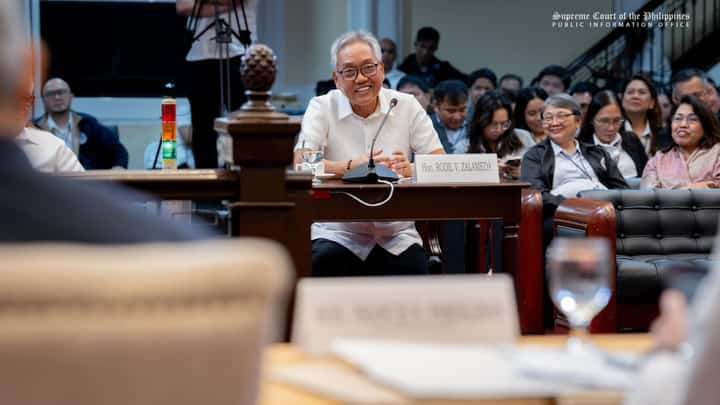
In the space of three years, Justice Rodil Zalameda wrote decisions covering two very different litigants: a former opposition lawmaker who sought protection from red-tagging, and a former first lady who challenged her graft conviction.
Together, they offer a glimpse of the legal thinking he may bring to the Supreme Court’s top post.
President Ferdinand Marcos Jr. on Thursday named Zalameda the 28th Chief Justice. He takes over from Alexander Gesmundo, who is retiring on 6 November on reaching the mandatory retirement age of 70.
Zalameda is the first chief justice appointed by Marcos. His record does not fit an easy political or ideological label. Still, his decisions as an associate justice, along with what he told the Judicial and Bar Council (JBC) during the selection process, tend to show the priorities he has set for himself.
Born in Caloocan City, Zalameda earned his Bachelor of Laws degree from Ateneo de Manila University in 1987 under an academic scholarship.
He was a dean’s lister and participated in extracurricular activities, serving as an associate editor of the Ateneo Law Journal and a senior staff member of the Ateneo Law Bulletin. He was also a member of the Fraternal Order of Utopia.
Early practice
Zalameda passed the bar in 1988, although he did not place in the top 10. He began his government career as a branch clerk in the Makati City Regional Trial Court before briefly entering private practice from 1990 to 1995.
He returned to government service in 1995 as a public prosecutor and was appointed Mandaluyong City prosecutor in 2002, at the age of 39. He later served as an associate justice of the Court of Appeals for 11 years, chairing its 17th Division, before being appointed to the Supreme Court in 2019 by then President Rodrigo Duterte.
Zalameda wrote the decision dated 4 July 2023, for the Court en banc in the case of former Bayan Muna Partylist Representative Siegfred Deduro. Deduro had sought a writ of amparo, alleging that military personnel red-tagged and surveilled him. The ruling was made public only in May 2024.
The Supreme Court reversed the Iloilo trial court’s dismissal of Deduro’s petition and issued the writ. It ordered a summary hearing and held that red-tagging, when it risks abduction or extrajudicial killing, can threaten a person’s life, liberty and security.
The Court stopped short of ruling on the truth of Deduro’s claims. The decision offered a remedy against threats to life and liberty while leaving the facts to be settled in the proper forum.
Zalameda also wrote the First Division decision acquitting former First Lady Imelda Marcos of seven counts of graft tied to Swiss foundations, reversing her 2018 Sandiganbayan conviction. The decision was dated 10 June 2026 and released on 9 September.
The Court found that the prosecution failed to prove her guilt beyond reasonable doubt.
Due process
The ruling said key Swiss bank records were not properly authenticated and the prosecution did not show that the foundations were “businesses” covered by the anti-graft law. The ruling stressed that the State’s interest in prosecuting graft cannot override an accused person’s right to due process.
The acquittal was politically charged because Imelda Marcos is the President’s mother. Martial law survivors and legal observers criticized the decision. Lawyer Ruben Carranza warned that Zalameda’s selection could further erode public confidence in the courts.
Read together, the rulings point to a justice who protects constitutional rights, insists on due process, and expects courts to decide on evidence and the law.
They do not reveal a fixed political leaning or predict how he will vote. Both were rulings of the High Court, with Zalameda as the ponente or writer, and not statements of a personal judicial philosophy.
In his JBC interview on 26 October, Zalameda outlined an agenda built on measurable results.
Reforms would roll out in phases: set baselines and priorities, test initiatives, then expand the ones that work.
He said success should be judged by the impact on ordinary Filipinos, not by the number of projects launched. He proposed a specialized anti-graft monitoring group and measures to speed up trials. He also pledged leadership rooted in service and accountability, and a supportive workplace for court personnel.
Still only one vote
His own career informs that last pledge. From his early years as a branch clerk and prosecutor to his years in private practice, in the Court of Appeals, and the Supreme Court, Zalameda has served in different capacities within the justice system.
In announcing the appointment, Presidential Communications Office Acting Secretary Lino Cayetano said the President recognized the importance of “experienced and principled leadership” in preserving public confidence in judicial institutions.
“The President expresses his confidence that Justice Zalameda will discharge the responsibilities of Chief Justice with integrity, impartiality, and an unwavering commitment to the rule of law,” Cayetano said.
The Chief Justice leads the Judiciary and presides over the Supreme Court, but is still only one vote on a 15-member tribunal. The Court’s rulings are collective, and its independence rests on the institution as a whole.
Zalameda’s tenure will therefore be judged on more than the cases he writes. The test is whether his reforms deliver faster trials, stronger accountability, and renewed public trust in the courts.