
ASEAN, EU push blue economy skills, innovation
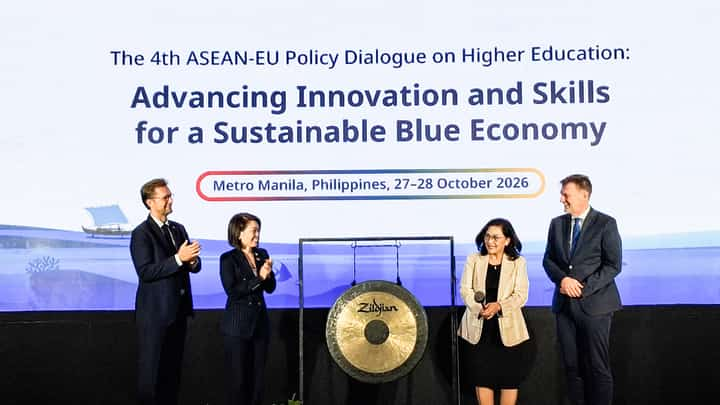
(From left to right) Deputy Head of the European Union Mission to ASEAN Dr. Radomir Jansky, Singapore Ambassador to the Philippines Constance See, CHED Chairperson Dr. Shirley Agrupis and Nuffic Director General Marco Schouten sounded the gong, marking the start of the two-day policy dialogue on higher education for the blue economy on 27 October at Seda Vertis North, Quezon City.
Photograph by Sean Magbanua
The Association of Southeast Asian Nations (ASEAN) and the European Union (EU) have renewed their commitment to strengthening higher education cooperation, focusing on skills development, research and innovation to support a sustainable blue economy.
Policymakers, educators and industry representatives gathered Tuesday for the two-day 4th EU-ASEAN Policy Dialogue on Higher Education, organized under the EU-funded Sustainable Connectivity Package – Higher Education (SCOPE-HE) in partnership with the Commission on Higher Education (CHED).
CHED Chairperson Shirley Agrupis emphasized the need to align academic programs and research with industry requirements.
“Universities, developed institutions, industry and government must work together to ensure that what we teach and discover and what our industries need are not disconnected efforts but parts of a common agenda,” Agrupis said.
“This requires progress on two fronts: preparing people to shape the future of the blue economy and harnessing research and innovation to make the future sustainable,” she added.
The blue economy refers to the sustainable use of marine and coastal resources to support economic growth, livelihoods and environmental protection.
Agrupis said the Philippines' 2,366 higher education institutions could play a significant role in developing professionals and technical expertise for marine-related industries.
Singapore Ambassador to the Philippines Constance See also underscored the importance of preparing workers for emerging opportunities.
“Achieving sustainable growth will depend not only on new technologies and policies, but also on our ability to develop the people and the skills needed for the future,” See said.
She noted that marine resources are essential to trade, livelihoods and economic development across ASEAN and the EU.
ASEAN Secretary-General Kao Kim Hourn opened the dialogue, highlighting higher education cooperation as part of the region's pursuit of inclusive and sustainable growth.
Blue economy legislation
Agrupis also highlighted proposals for a Philippine Blue Economy Act, which would establish a framework for the sustainable development of coastal and marine resources.
The proposed measures include integrating ocean literacy into education, strengthening marine research and expanding technical and vocational training.
“We also recognize that our work must extend beyond university degrees,” Agrupis said.
“The blue economy needs researchers and engineers, as well as skilled technicians and practitioners who can translate knowledge into action,” she added.
She stressed that higher education institutions and technical-vocational training providers must coordinate with industry to equip Filipinos with relevant skills.