
Sara threshold fight tests Senate, SC powers

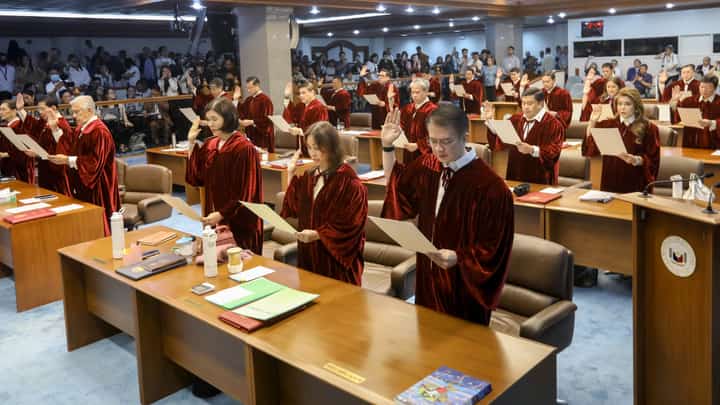
TRIAL unfolds Senators take their oath as the impeachment court convenes at the Senate in Pasay City on Monday for the trial of Vice President Sara Duterte. Outside the complex, opposing groups of protesters gather, underscoring heightened tensions surrounding the proceedings. The Vice President faces charges over alleged misuse of confidential funds, unexplained wealth, and controversial statements against President Ferdinand Marcos Jr., First Lady Liza Araneta-Marcos and House Speaker Martin Romualdez.
PHOTOGRAPH by Aram Lascano for DAILY TRIBUNE
The dispute over the 16-vote requirement to convict Vice President Sara Duterte is shaping up as a test not only of the Senate’s impeachment power but also of the Supreme Court (SC)’s authority to interpret the Constitution, an expert said Wednesday.
University of the Philippines College of Law professor Dante Gatmaytan said the question remains unsettled because no SC ruling has directly determined how many votes are constitutionally required to convict an impeached official under the 1987 Constitution.
“Technically, the issue of how many votes are required to convict a person who has been impeached has not been settled. There is no Supreme Court decision that answers that question. So, it’s open,” Gatmaytan said in a television interview.
In July, the Senate impeachment court initially adopted a 16-vote threshold, based on the constitutional requirement that conviction requires the concurrence of two-thirds of all members of the Senate.
But Senator-judge Erwin Tulfo on Tuesday has asked the impeachment court to clarify who among the senators can validly vote when the case reaches the final judgment.
Under Article XI, Section 3 of the Constitution, the Senate has the “sole power to try and decide all cases of impeachment,” while conviction requires the concurrence of two-thirds of all its members.
That language puts the Senate at the center of the dispute. But Gatmaytan said the SC’s power to interpret the Constitution creates a competing constitutional claim.
“I think the Senate sitting as an impeachment court or the Senate has the power to interpret the Constitution because according to the Constitution, as you pointed out, they have the sole power to try an individual,” he said.
“However, under our jurisprudence, our Supreme Court justifies judicial review when there is a question of interpretation of the provisions of the Constitution.”
The Senate is now preparing to hear from legal experts, with amici curiae expected to weigh in on the issue and oral arguments between the prosecution and defense scheduled for 23 September.
The first question before the impeachment court, however, is whether existing jurisprudence provides a clear basis for the 16-vote requirement.
No direct SC ruling
Gatmaytan rejected arguments that existing SC jurisprudence has already settled the question in favor of a two-thirds vote of the entire Senate.
He said Avellino v. Cuenco, one of the cases cited in the debate, did not involve the number of votes required to convict an impeached official.
He noted that the 1935 Constitution contained a separate provision governing the number of votes needed to convict an impeached official, but said that issue was not discussed in Avellino.
Gatmaitan likewise said Bayan v. Zamora does not resolve the current dispute. The case concerned the Senate’s concurrence in a treaty, he said, not an impeachment conviction.
“If you examine that case, one, the issue of the number of votes required was not an issue, and number two, it was specific to the question of the concurrence of the Senate to a treaty,” he said.
“Again, it did not touch on the constitutional provisions on impeachment and the votes necessary to find someone guilty.”
With neither case providing the answer, the dispute turns to the composition of the voting body itself: who should be included when the threshold is calculated?
Who should be counted?
Gatmaytan said the dispute should ultimately be settled because the same constitutional question could arise in future impeachment proceedings.
“I think there’s a possibility that similar cases might happen in the future and therefore, whether it is to be decided by the Senate or the Supreme Court, we have to have categorical statements on who among the senators should be counted when we are counting votes for the acquittal or conviction of an impeached official,” he said.
Gatmaytan said the framers of the Constitution may not have anticipated a situation in which senator-judges would become unavailable because of criminal proceedings, detention or other circumstances.
He also rejected the idea that an absent senator-judge could cast a vote that carries less weight than that of a participating senator.
“I’m very sure that if the senators were not able to take their oath as a senator judge, they cannot be allowed to vote,” he said.
Gatmaytan also questioned whether a senator who had not attended the proceedings could properly vote on Duterte's guilt or innocence.
“I think it will be a mockery of the entire system if we allowed people who were never present and were able to appreciate the evidence or the testimonies to come in suddenly and be allowed to vote,” he said.
The question of who may vote, however, is only part of the larger constitutional dispute. Even if the Senate settles the threshold for Duterte’s trial, it remains unclear whether its interpretation would be the final word.
A question bigger than Duterte
Gatmaytan said the threshold dispute should not be viewed solely through the lens of Duterte's impeachment.
Sen. Tulfo has warned that failing to resolve the issue could result in what he described as an “acquittal by default” if the number of senators available to vote falls below the required threshold.
Gatmaytan agreed that the issue warrants a definitive interpretation.
The question now is not simply whether Duterte can be convicted by 16 senators, but who has the constitutional authority to determine how that number should be calculated.
For Gatmaytan, neither institution's position is entirely free from constitutional tension: the Senate has the Constitution's express grant of the sole power to try and decide impeachment cases, while the Supreme Court has the power to interpret constitutional provisions and exercise judicial review.
Whether the dispute ultimately ends with the Senate or reaches the Supreme Court, he said, the country needs a categorical answer that can govern future impeachment cases as well.