
Review: TGA’s 'The Notebook The Musical' triumphs on the Manila stage
Despite opening-night technical glitches, an exceptional Filipino cast makes TGA’s production worth remembering


An intense summer love cut short beneath North Carolina skies. A miracle of devotion that defies time. This is the story of a boy and a girl severed by class, war, distance, and ultimately, memory.
Whether you revere or resist Nicholas Sparks’ novel or the cult-classic film with its iconic, rain-soaked kiss, shed those expectations before entering the theater. There are no Ferris wheel stunts from Noah here, nor migratory swans. Instead, this musical adaptation takes the story in a distinctly theatrical direction, allowing past and present to coalesce into a singular vision.
Playing a limited 18-show run at the Samsung Performing Arts Theater, Theatre Group Asia’s production of The Notebook The Musical can make you weep or leave you dry-eyed, but it will undoubtedly move you.
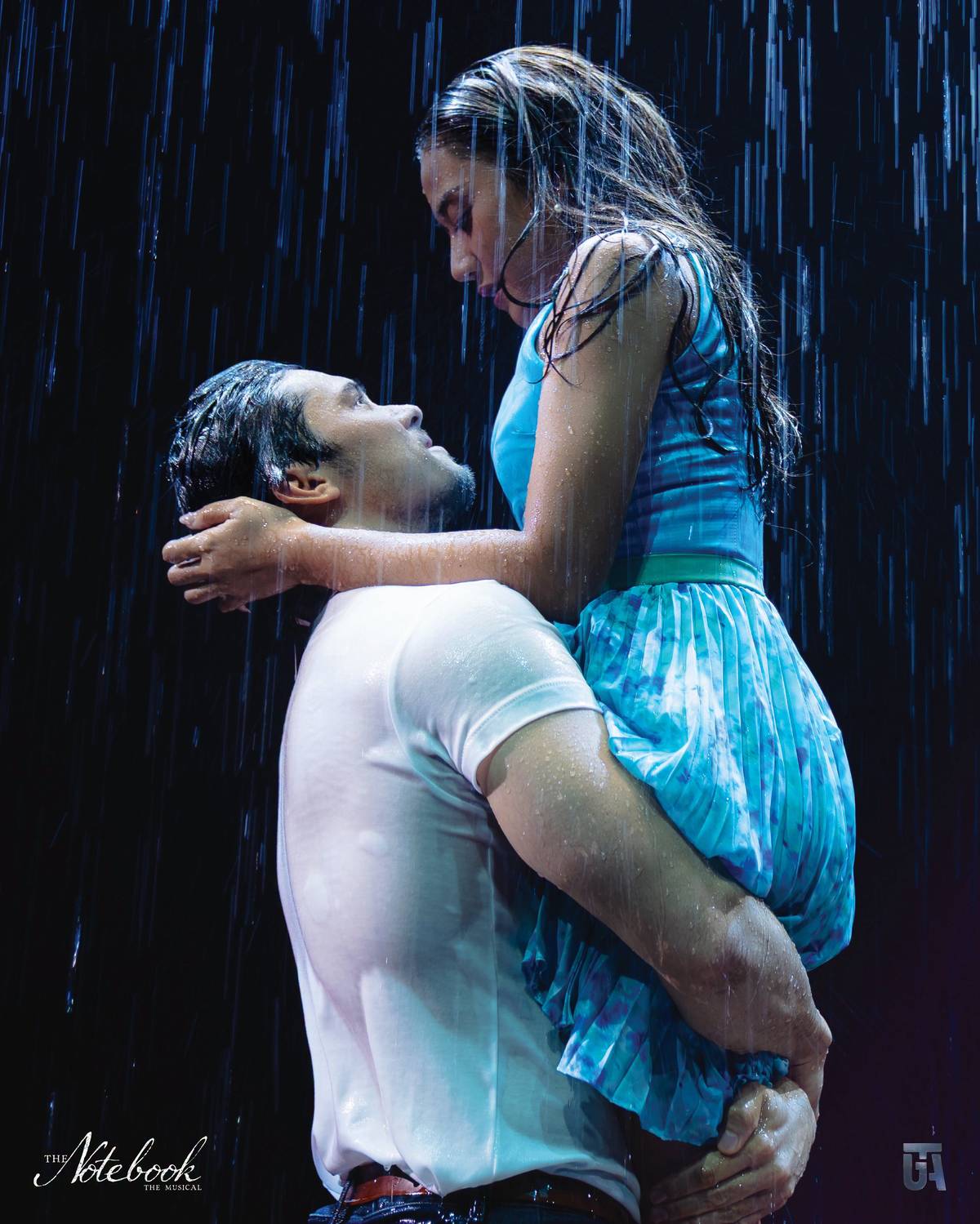
With a book by Bekah Brunstetter, the musical plunges into the nature of time. Shakespeare framed time as a destroyer; T.S. Eliot saw past, present, and future as overlapping states of consciousness; Proust proved memory can collapse it entirely. Old Noah, in the musical, laments, “Time is never mine.”
Time becomes the core mechanism of a romance hijacked by dementia—retaining the narrative heart of the film while engineering a distinct theatrical landscape.
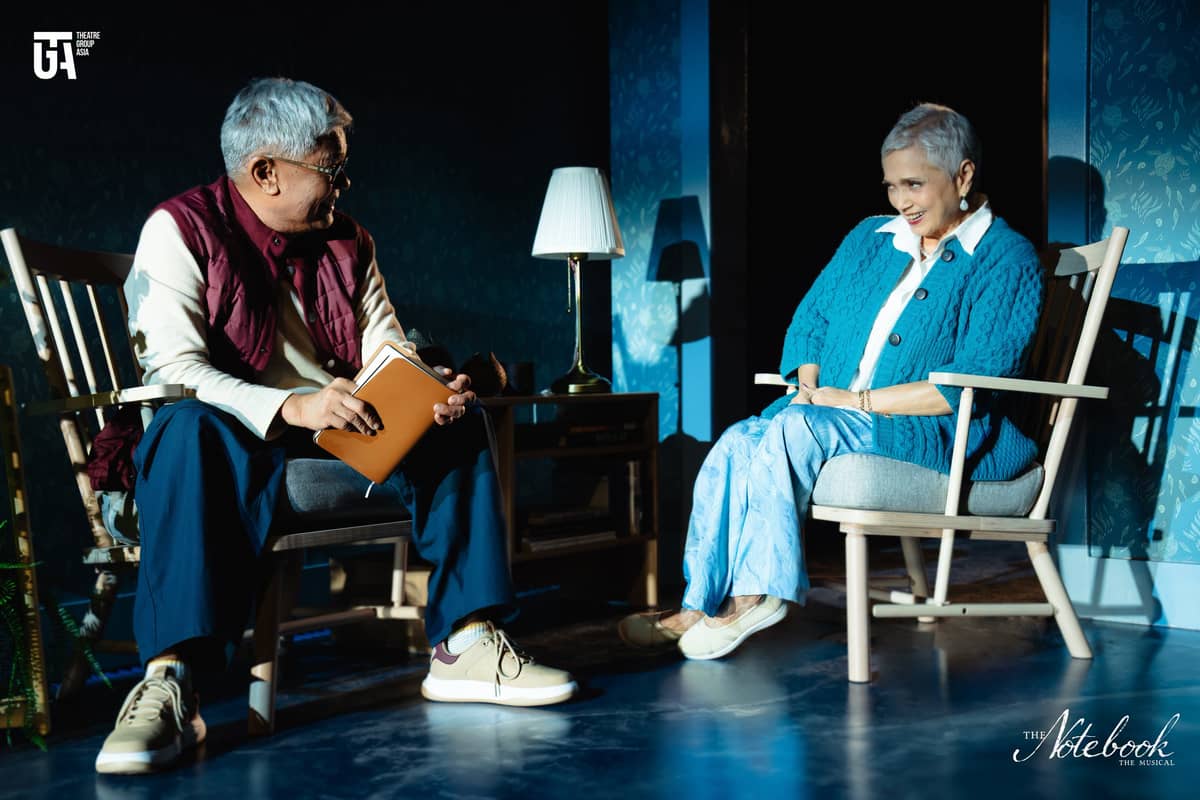
Three timelines intermingle: young Noah and Allie (Benedix Ramos and Sheena Belarmino), their adult counterparts (Laurence Mossman and Morissette), and the elder pair (Rody Vera and Celeste Legaspi) at the story’s center, as Noah reads their history to an Allie lost to Alzheimer’s. It is an intelligent framework: memory does not function like a filing cabinet—it leaks, bleeds, and intrudes upon the present.
Ingrid Michaelson’s score understands this implicitly. Infusing folk-pop, indie-pop, and country sensibilities, she delivers an intimate soundscape far removed from traditional Broadway bombast.
Her lyrics are raw and emotionally direct. Simple, and often strikingly domestic. A line such as “heat up the kettle, butter some bread” takes an ordinary household action and places it within a larger emotional landscape.
The words are not elaborate poetry, but that is part of their appeal. Pining in his newly framed house, for instance, Noah sings, “Where have you gone? Just out for a walk? I’ll leave the light on anyway.” The words become immediate shorthand for the desire to build a life together with Allie, proving Michaelson’s gift for endowing the ordinary with profound meaning.
This is also one of the musical’s cleverest uses of the conventions of musical theater. In ordinary life, people rarely have direct access to another person’s private thoughts. Romantic relationships are full of questions: What is this person feeling? What does this person really want? What is being left unsaid? In this musical, those private thoughts are sung, heartbreakingly painful or funny, yet relatable in their unfiltered truths.
And the stellar cast gives these songs visceral life. Belarmino is a clear standout; every song she sings reveals a deep understanding of Allie’s emotional journey. She moves from tenderness to pain with remarkable ease, proving once again the instinct for acting she has demonstrated in every role since I first saw her in Spring Awakening.
Morissette’s “My Days” is a powerhouse 11 o’clock number, but the abrupt visual reveal of the orchestra turns it into a concert spectacle, pulling us out of the story as she briefly ceases to be Allie and becomes Morissette the pop star. The production thus undercuts what should be an emotionally immersive moment. Nevertheless, the production showcases her overall genuine dramatic and comedic chops.
Vera is superb as Older Noah—ornery, limping, and commanding, embodying the soul of a man who touchingly refuses to relinquish hope for a miracle. Legaspi’s thick Filipino accent initially jars against her castmates' neutral American tones, but her nuanced portrayal of dementia quickly renders the discrepancy irrelevant. A similar vocal clash occurs with Carla Guevara Laforteza’s pronounced Southern drawl as the mother, though the strength of the ensemble keeps the production grounded.
However, the September 2 gala occasionally felt more like a technical dress rehearsal. A scrim caught on the house, shutters required adjustment mid-scene, and narrow spotlights had to be adjusted while soloists were performing. In years of attending Virgin Labfest technical dress rehearsals, I have never encountered this many technical adjustments taking place in the middle of a scene.
The wooden boat creaked loudly as actors dragged it across the stage, a distracting contrast to the magical boat in 9 Works Theatrical's staging of Yemaya, which is suspended by strings from above and controlled to hover just above the floor, allowing it to move smoothly and almost effortlessly across the stage.
Microphones crackled upon sudden movements, a visible black, not flesh-colored, coil of mic cable trailed down Ramos’ bare back, and the rain effect resembled a localized rain cloud that barely caught Morissette. While fixable, these technical slip-ups made the production feel surprisingly unprepared for a high-profile press and VIP gala.
Yet these lapses do not diminish the strength of the production’s overall visual design, particularly Miguel Urbino’s set. A skeletal house, complete with pitched roof, balcony, and an open ground level, provides a substantial architectural framework for the narrative. Scrims function as portals to the past, while surrounding elements evoke North Carolina through painterly, dreamlike hues that suggest the fluid nature of memory rather than a literal landscape.
Flanked by the subtle boundaries of a nursing home at the stage edges, memories materialize behind them, reinforcing the musical’s central thesis: the past does not need to vanish for the present to exist. It is a restrained design that trusts the minimalist score, allowing the expressive force of the performances to fill the space.
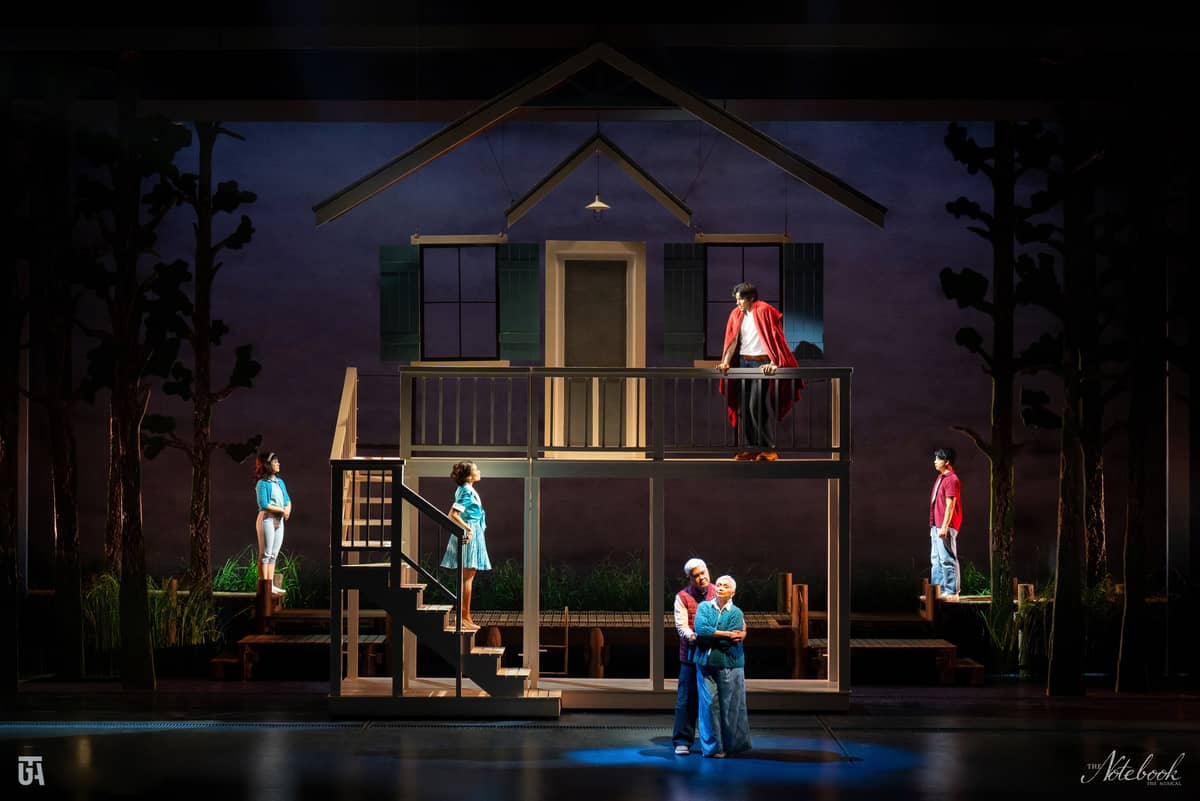
Nicholas Polonio’s direction handles the temporal shifts with fluid assurance. Beautiful transitions feel organic, avoiding dead air and allowing movement to drive the narrative. Crucially, the six leads make three distinct ages feel like one continuous Noah and Allie, relying on costume, physical behavior, and emotional continuity rather than literal physical or facial resemblance.
The strength of this ensemble also speaks to TGA’s discernment. The company knows exactly whom to put in these roles, choosing artists who can sing with exceptional ability while fully inhabiting their characters. The result is an all-Filipino cast capable of carrying emotionally complex material with conviction.
The Notebook The Musical is not in the same artistic league as Les Misérables, Into the Woods, or The Phantom of the Opera, nor does it aspire to that kind of theatrical ambition. Its appeal is more immediate: an accessible romantic story, intimate songs, and characters whose private feelings are placed directly before the audience. That clarity of purpose is precisely what TGA understands, knowing what the musical needs and which Filipino artists have the range and talent to deliver it.
Technical hiccups aside, which could be easily ironed out in the succeeding performances, this staging of Brunstetter’s Tony-nominated book tells the story on its own terms rather than simply cloning the film. And TGA gives the licensed production a new and vibrant theatrical life on a Manila stage, powered by top-notch Filipino talent and worthy of its status as an international premiere.
The Notebook The Musical plays from 3 to 20 September 2026, at the Samsung Performing Arts Theater, Ayala Malls Circuit, Makati.