
Nepali rescuers face danger from dam burst
More than 1,400 people are missing, including trekkers in the Himalayas and scores of Hindu pilgrims to Tibet’s sacred snow-capped Mount Kailash.
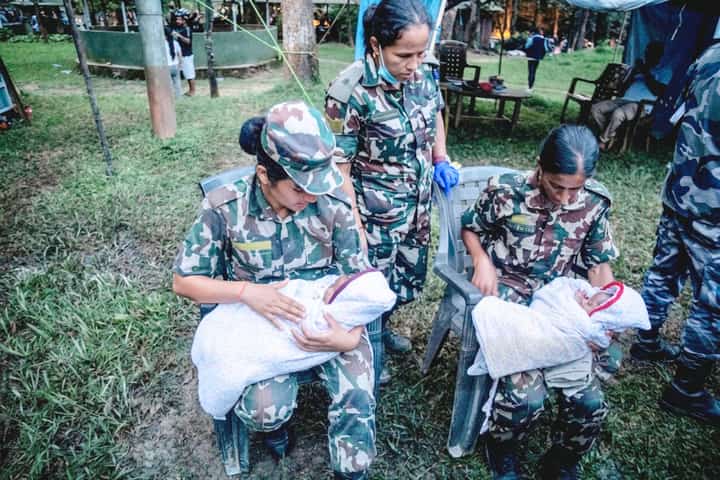
NEPALI Army soldiers comfort twin infants during rescue operations in the aftermath of flash floods, at Trishuli camp in Nepal’s Nuwakot district on 27 August 2026.
PRABIN RANABHAT/AGENCE FRANCE-PRESSE
NUWAKOT, Nepal (AFP) — Nepal ordered rescuers searching for survivors of deadly floods to get to safety as it reported a debris dam had burst in Tibet on Friday, bringing risks of new torrents.
Emergency teams have recovered 472 bodies after a tsunami-like wall of water and mud crashed down on Wednesday, burying homes, smashing bridges and sweeping away vehicles in both Nepal and Tibet.
More than 1,400 people are missing, including trekkers in the Himalayas and scores of Hindu pilgrims to Tibet’s sacred snow-capped Mount Kailash.
The United States Geological Survey said the disaster — the deadliest for Nepal since a 2015 earthquake — was caused by a glacial collapse that triggered a vast flow of icy debris.
The deluge of ice and mud also caused huge pools of water to form, with one of these formations bursting on Friday in Tibet in a new threat to emergency workers scouring the region for survivors.
Nepali police urged all rescuers to “immediately move to a safe location,” saying it had received information that “a water dam has burst again on the Tibetan side.”
Separately in Tibet, China had earlier Friday paused its rescue operation at the hardest-hit area of Gyirong over the risk of renewed flooding.
State broadcaster CCTV reported that a lake formed by immense piles of debris has begun overflowing towards the area that rescue teams were headed.
“So all rescue teams have been ordered to stand by in place and wait for further instructions,” it said, adding that emergency teams which had earlier accessed the area “have been ordered to withdraw one kilometer.”
Tunnel rescue
Emergency teams had been racing to retrieve survivors from affected zones, where the widespread devastation mean food and water supplies were running out.
The Nepali military had meanwhile located people trapped in the tunnel of Trishuli 3A hydropower project, where they are working to find a way in to retrieve the survivors.
“Two helicopters have been dispatched but it is challenging because it is tough to even locate the entry points of the tunnel,” army spokesperson Raja Ram Basnet told Agence France-Presse.
Some 350 workers and residents have been brought to safety from the site, he added, but efforts were ongoing to extract more than 100 people trapped in the same area.
Workers rescued from other dam projects along the Trishuli valley described a disaster that unfolded with terrifying speed.
Worker Buddha Tamang said he survived only because he was inside a tunnel at the dam where he worked when the flood struck — but he had managed to get out and reach help.
“I survived as I was in the tunnel,” said Tamang, who was airlifted on Thursday after being marooned for more than 24 hours.
“The senior officers working on the other side, they were all swept away.”