
Leonen urges critical, human-centered use of AI in Philippine justice system

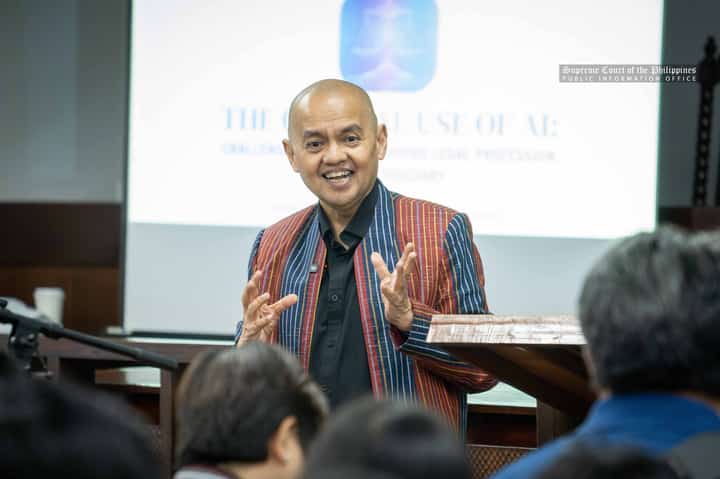
Artificial intelligence can assist lawyers and the Judiciary, but its use must remain critical, human-centered and subject to human judgment, then Acting Chief Justice Marvic M.V.F. Leonen said during a special lecture in Baguio City.
Leonen delivered the lecture, titled “The Critical Use of AI: Challenges for the Philippine Legal Profession and the Judiciary,” on 20 August at the Supreme Court Session Hall, where trial court judges, lawyers and law students from across the Cordillera region gathered.
He urged members of the legal profession and the Judiciary to approach AI with caution by verifying its outputs, protecting sensitive information, maintaining a record of AI use and preserving independent legal and analytical judgment.
As chair of the Supreme Court’s Committee on Human-Centered Augmented Intelligence, Leonen also discussed the Court’s Governance Framework on the Use of Human-Centered Augmented Intelligence in the Judiciary, approved by the Supreme Court En Banc on 18 February 2026.
The framework supports the objectives of the Strategic Plan for Judicial Innovations 2022-2027, which promotes technological innovation in court operations and the administration of justice.
Leonen said AI can be useful in generating language and providing context, but its fluency should not be mistaken for human understanding.
“An AI model can parse a contract; it can analyze it, but it cannot tell you whether these two parties understood the words the way the words read,” Leonen said, pointing out that AI may also fail to recognize irony, regional expressions and the difference between what a witness says and what the witness actually means.
He also distinguished digitalization from artificial intelligence, noting that digitalization primarily involves moving court processes and records from paper to digital platforms to improve speed, accessibility, transparency and resilience.
AI, meanwhile, involves systems capable of predicting, classifying and generating information, moving beyond the digitalization of existing processes.
Leonen said human intelligence remains fundamentally different from AI because it is shaped by lived and embodied experiences.
“The difference of human thinking from that of AI can never be covered by an update or the next release note,” he said.
He warned that the apparent confidence and fluency of AI systems can make their mistakes particularly dangerous, stressing that practical wisdom is developed through human experience and cannot simply be computed.
Leonen also underscored the cultural and relational dimensions of human intelligence, noting that concepts such as kapwa and loob are rooted in shared experiences, relationships and accountability that machines cannot independently possess.
He identified four approaches to AI use: use, responsible use, ethical use and critical use.
According to Leonen, critical use places the greatest responsibility on the human user because it requires the ability to identify and correct AI-generated errors.
“Critical use means that when you use AI, you should be capable of catching its errors,” he said.
Leonen likewise emphasized the importance of maintaining an “interval” or pause between receiving information and making a decision. For lawyers and judges, he said, this space allows them to assess circumstances and exercise independent judgment instead of simply accepting AI-generated answers.
During the open forum, Leonen discussed the Supreme Court’s approach to emerging technology, saying that while the Court continues to pursue digitalization, it remains cautious about adopting AI.
The Court currently uses the AI-powered transcription tool Scriptix, which has helped reduce the time required for court stenographers to transcribe proceedings while retaining human oversight in the process.
The lecture was organized to promote a more informed and responsible approach to AI among members of the legal profession and the Judiciary as the technology continues to develop.