
Follow that car
This is where the AI earns its keep because finding the same vehicle across changing camera angles is exactly the problem that vehicle re-identification tries to solve.

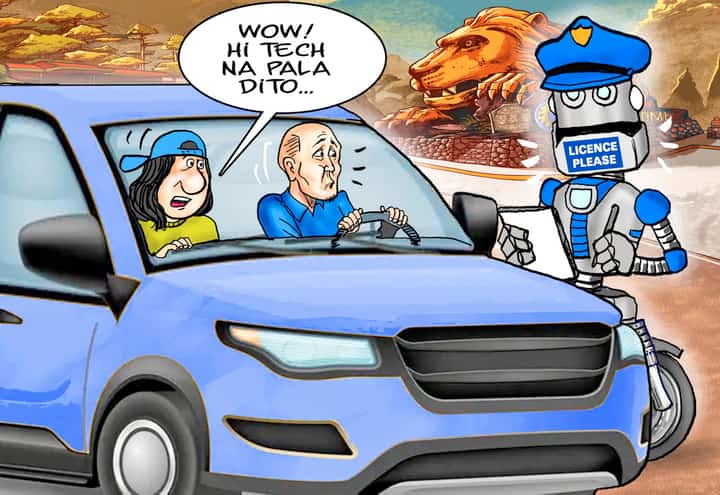
A gray MPV entered Baguio through Irisan at around 11:22 a.m. on 23 May.
Eight minutes later, a CCTV camera caught the vehicle violating the city’s “King of the Road” ordinance at a pedestrian lane along Yandoc Street.
The gray MPV was clearly captured, but sunlight glare made the plate number difficult to read.
Baguio’s Smart and Safe City Command Center and its investigators reviewed footage from other cameras and used the city’s AI-assisted monitoring system to trace the vehicle.
The search led authorities to the registered owner. The driver was contacted, reportedly acknowledged the violation and was issued a traffic citation.
I know Baguio’s roads quite well.
I worked at Texas Instruments Philippines in Baguio for five years and drove to Manila almost every weekend. On Sunday nights, I would leave Manila around midnight and head back up so I could report for work on Monday morning.
That was long before SCTEX and TPLEX shortened the trip. There was no SM City Baguio yet, traffic was lighter and I remember taxi drivers returning my change even when it was only one peso.
I have not driven around Baguio for years, so reading that the city can now use AI-assisted cameras to trace a vehicle caught my attention.
My work with AI made me curious about how they may have done it.
Baguio has not disclosed exactly how its system traced the MPV, so I can only make an educated guess based on technology already being developed and tested elsewhere.
One good example is CityFlow, a research benchmark introduced at the 2019 IEEE/CVF Conference on Computer Vision and Pattern Recognition.
CityFlow contains more than three hours of synchronized video from 40 cameras covering 10 intersections. Researchers use it to develop systems that can follow the same vehicle as it moves from one camera to another.
A key part of the process is called vehicle re-identification.
It does not have to rely only on the plate number.
In the Baguio case, investigators already knew they were looking for a gray MPV seen on Yandoc Street at around 11:30 a.m.
That gives the search a starting point.
If the vehicle appears on another camera several minutes later, the system can compare it with the original image. A similar gray MPV appearing somewhere that could not reasonably be reached in that amount of time can be removed from the list.
The next camera may see the rear instead of the front. Another may record the vehicle under different lighting or with other cars partly blocking the view.
This is where the AI earns its keep because finding the same vehicle across changing camera angles is exactly the problem that vehicle re-identification tries to solve.
The city said its investigation team reviewed additional CCTV footage and used AI-assisted monitoring to trace the vehicle. It did not say that a computer automatically identified the owner and issued the citation.
My guess is that AI helped narrow the number of possible matches, while investigators checked the footage that looked relevant.
The camera at Yandoc Street did not get everything it needed and may have missed the plate number. Connect enough of them with AI, and they can compare notes.
Apparently, even CCTV has a group chat now.