
Gospel according to Reverend Wowa Ledama
‘Si Wowa, Diyos, at Bayan’ recounts the remarkable life of the Philippines’ first transgender clergywoman.


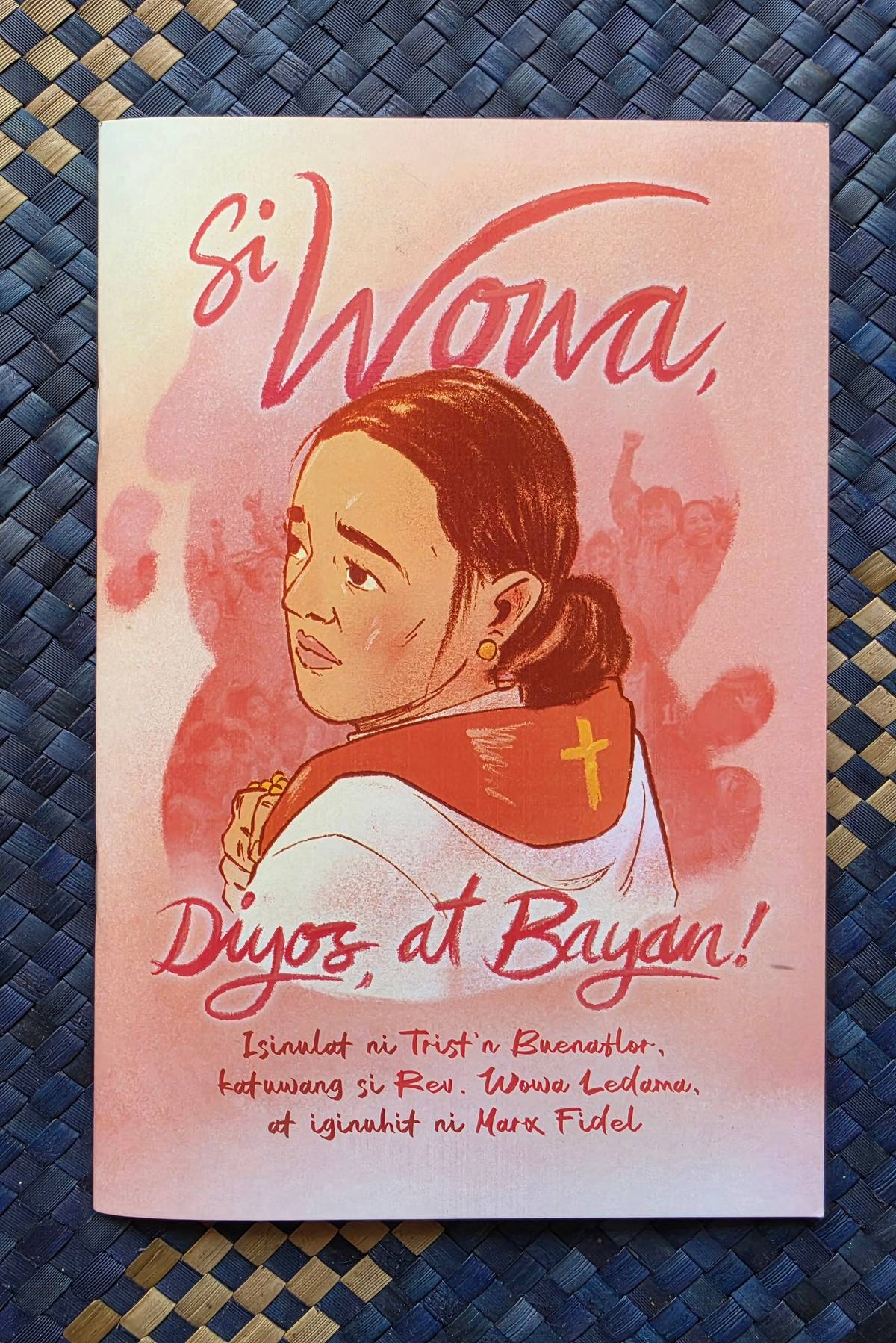
TH illustrated biography 'Si Wowa, Diyos, at Bayan' brings together Wowa Ledama’s transgender identity, Christian faith and commitment to serving the Filipino people.
There is a glaring dearth of books — and written materials in general — about Filipino transgender lives. This does not mean that such lives are rare, but that they have seldom been deemed worthy of record. Since time immemorial, transgender people have lived within families and communities across the Philippines, shaping culture, sustaining relationships, pursuing their vocations, and claiming moments of dignity and joy. Yet many of their stories have remained at the margins — dismissed, trivialized, concealed, distorted, or erased by communities, institutions and traditions that refused to recognize them.
It was only in 2018 that singer Jake Zyrus, a trans man, broke ground with the release of his memoir, I Am Jake, published in Metro Manila by Anvil Publishing. Two memoirs by Filipino Americans followed in the United States: Meredith Talusan’s Fairest: A Memoir (Viking Press, New York, 2020) and Geena Rocero’s Horse Barbie: A Memoir of Reclamation (The Dial Press, New York, 2023).Reverend Wowa Ledama with author Trist’n Buenaflor and illustrator Marx Fidel.
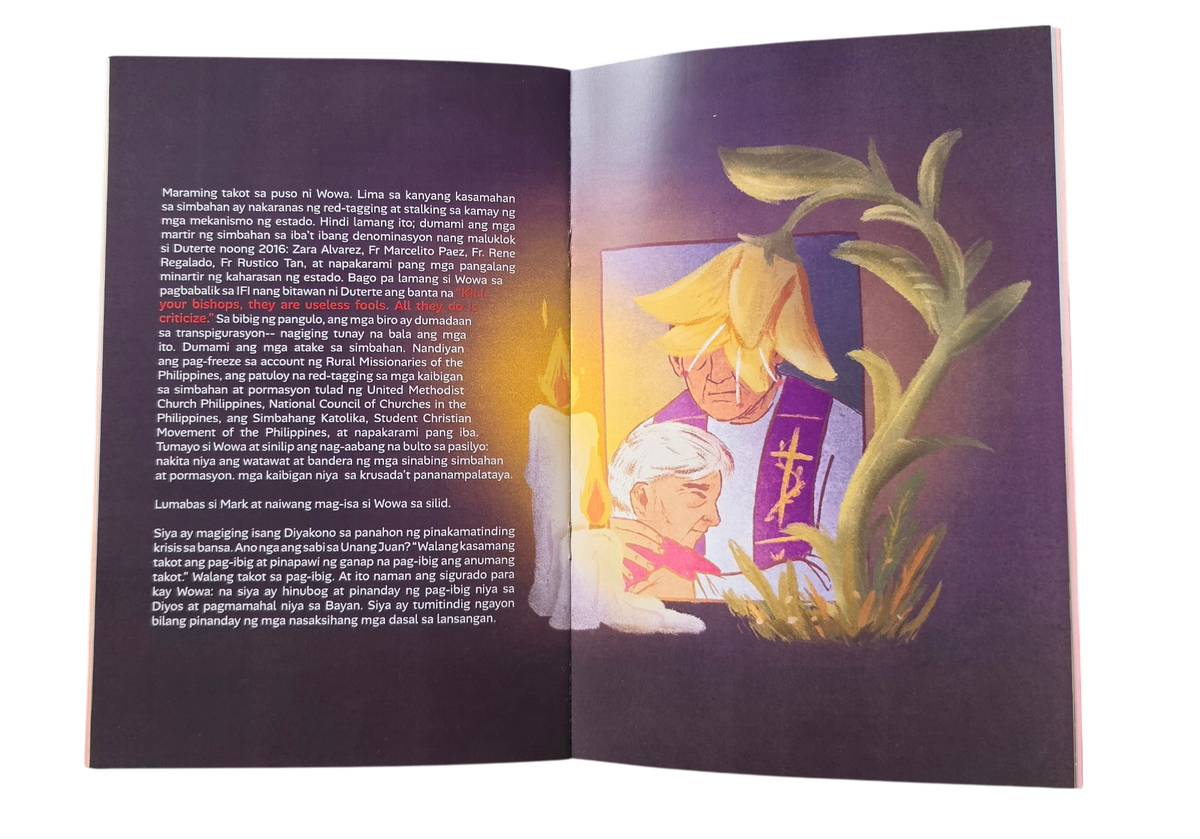
An illustrated spread from 'Si Wowa, Diyos, at Bayan,' which situates Wowa Ledama’s ministry within a period of political repression and attacks against church workers.
It would take eight years for another biography of a transgender Filipino to be published locally. Si Wowa, Diyos, at Bayan (Wowa, God, and Nation) was launched on 30 April 2026, at the University of the Philippines, coinciding with Ledama’s 32nd birthday. Published by Packing Sheets, the slim volume traces the life of Reverend Wylard “Wowa” Ledama, a deacon of the Iglesia Filipina Independiente and the first transgender clergywoman in the Philippines.
Written by children’s author Trist’n Buenaflor in collaboration with Ledama and illustrated by Marx Fidel, the biography takes the form of a children’s book, although Buenaflor emphasized that it is intended for readers of all ages.
“Parang gusto namin huwag na natin ibigay sa mga bata kungdi para sa lahat na talaga. Kasi hindi naman mga bata iyong nag-didiscriminate marami sa akin, mga matatanda at mga youth people. After my ordination, my God, parang two-thousand affirmative, one million ‘yung discriminative talaga (We felt that perhaps we should no longer make it only for children, but for everyone. After all, it was not children who discriminated against me the most, but adults and young people. After my ordination, my God, it seemed as though there were only two thousand affirming comments against a million truly discriminatory ones),” Ledama shared.
Si Wowa, Diyos, at Bayan was initially conceived as a comic book, but the project evolved over three years.
Loquacious in person, Ledama said there was much more that she wanted to include, but she and Buenaflor ultimately chose the most significant episodes of her life.
The narrative is framed by a historic day: 24 February 2023, when Ledama was ordained at the Cathedral of the Holy Child in Ermita, Manila — the national cathedral of the Iglesia Filipina Independiente (IFI), colloquially known as the Aglipayan Church. The Philippine Christian denomination emerged from the nationalist movement in 1902 as a revolt against the authority of the Roman Catholic Church. Recently, it has become one of the most progressive churches in the country. Occurring on the anniversary of the EDSA People Power Revolution, Ledama’s ordination becomes a moment of both personal and national remembrance, resistance, and public affirmation.
As she prepares for the ceremony, Ledama recalls her childhood with her grandmother, Lola Doding, who first brought her to church and lovingly affirmed her femininity. She also remembers her father, Papa Boy, who, though imperfect, accepted her as both his child and daughter while warning her that the world would not always be kind.
The book follows Ledama’s gradual recognition of herself as a trans woman alongside her growing awareness of the struggles of ordinary Filipinos. This consciousness deepened while she worked in health care and completed her nursing studies at the Universidad de Zamboanga Pagadian Campus in Zamboanga del Sur. In 2014, she became active again in the Iglesia Filipina Independiente. A decisive experience came in 2017, when she joined the IFI’s Mindanao Lumad Ministry in Bukidnon and listened to accounts of militarization, displacement and struggle. The encounter shaped her understanding of service as being “para sa Diyos at bayan” (for God and nation).
Her decision to enter Aglipay Central Theological Seminary marked another turning point. Her biological mother, Mama Betha, struggled to accept the choice and cut ties with her. During her seminary journey, Wowa found another mother in Mama Cita of Samal, Bataan, who gave her the support she needed. Mama Betha eventually reconciled with Wowa, and both mothers were present at her graduation.
The book culminates in the ordination, rendered through ceremonial details and symbolic meanings. It is a “peak experience” not only for Ledama but also for LGBTIQ+ people and their allies. Yet the book insists that the joy found on the mountaintop must be carried back into the world through service to those who are mocked, excluded and oppressed.
Ledama’s historic achievement is also situated within the perilous political climate: during the administration of President Rodrigo Duterte. Described in the book as “sa panahon ng pinakamatinding krisis sa bansa (during the country’s gravest crisis),” the period was marked by the red-tagging, surveillance, and killing of church workers and activists.
The book goes on to recount Ledama’s work after ordination in Zamboanga Sibugay: her ministry and community engagement, LGBTIQ+ advocacy, participation in beauty pageants, and further studies in theology and law. These seemingly disparate pursuits coexist within one life, echoing the book’s larger theme — and its title — which brings together identities and aspects often regarded as incompatible: the queer, the spiritual and the national.
“Ang rich-rich ng kasaysayan at karanasan sa Filipinas sa pagtatagpo ng parehong kabaklaan at pananampalataya. Sana ang mapagpatuloy natin siya. Kasi kaya naman, eh. Parang kaya naman na ikaw ay bakla, ikaw ay Kristiyano — go, rampa (The Philippines has such a rich history and experience of bringing queerness and faith together. I hope we can continue this, because it is possible. You can be queer, you can be Christian — go, strut your stuff),” Buenaflor said.
Trans woman poet and cultural critic Jaya Jacobo observed that the book “even shines brighter for its deeply postcolonial framework, connecting trans feminine life to faith on the one hand, and the revolution on the other.”
“It is a testimony of wrestling with identity and faith, and ultimately claiming both. In a world that often asks people to choose between who they are and what they want to be, Wowa’s life reminds us that we do not have to choose. As the first transgender ordained clergy, Wowa stands at the intersection of faith and authenticity, of devotion and defiance,” commented Anna Myrishia R. Villanueva, coordinator of the University of the Philippines Diliman Gender Office.
She added: “Her journey is not just personal. It is deeply political, deeply spiritual, and siyempre (of course), deeply Filipino. This book invites us to listen, to listen beyond our assumptions, beyond our discomforts, and into the stories that are often silenced. Because when one story like Wowa’s is told… it opens more doors to more stories.”
Si Wowa, Diyos, at Bayan is an act of record-making, remembrance, and resistance, affirming that transgender lives have always formed part of the Philippine story and deserve their rightful place in the nation’s collective memory. By restoring one voice to the record, the book also gestures toward the many others still waiting to be heard and reclaimed to make the history of the Filipino people more truthful and fuller.