
UST Conservatory of Music celebrates 80 years of artistry in an exhibit
Sheet music, well-worn instruments and treasured recordings tell the story of eight decades of musical artistry in the exhibit ‘Legacy in Harmony,’ honoring the UST Conservatory of Music and the generations who have shaped its legacy.
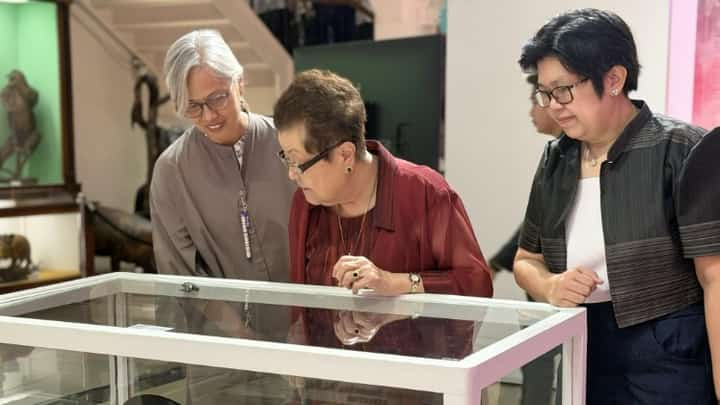
COL. Buenaventura’s daughter Maria Lourdes Buenaventura-Salipsip (center) and granddaughter Bea Salipsip (right) observe his musical works and keepsakes.
Eight decades of music-making are showcased in Legacy in Harmony: Celebrating 80 Years of Musical Excellence, a commemorative exhibition that opened on 26 August at the Main Gallery of the University of Santo Tomas (UST) Museum.
Mounted in celebration of the UST Conservatory of Music’s 80th founding anniversary, the interactive exhibition brings together memorabilia from generations of students, alumni, faculty members, administrators, and support staff. With artistic assistance from the College of Fine Arts and Design, it traces the institution’s history through objects that bear witness to its musical life.
Among the featured items are vinyl records of National Artist for Music Ernani J. Cuenco and keepsakes of former music director and National Artist for Music Antonino P. Buenaventura. Souvenir programs recall notable Conservatory productions, including Sampung Mga Daliri and its recent staging of the musical South Pacific.
The exhibition also offers an occasion to reflect on the places and people that shaped the Conservatory. Before settling into its permanent home in the Albertus Magnus Building, it occupied the University’s old gymnasium, on the site of the present Blessed Buenaventura G. Paredes, O.P. Building.
For conservatory dean Ma. Alexandra I. Chua, these spaces evoke memories of her own student years and of the people with whom she rehearsed and studied — many of whom went on to become renowned composers, educators, researchers, and cultural workers serving their communities.
Their lives and experiences form part of the exhibition’s broader story, inviting visitors to reflect on the Conservatory’s past and consider its future. For students, the call to “honor the legacy” means pursuing their musical education with a deeper sense of purpose.
For exhibition curator Mary Ann Venturina-Bulanadi, who leads Fine Arts and Design Studies at the UST Research Center for Culture, Arts, and Humanities, the undertaking presented an intriguing challenge: how to make music tangible.
The answer emerged through the objects that preserve its traces — sheet music, well-worn instruments, and recordings on cassette tapes, vinyl records, and compact discs. Working with Conservatory students, she helped assemble a presentation that connects these materials with the memories and experiences they hold.
Together, the objects offer an intimate view of an institution sustained by generations of musical practice, teaching and performance. As the exhibition reminds visitors, “Although music cannot be held, traces of it remain.”