
10 nations reaffirm support for Philippines arbitral victory


Ambassadors from 10 like-minded countries reaffirmed their support for the 2016 South China Sea arbitral ruling on its 10th anniversary Sunday, pledging deeper defense, maritime and technical cooperation with the Philippines to help bolster regional security, particularly in the West Philippine Sea (WPS).
Envoys from Australia, Canada, the European Union, France, Germany, India, Japan, New Zealand, South Korea and the United Kingdom reaffirmed their support for the United Nations Convention on the Law of the Sea (UNCLOS), which underpins the landmark ruling, and stressed the importance of upholding a rules-based order in the Indo-Pacific.
The diplomats made the remarks during a forum marking the ruling's 10th anniversary.
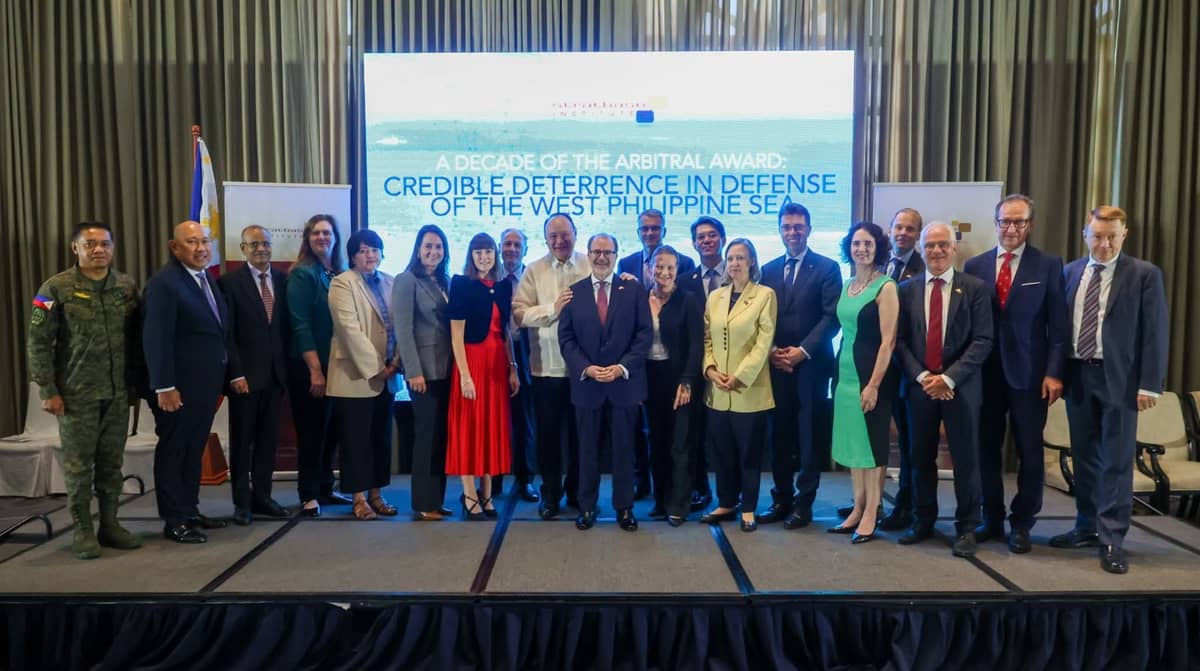
Photo: Stratbase Institute
Rules-based order
Stratbase Institute President Victor Andres "Dindo" Manhit said the commitments reflect growing international support for the Philippines' position in the WPS, citing a commissioned survey showing that 86% of Filipinos favor continued cooperation with like-minded countries.
He said China's "gray-zone" activities and the expansion of competition into cyber and information domains require the Philippines to adopt a modern, integrated and multidomain defense posture.
"Every port call, every joint patrol, every diplomatic statement citing the award carries the same message. The defense of the West Philippine Sea is no longer the Philippines' burden to carry by itself. It is part of the broader defense of a rules-based order that every state in this interconnected network depends on," Manhit said.
The ambassadors echoed that view, saying legal principles must be backed by practical cooperation.
French Ambassador Marie Fontanel said defending international law requires more than legal victories.
"Defending international law requires power. Power requires ships, aircraft, joint drills, agreements. It requires that like-minded partners can operate together quickly, credibly and lawfully," she said.
German Ambassador Andreas Michael Pfaffernoschke likewise reaffirmed that the 2016 arbitral award is final and legally binding, describing stability in the WPS as "a litmus test for the global rule of law."
Defense cooperation
Several envoys also outlined ongoing and planned defense initiatives with the Philippines.
Australia announced an additional AU$18 million investment to strengthen the Philippines' maritime domain awareness, operational capabilities, cyber resilience and law of the sea training.
Australian Ambassador Marc Innes-Brown said Canberra expects to sign a new defense cooperation arrangement with Manila in 2026, building on its AU$160 million maritime cooperation program in Southeast Asia.
The United Kingdom is also expanding its military engagement with the Philippines.
British Ambassador Laure Beaufils Hulton said London is negotiating a Status of Visiting Forces Agreement and plans to increase participation in military exercises after joining Balikatan 2026 as an observer.
Canada and India likewise highlighted new areas of cooperation.
Canadian Ambassador David Hartman cited the recently signed Visiting Forces Agreement and said Ottawa is preparing joint initiatives with ASEAN partners on UNCLOS, climate security, cybersecurity and defense cooperation.
Indian Ambassador Harsh Kumar Jain said the first India-Philippines disaster management exercise will be held in Manila next month. He also noted that the Philippines has joined the Indian Navy's Information Fusion Center to strengthen maritime domain awareness.
Maritime, tech initiatives
Beyond defense agreements, several countries highlighted efforts to strengthen the Philippines' maritime capabilities through technology and capacity-building.
Japanese Ambassador Endo Kazuya said Tokyo and Manila are advancing discussions on the possible transfer of Abukuma-class destroyer escorts and TC-90 training aircraft to deepen their security partnership.
South Korean Ambassador Lee Sang-hwa said bilateral cooperation has expanded to shipbuilding, including Korean-built offshore patrol vessels and support for local vessel construction at HD Hyundai's Subic shipyard.
New Zealand Ambassador Catherine McIntosh said Wellington is using its Starboard Maritime Intelligence Program to help regional partners improve maritime awareness and reduce the risk of miscalculation.
European Union Ambassador Massimo Santoro highlighted the bloc's IORIS maritime information-sharing platform and said additional initiatives to support maritime security cooperation with the Philippines could be rolled out "soon."