
Why the rich may not survive the apocalypse
At the Singapore Writers Festival, acclaimed author Amitav Ghosh challenged the popular belief that wealth and technology can shield humanity from a future marked by climate change and global crises
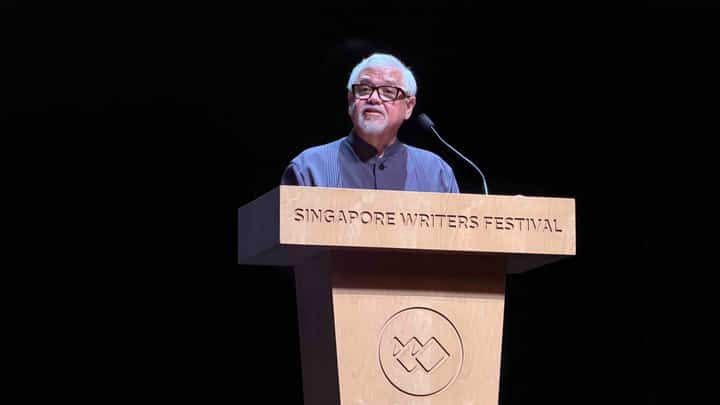
Acclaimed author Amitav Ghosh speaks at the Singapore Writers Festival, where he argued that resilience in a future shaped by climate change and global crises may lie not with billionaires building bunkers but with communities that have long lived in harmony with their environment.
Photograph by Pauline Songco for Daily Tribune
SINGAPORE — If the world were to face a catastrophic collapse, Amitav Ghosh believes billionaires retreating to fortified bunkers may not be the ones left standing.
Speaking at the Singapore Writers Festival a week ago, the acclaimed Indian author questioned the growing belief among some of the world’s wealthiest technology leaders that money, artificial intelligence and high-tech shelters can guarantee survival in an increasingly unstable future.
Instead, he argued, those who have spent generations living close to the land — farmers, fishers and Indigenous communities — may be far better equipped to endure what lies ahead.
“What does the government know? That it is not the strongest, the most intelligent of the species that survive, but rather the most adaptable,” Ghosh said.
“I think it’s fair to say that upon any index of adaptability, the world’s wealthy would rank very low, while farmers, laborers and Indigenous peoples would rank at the top.”
His talk, “Intonations of Confidence,” explored what he described as ideas hiding “in plain sight” — one of the central themes of this year’s festival.
Ghosh noted that today’s fears extend far beyond climate change alone. Nuclear conflict, artificial intelligence, biodiversity loss, pandemics and cyberattacks now intersect to create what he described as a cascading planetary crisis.
He pointed to a growing trend among Silicon Valley billionaires who have invested millions in remote compounds, underground bunkers and self-sustaining estates designed to withstand global catastrophe.
Figures from the technology sector, he said, increasingly view societal collapse as a scenario worth preparing for rather than preventing.
These compounds are often equipped with renewable energy systems, food-production facilities, private security, air filtration systems and enough supplies to remain isolated for years.
Yet Ghosh questioned whether these expensive preparations would actually work.
In the event of widespread social collapse, he asked, how would wealthy families even reach their private airstrips? If they succeeded, what would stop armed guards from turning against them once money and institutions no longer carried value? How would isolated compounds maintain complex systems without functioning global supply chains?
“The billionaires would be far more, not less, dependent on complex supply chains than those of us embedded in industrial civilization,” he said.
More importantly, Ghosh challenged what he sees as a dangerous assumption underpinning these visions of survival — that technological sophistication automatically translates into resilience.
He argued that many of the communities often described as poor or vulnerable already possess practical knowledge developed over centuries of adapting to difficult environments.
People who rely on subsistence farming, fishing or hunting, he said, do not need crash courses in living off the grid because they have never depended entirely on modern infrastructure.
“The irony is that the life ways of such people are precisely those that have been stigmatized for centuries,” he said.
“But such people are, in fact, the last heirs to those forms of resilience that humans have acquired over millennia of learning to live on this planet.”
For Ghosh, the fascination with doomsday bunkers reveals more than fear of climate change. It exposes a worldview in which the affluent imagine themselves surviving while billions of others perish.
He warned that this mindset risks treating catastrophe as inevitable rather than something humanity should work collectively to avoid.
“The interests of the likely winners might be best served by accelerating the collapse,” he said, describing an uncomfortable implication that often goes unspoken.
Although he acknowledged that climate scientists have raised legitimate concerns about severe disruptions ahead, Ghosh rejected the notion that technology and wealth alone offer a path to safety.
Instead, he suggested that humanity has long overlooked the people whose knowledge may prove most valuable in times of crisis.
Closing his talk, Ghosh left the audience with a simple but pointed question.
“In the event of a collapse,” he asked, “who would you rather be with — a farmer or a fisherman, or some guy who spent his life staring at a screen?”